Inizio Registrati Login

Elenco album Ultimi arrivi Ultimi commenti Più viste Più votate Preferiti Cerca

Inizio > MARS > Mars Reconnaissance Orbiter (MRO)
Ritorna alla pagina delle miniature FILE 338/2237 Torna all'inizio Guarda foto precedente Guarda foto successiva Salta alla fine
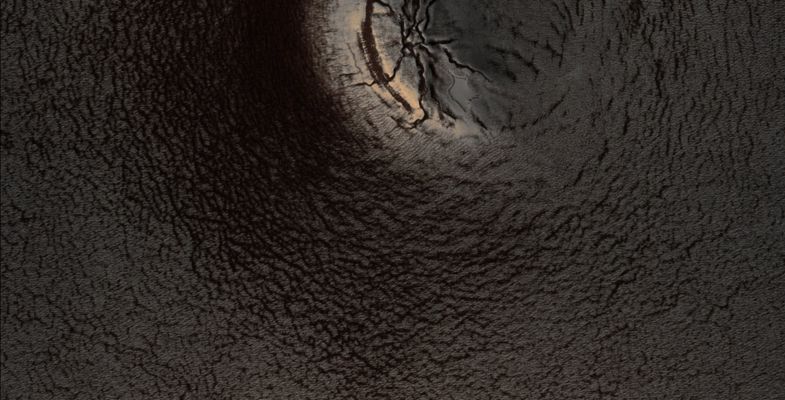
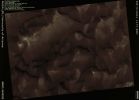
Icy Impact (EDM - Natural Colors; credits: Lunexit)
The Impact Crater in this image is roughly 900 meters (a little over 0,5 mile) across. 
The remaining Raised Rim of the Crater is illuminated from the bottom right of the image, causing preferential heating of the interior of the Rim structure. 
The ice appears thin here (more brown material is exposed), with an even thinner cover on the remaining exterior Rim. 
This could be caused by a number of possibilities: perhaps the Exterior Wall is steeper than the Interior Wall, resulting in more direct exposure to sunlight, causing more efficient sublimation when the Sun shines on that Wall.

Once ice begins to melt, darker dustier material is exposed. The darker material absorbs more heat than white ice (just like standing in the Sun wearing a black shirt makes you warmer than wearing a white shirt, which reflects the Sun's light), causing more and more ice to sublimate near the dark material.
Parole chiave: Mars from orbit - Craters - Unnamed Crater in the South Polar Region

Icy Impact (EDM - Natural Colors; credits: Lunexit)

The Impact Crater in this image is roughly 900 meters (a little over 0,5 mile) across.
The remaining Raised Rim of the Crater is illuminated from the bottom right of the image, causing preferential heating of the interior of the Rim structure.
The ice appears thin here (more brown material is exposed), with an even thinner cover on the remaining exterior Rim.
This could be caused by a number of possibilities: perhaps the Exterior Wall is steeper than the Interior Wall, resulting in more direct exposure to sunlight, causing more efficient sublimation when the Sun shines on that Wall.

Once ice begins to melt, darker dustier material is exposed. The darker material absorbs more heat than white ice (just like standing in the Sun wearing a black shirt makes you warmer than wearing a white shirt, which reflects the Sun's light), causing more and more ice to sublimate near the dark material.

ESP_014432_2110_RED_abrowse.jpg ESP_014436_0920_RED_abrowse-00.jpg ESP_014436_0920_RED_abrowse-01.jpg ESP_014439_1505_RED_abrowse.jpg ESP_014441_1275_RED_abrowse.jpg
Informazioni sul file
Nome del file:ESP_014436_0920_RED_abrowse-01.jpg
Nome album:MareKromium / Mars Reconnaissance Orbiter (MRO)
Valutazione (3 voti):55555(Mostra dettagli)
Parole chiave:Mars / from / orbit / - / Craters / - / Unnamed / Crater / in / the / South / Polar / Region
Copyright:NASA/JPL/Univ. of Arizona e Lunar Explorer Italia per il processing addizionale e la colorizzazione
Dimensione del file:369 KiB
Data di inserimento:Ott 09, 2009
Dimensioni:2001 x 1019 pixels
Visualizzato:67 volte
URL:https://www.lunexit.it/gallery/displayimage.php?pid=25459
Preferiti:Aggiungi ai preferiti

Commento 1 a 4 di 4
Pagina: 1

walthari   [Ott 09, 2009 at 01:20 PM]
come sono diversi i crateri su ghiaccio rispetto a quelli su roccia!!!Bella foto!
MareKromium   [Ott 11, 2009 at 11:46 AM]
Per "simulare" un cratere da impatto ordinario, prendi un martello, vai su un'area non particolarmente dura nè soffice (o creala "a tavolino"), e poi "picchia" una martellata (con angolo d'impatto compreso tra i 45 ed i 90°) e guarda il risultato.
La somiglianza del "tuo lavoro" con un cratere da impatto "ordinario" che noterai sarà impressionante.

Se vuoi simulare, invece, l'impatto su suolo ghiacciato, fai la stessa cosa (ma con prudenza questa volta, mi raccomando) e quindi "picchia" una martellata su due lastre di vetro sovrapposte (vetro da finestra, spesso circa 1 cm). Angolo d'incidenza sempre compreso tra i 45 ed i 90°.

D'Inverno, per i più "esigenti", si può aspettare una gelata e poi "picchiare" una martellata su una pozza d'acqua ghiacciata. E vedrete che somiglianza con il cratere di questo frame! PCF
2di7   [Ott 11, 2009 at 03:52 PM]
Eheheh MK e che so tutte ste martellate? :) ... Però forse bisognerebbe spiegarlo alla NASA come creare un cratere "con un impatto"!!! ... eheheheh
MareKromium   [Ott 11, 2009 at 04:57 PM]
Eheheheheh... Cara "2di7", oggi sono di umore inverso, ergo vado a "martellate"!!! :-) Però, se vogliamo essere seri, quello è il metodo giusto per "ricreare" gli impatti in maniera "casalinga" e senza fare costose (e spesso errate) simulazioni al pc. Un abbraccio e Buona Serata! paolo

Commento 1 a 4 di 4
Pagina: 1


Powered by Coppermine Photo Gallery