Inizio Registrati Login

Elenco album Ultimi arrivi Ultimi commenti Più viste Più votate Preferiti Cerca

Inizio > MARS > Mars Reconnaissance Orbiter (MRO)
Ritorna alla pagina delle miniature FILE 2183/2237 Torna all'inizio Guarda foto precedente Guarda foto successiva Salta alla fine
Subsurface Ice is EVERYWHERE!
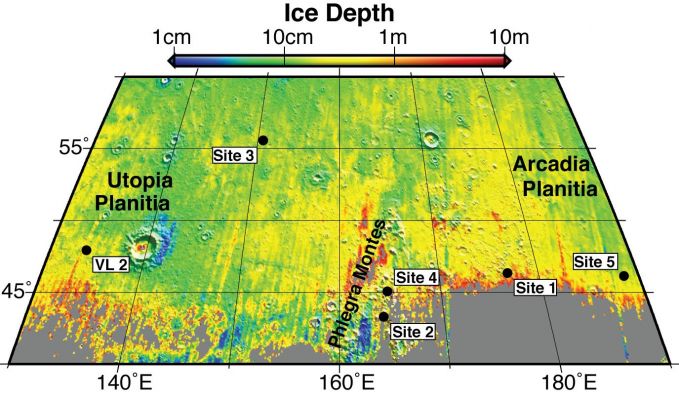
This map shows five locations where fresh impact cratering has excavated water ice from just beneath the Surface of Mars (sites 1 through 5) and the Viking Lander 2 Landing Site (VL2), in the context of color coding to indicate estimated depth to ice. 

The map covers an area from 40 to 60° North Latitude and from 130 to 190° East Longitude. Estimates of the depth to water-ice come from a computer model and observations of the brightness and temperature of the Surface. The model matches the ice-exposing crater observations by NASA's Mars Reconnaissance Orbiter and data from the neutron spectrometer on NASA's Mars Odyssey Orbiter. 

Analysis of the observations of ice-exposing fresh craters at sites 1 through 5, reported by Byrne et al. in a Sept. 25, 2009, paper in the journal Science, leads the paper's authors to calculate that if NASA's Viking Lander 2 had been able to dig slightly deeper than the 10-to 15-centimeter-deep (4-to-6-inch-deep) trench that it excavated in 1976, it would have hit water ice. 

The color coding indicates depths to the top of a water-ice-containing layer, ranging from 1 cm (about 0,5") in dark-blue coded locations to 10 meters (33 feet) in red-coded locations.
Parole chiave: Maps

Subsurface Ice is EVERYWHERE!

This map shows five locations where fresh impact cratering has excavated water ice from just beneath the Surface of Mars (sites 1 through 5) and the Viking Lander 2 Landing Site (VL2), in the context of color coding to indicate estimated depth to ice.

The map covers an area from 40 to 60° North Latitude and from 130 to 190° East Longitude. Estimates of the depth to water-ice come from a computer model and observations of the brightness and temperature of the Surface. The model matches the ice-exposing crater observations by NASA's Mars Reconnaissance Orbiter and data from the neutron spectrometer on NASA's Mars Odyssey Orbiter.

Analysis of the observations of ice-exposing fresh craters at sites 1 through 5, reported by Byrne et al. in a Sept. 25, 2009, paper in the journal Science, leads the paper's authors to calculate that if NASA's Viking Lander 2 had been able to dig slightly deeper than the 10-to 15-centimeter-deep (4-to-6-inch-deep) trench that it excavated in 1976, it would have hit water ice.

The color coding indicates depths to the top of a water-ice-containing layer, ranging from 1 cm (about 0,5") in dark-blue coded locations to 10 meters (33 feet) in red-coded locations.

South_Pole-PIA13985.jpg Spirit-OrbitalView-20081009-MRO.jpg SubsurfaceIce-PIA12214.jpg SubsurfaceIce-PIA12216.jpg SubsurfaceIce-PIA12217.jpg
Informazioni sul file
Nome del file:SubsurfaceIce-PIA12214.jpg
Nome album:MareKromium / Mars Reconnaissance Orbiter (MRO)
Valutazione (2 voti):55555(Mostra dettagli)
Parole chiave:Maps
Copyright:NASA/JPL/University of Arizona
Dimensione del file:194 KiB
Data di inserimento:Set 26, 2009
Dimensioni:1375 x 810 pixels
Visualizzato:56 volte
URL:https://www.lunexit.it/gallery/displayimage.php?pid=25383
Preferiti:Aggiungi ai preferiti


Powered by Coppermine Photo Gallery