Inizio Registrati Login

Elenco album Ultimi arrivi Ultimi commenti Più viste Più votate Preferiti Cerca

Inizio > MARS > Mars Reconnaissance Orbiter (MRO)
Ritorna alla pagina delle miniature FILE 164/2237 Torna all'inizio Guarda foto precedente Guarda foto successiva Salta alla fine
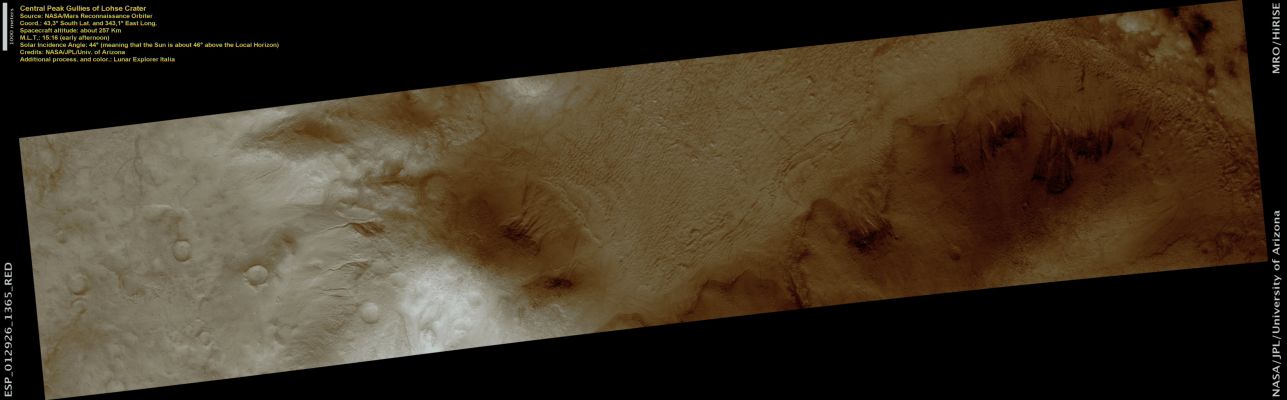
Lohse Crater (Natural Colors; credits: Lunar Explorer Italia)
This image is of the Eastern half of the Central Peak of Lohse Crater located in the Southern Hemisphere.
The crater itself is highly degraded and is roughly 80 miles in diameter. Of specific interest are the pristine looking Gullies that appear to have sourced from layers below the top of this uplifted region.
Smaller Gullies appear to emanate in all directions from the uplifted region, but of special interest is the larger Gully located on the northern most slope of the Central Peak. This Gully has a larger alcove and a better developed debris apron than surrounding Gullies. This implies that either this gully formed over a longer time period or that more fluid was involved in its formation.

Gullies are present on many slopes on Mars, especially between the latitudes of 30 and 70° in both Hemispheres. Gullies are formed by fluids and have three distinct parts to them: an eroded “alcove” at the top, a sometimes sinuous “channel” section, and finally a large “debris apron” where the material eroded by the Gully is deposited.
Parole chiave: Mars from orbit - Craters - Lohse Crater

Lohse Crater (Natural Colors; credits: Lunar Explorer Italia)

This image is of the Eastern half of the Central Peak of Lohse Crater located in the Southern Hemisphere.
The crater itself is highly degraded and is roughly 80 miles in diameter. Of specific interest are the pristine looking Gullies that appear to have sourced from layers below the top of this uplifted region.
Smaller Gullies appear to emanate in all directions from the uplifted region, but of special interest is the larger Gully located on the northern most slope of the Central Peak. This Gully has a larger alcove and a better developed debris apron than surrounding Gullies. This implies that either this gully formed over a longer time period or that more fluid was involved in its formation.

Gullies are present on many slopes on Mars, especially between the latitudes of 30 and 70° in both Hemispheres. Gullies are formed by fluids and have three distinct parts to them: an eroded “alcove” at the top, a sometimes sinuous “channel” section, and finally a large “debris apron” where the material eroded by the Gully is deposited.

ESP_012873_1075_RED_abrowse.jpg ESP_012912_1320_RED_abrowse.jpg ESP_012926_1365_RED_abrowse.jpg ESP_012934_1070_RED_abrowse.jpg ESP_012940_1655_RED_abrowse-00.jpg
Informazioni sul file
Nome del file:ESP_012926_1365_RED_abrowse.jpg
Nome album:MareKromium / Mars Reconnaissance Orbiter (MRO)
Valutazione (4 voti):55555(Mostra dettagli)
Parole chiave:Mars / from / orbit / - / Craters / - / Lohse / Crater
Copyright:NASA/JPL/Univ. of Arizona e Lunar Explorer Italia per il processing addizionale e la colorizzazione
Dimensione del file:953 KiB
Data di inserimento:Giu 05, 2009
Dimensioni:6590 x 2048 pixels
Visualizzato:57 volte
URL:https://www.lunexit.it/gallery/displayimage.php?pid=24609
Preferiti:Aggiungi ai preferiti


Powered by Coppermine Photo Gallery