|
|
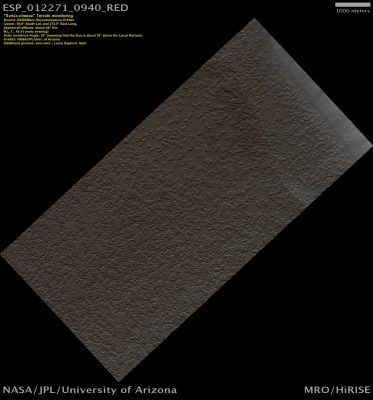
South Polar "Swiss-Cheese Surface Features" (Natural Colors; credits: Lunar Explorer Italia)
|
This image represents a Martian Terrain containing "Swiss Cheese" features. This Terrain is found only within the residue of the Southern Polar Cap, which comprises of mostly frozen CO2 and H2O.
These particular features are flat-floored, circular depressions that are believed to form from different rates in the seasonal changes of the CO2 and H2O ices. Varying rates in sublimation (when these ices change directly to vapors upon heat and back to deposited solids upon cooling) produces these rimmed depressions from the flat polar ice plane. It is hypothesized that the depression areas are made up of dry ice - such as Carbon Dioxide - and the material below consists of the water ice.
This Carbon Dioxide solid rises and slightly evaporates into the thin Atmosphere in the Summer while the water layer remains in place. As the South Pole cools with seasonal change, the "Swiss Cheese" formation is obtained with risen CO2 rimmed depressions and flat water mesas.
The Martian North Pole will evaporate all of its CO2 in the Summer; however the South Pole is colder and this may explain why this Terrain is only found in this area.
Some of the circular features in the full image show distinct cusps that point in the direction of the Pole. These cusps suggest insolation, a measure of solar radiation that is pushing the movement/formation of these depressions away from the Pole. There is also an observed lateral outward growth of the features at the rate of about 1-to-3 meters a year, indicating to scientists that the depressions must form in a CO2 medium.
|
|