Inizio Registrati Login

Elenco album Ultimi arrivi Ultimi commenti Più viste Più votate Preferiti Cerca

Inizio > MARS > Mars Reconnaissance Orbiter (MRO)
Ritorna alla pagina delle miniature FILE 96/2237 Torna all'inizio Guarda foto precedente Guarda foto successiva Salta alla fine
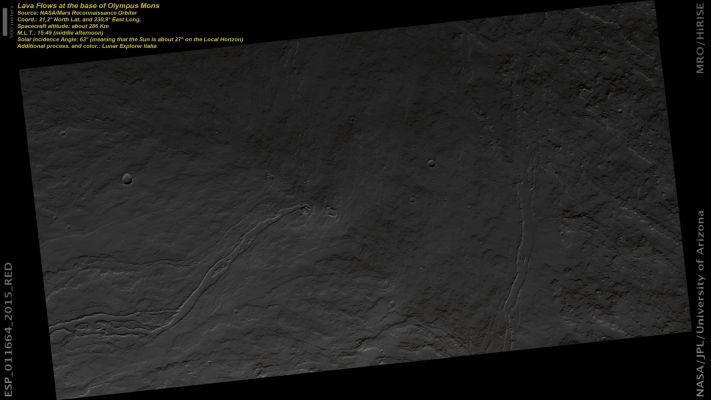
At the base of Olympus Mons... (ctx frame - Natural Colors; credits: Lunar Explorer Italia)
This image is located at the foot of the largest volcano of the Solar System: Olympus Mons.

The entire scene is covered with a multitude of Lava Flows. Most of the Flows consisted of relatively sticky lava that froze after flowing for only a short distance (often less than 1 Km, or about 1/2 a mile). However, a few of the Flows were more fluid and actually drained out of their Channels, leaving Troughs with distinct levees. These “Channelized” Flows extend out of the HiRISE image so they must be at least several kilometers (a few miles) long. 

In all likelihood, both the short and long Lava Flows have very similar chemical compositions. 
Based on experience with Lava Flows on Earth, the Channelized Flows were probably fed by more vigorous eruptions. That is, the Lava Flow was fed so quickly that the lava traveled a long distance before it solidified. With the shorter flows, a slow dribble of lava froze before going more than the equivalent of a few city blocks.
Parole chiave: Mars from orbit - Volcanoes - Olympus Mons

At the base of Olympus Mons... (ctx frame - Natural Colors; credits: Lunar Explorer Italia)

This image is located at the foot of the largest volcano of the Solar System: Olympus Mons.

The entire scene is covered with a multitude of Lava Flows. Most of the Flows consisted of relatively sticky lava that froze after flowing for only a short distance (often less than 1 Km, or about 1/2 a mile). However, a few of the Flows were more fluid and actually drained out of their Channels, leaving Troughs with distinct levees. These “Channelized” Flows extend out of the HiRISE image so they must be at least several kilometers (a few miles) long.

In all likelihood, both the short and long Lava Flows have very similar chemical compositions.
Based on experience with Lava Flows on Earth, the Channelized Flows were probably fed by more vigorous eruptions. That is, the Lava Flow was fed so quickly that the lava traveled a long distance before it solidified. With the shorter flows, a slow dribble of lava froze before going more than the equivalent of a few city blocks.

ESP_011648_1730_RED_abrowse-01.jpg ESP_011648_1730_RED_abrowse-02.jpg ESP_011664_2015_RED_abrowse-00.jpg ESP_011664_2015_RED_abrowse-01.jpg ESP_011677_1655_RED_abrowse.jpg
Informazioni sul file
Nome del file:ESP_011664_2015_RED_abrowse-00.jpg
Nome album:MareKromium / Mars Reconnaissance Orbiter (MRO)
Valutazione (3 voti):55555(Mostra dettagli)
Parole chiave:Mars / from / orbit / - / Volcanoes / - / Olympus / Mons
Copyright:NASA/JPL/Univ. of Arizona e Lunar Explorer Italia per il processing addizionale e la colorizzazione
Dimensione del file:575 KiB
Data di inserimento:Apr 25, 2009
Dimensioni:3642 x 2048 pixels
Visualizzato:58 volte
URL:https://www.lunexit.it/gallery/displayimage.php?pid=24295
Preferiti:Aggiungi ai preferiti


Powered by Coppermine Photo Gallery