Inizio Registrati Login

Elenco album Ultimi arrivi Ultimi commenti Più viste Più votate Preferiti Cerca

Inizio > MARS > Mars Reconnaissance Orbiter (MRO)
Ritorna alla pagina delle miniature FILE 156/2237 Torna all'inizio Guarda foto precedente Guarda foto successiva Salta alla fine
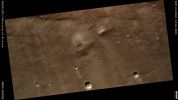
The "Dusty" Summit of Pavonis Mons (Natural Colors; credits: Lunar Explorer Italia)
Pavonis Mons is one of the 3 giant Tharsis Montes Shield Volcanoes. Its Summit rises so far above the Surface that the Atmosphere is extremely thin, even for Mars.
Dust that reaches these heights (for example, during major Dust Storms) is hard to remove, so the upper parts of these Volcanoes are covered by vast deposits of dust. The dust is moved a little by the thin winds, producing ripples and other textures near the limit of HiRISE’s resolution. The fluffy, ripply surface looks “smudged” or out of focus, but by looking at some of the small impact craters you can see that the HiRISE camera is, indeed, properly focused. It’s the surface of Mars that is blurry! 

Nota Lunexit: NO. A nostro parere NON è la Superficie di Marte che è "sfuocata" (blurry) e non è neppure la fotocamera dell'Orbiter che è "out of focus". Si tratta, come abbiamo già visto in passato (nelle immagini dei fly-by ravvicinati di alcune Lune Saturniane - Encelado su tutte) di un caso classico di "Sfuocatura da Movimento" (in altre parole: è un mero problema di lunghezza dell'esposizione - ivi: eccessiva -, data la vicinanza del target ripreso in rapporto alla velocità dell'Orbiter rispetto al medesimo). Curioso che i Ragazzi di Pasadena non ci abbiano pensato...

The impact craters also show that the dust is not a thin veneer. Instead, it is a thick coat, at least several meters deep. This mantling of dust hides the details of the Lava Flows and Vents, frustrating volcanologists but delighting those who study dust.

Mars Local Time: 15:23 (early afternoon)
Coord. (centered): 0,9° North Lat. and 246,8° East Long.
Spacecraft altitude: 254,1 Km (such as about 158,8 miles) 
Original image scale range: 50,8 cm/pixel (with 1 x 1 binning) so objects ~1,53 mt across are resolved 
Map projected scale: 50 cm/pixel
Map projection: EQUIRECTANGULAR 
Emission Angle: 2,5° 
Phase Angle: 52,4°
Solar Incidence Angle: 55° (meaning that the Sun is about 35° above the Local Horizon)
Solar Longitude: 244,7° (Northern Autumn)
Credits: NASA/JPL/University of Arizona
Additional process. and coloring: Lunar Explorer Italia
Parole chiave: Mars from orbit - Volcanoes - Pavonis Mons

The "Dusty" Summit of Pavonis Mons (Natural Colors; credits: Lunar Explorer Italia)

Pavonis Mons is one of the 3 giant Tharsis Montes Shield Volcanoes. Its Summit rises so far above the Surface that the Atmosphere is extremely thin, even for Mars.
Dust that reaches these heights (for example, during major Dust Storms) is hard to remove, so the upper parts of these Volcanoes are covered by vast deposits of dust. The dust is moved a little by the thin winds, producing ripples and other textures near the limit of HiRISE’s resolution. The fluffy, ripply surface looks “smudged” or out of focus, but by looking at some of the small impact craters you can see that the HiRISE camera is, indeed, properly focused. It’s the surface of Mars that is blurry!

Nota Lunexit: NO. A nostro parere NON è la Superficie di Marte che è "sfuocata" (blurry) e non è neppure la fotocamera dell'Orbiter che è "out of focus". Si tratta, come abbiamo già visto in passato (nelle immagini dei fly-by ravvicinati di alcune Lune Saturniane - Encelado su tutte) di un caso classico di "Sfuocatura da Movimento" (in altre parole: è un mero problema di lunghezza dell'esposizione - ivi: eccessiva -, data la vicinanza del target ripreso in rapporto alla velocità dell'Orbiter rispetto al medesimo). Curioso che i Ragazzi di Pasadena non ci abbiano pensato...

The impact craters also show that the dust is not a thin veneer. Instead, it is a thick coat, at least several meters deep. This mantling of dust hides the details of the Lava Flows and Vents, frustrating volcanologists but delighting those who study dust.

Mars Local Time: 15:23 (early afternoon)
Coord. (centered): 0,9° North Lat. and 246,8° East Long.
Spacecraft altitude: 254,1 Km (such as about 158,8 miles)
Original image scale range: 50,8 cm/pixel (with 1 x 1 binning) so objects ~1,53 mt across are resolved
Map projected scale: 50 cm/pixel
Map projection: EQUIRECTANGULAR
Emission Angle: 2,5°
Phase Angle: 52,4°
Solar Incidence Angle: 55° (meaning that the Sun is about 35° above the Local Horizon)
Solar Longitude: 244,7° (Northern Autumn)
Credits: NASA/JPL/University of Arizona
Additional process. and coloring: Lunar Explorer Italia

ESP_012588_1855_RED_abrowse-01.jpg ESP_012625_1720_RED_abrowse.jpg ESP_012692_1810_RED_abrowse.jpg ESP_012725_2015_RED_abrowse.jpg ESP_012774_1080_RED_abrowse-00.jpg
Informazioni sul file
Nome del file:ESP_012692_1810_RED_abrowse.jpg
Nome album:MareKromium / Mars Reconnaissance Orbiter (MRO)
Valutazione (5 voti):55555(Mostra dettagli)
Parole chiave:Mars / from / orbit / - / Volcanoes / - / Pavonis / Mons
Copyright:NASA/JPL/Univ. of Arizona e Lunar Explorer Italia per l'additional process. e la colorizzazione
Dimensione del file:617 KiB
Data di inserimento:Apr 25, 2009
Dimensioni:3657 x 2048 pixels
Visualizzato:54 volte
URL:https://www.lunexit.it/gallery/displayimage.php?pid=24292
Preferiti:Aggiungi ai preferiti


Powered by Coppermine Photo Gallery