Inizio Registrati Login

Elenco album Ultimi arrivi Ultimi commenti Più viste Più votate Preferiti Cerca

Inizio > MARS > Mars Reconnaissance Orbiter (MRO)
Ritorna alla pagina delle miniature FILE 144/2237 Torna all'inizio Guarda foto precedente Guarda foto successiva Salta alla fine
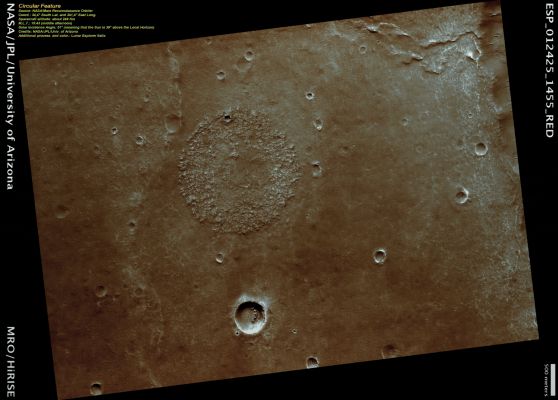
Unusually-looking "Circular Surface Feature" (possible True Colors; credits: Dr G. Barca)
This circular feature is a collection of hills, with some connected by ridges. The circularity suggests that perhaps there was once an impact crater here that was subsequently filled with material which was somehow more resistant to erosion than the landscape around it. Over time, as erosion stripped away the ground, the fill material was left standing higher (although it has clearly been eroded as well).

Nota Lunexit: si tratta di un "Exhumed Crater", ossìa di un cratere prima ricoperto da detriti e sedimenti e poi, a seguito di azioni prevalentemente eoliche (un vero e proprio scorticamento del suolo), è stato riportato - parzialmente - alla luce. Lo scorticamento che evidenzia il cratere sepolto è indice del fatto che i materiali i quali lo avevano ricoperto erano più resistenti e stabili dei materiali che circondano il cratere stesse (i quali, appunto, sono stati smossi dai venti). Un fenomeno similare, ma relativo ai canali, dà luogo ai cosiddetti "Inverted Channels", di cui si è già parlato in passato
Parole chiave: Mars from orbit - Craters - Exhumed Unnamed Crater

Unusually-looking "Circular Surface Feature" (possible True Colors; credits: Dr G. Barca)

This circular feature is a collection of hills, with some connected by ridges. The circularity suggests that perhaps there was once an impact crater here that was subsequently filled with material which was somehow more resistant to erosion than the landscape around it. Over time, as erosion stripped away the ground, the fill material was left standing higher (although it has clearly been eroded as well).

Nota Lunexit: si tratta di un "Exhumed Crater", ossìa di un cratere prima ricoperto da detriti e sedimenti e poi, a seguito di azioni prevalentemente eoliche (un vero e proprio scorticamento del suolo), è stato riportato - parzialmente - alla luce. Lo scorticamento che evidenzia il cratere sepolto è indice del fatto che i materiali i quali lo avevano ricoperto erano più resistenti e stabili dei materiali che circondano il cratere stesse (i quali, appunto, sono stati smossi dai venti). Un fenomeno similare, ma relativo ai canali, dà luogo ai cosiddetti "Inverted Channels", di cui si è già parlato in passato

ESP_012271_0940_RED_abrowse.jpg ESP_012302_0985_RED_abrowse.jpg ESP_012425_1455_RED_abrowse.jpg ESP_012435_2015_RED_abrowse.jpg ESP_012506_0850_RED_abrowse.jpg
Informazioni sul file
Nome del file:ESP_012425_1455_RED_abrowse.jpg
Nome album:MareKromium / Mars Reconnaissance Orbiter (MRO)
Valutazione (4 voti):55555(Mostra dettagli)
Parole chiave:Mars / from / orbit / - / Craters / - / Exhumed / Unnamed / Crater
Copyright:NASA/JPL/Univ. of Arizona e Lunar Explorer Italia per il processing addizionale e la colorizzazione
Dimensione del file:1028 KiB
Data di inserimento:Apr 11, 2009
Dimensioni:3770 x 2700 pixels
Visualizzato:55 volte
URL:https://www.lunexit.it/gallery/displayimage.php?pid=24191
Preferiti:Aggiungi ai preferiti


Powered by Coppermine Photo Gallery