Inizio Registrati Login

Elenco album Ultimi arrivi Ultimi commenti Più viste Più votate Preferiti Cerca

Inizio > MARS > Walking on Mars with Spirit and Opportunity
Ritorna alla pagina delle miniature FILE 3761/5456 Torna all'inizio Guarda foto precedente Guarda foto successiva Salta alla fine
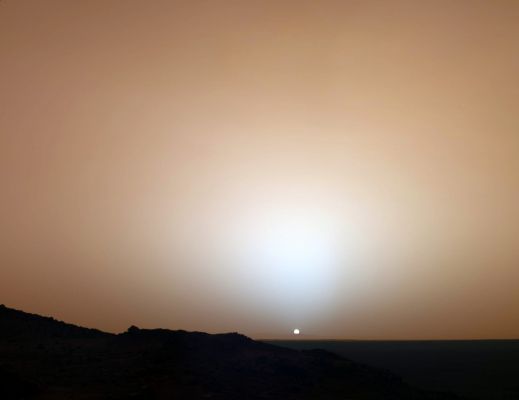
Sunset on Mars... - Sol 489 (strongly enhanced Natural Colors; credits: NASA/JPL/Texas A&M/Cornell)
Caption NASA:"On May 19th, 2005, NASA's Mars Exploration Rover Spirit captured this stunning view as the Sun sank below the Rim of Gusev Crater on Mars. 
This Panoramic Camera (PanCam) mosaic was taken around 18:07 in the evening of the Rover's 489th Sol. Spirit was commanded to stay awake briefly after sending that Sol's data to the Mars Odyssey Orbiter just before Sunset. This small panorama of the western sky was obtained using PanCam's 750-nanometer, 530-nanometer and 430-nanometer color filters. This filter combination allows false color images to be generated that are similar to what a human would see, but with the colors slightly exaggerated. 
In this image, the bluish glow in the sky above the Sun would be visible to us if we were there, but an artifact of the PanCam's infrared imaging capabilities is that with this filter combination the redness of the sky farther from the Sunset is exaggerated compared to the daytime colors of the Martian Sky. 
Because Mars is farther from the Sun than the Earth is, the Sun appears only about two-thirds the size that it appears in a Sunset seen from the Earth. The terrain in the foreground is the rock outcrop "Jibsheet", a feature that Spirit has been investigating for several weeks (Rover Tracks are dimly visible leading up to "Jibsheet"). 
The floor of Gusev Crater is visible in the distance, and the Sun is setting behind the wall of Gusev some 80 Km (about 50 miles) in the distance. 

This mosaic is yet another example from MER of a beautiful, sublime martian scene that also captures some important scientific information. Specifically, sunset and twilight images are occasionally acquired by the science team to determine how high into the Atmosphere the Martian Dust extends, and to look for dust or ice clouds. 
Other images have shown that the twilight glow remains visible, but increasingly fainter, for up to two hours before Sunrise or after Sunset. The long Martian Twilight (compared to Earth's) is caused by Sunlight scattered around to the night side of the Planet by abundant high altitude dust. 
Similar long twilights or extra-colorful sunrises and sunsets sometimes occur on Earth when tiny dust grains that are erupted from powerful volcanoes scatter light high in the Atmosphere".

Note Lunexit: la NASA, in questa caption, ci dice che il Sole, dalla Superficie di Marte, dovrebbe apparire con un diametro apparente pari a circa i 2/3 del diametro apparente che esso ci mostra dalla Terra. 
Curioso: sino a poco tempo fa, l'informazione NASA ufficiale era che il diametro apparente del Sole, dalla Superficie Marziana, era di 2/3 più piccolo rispetto al suo diametro apparente percepibile da Terra e quindi doveva essere pari ad 1/3 di quest'ultimo.
La differenza, come ovvio, non è piccola e le implicazioni - particolarmente quelle connesse alla luminosità dell'ambiente marziano - sono piuttosto importanti.
Lo ammettiamo: siamo un pò confusi a questo punto ma, forse, possiamo risolvere il dubbio noi stessi: abbiate solo un pizzico di pazienza...
Parole chiave: Postcard from Mars - Sunset

Sunset on Mars... - Sol 489 (strongly enhanced Natural Colors; credits: NASA/JPL/Texas A&M/Cornell)

Caption NASA:"On May 19th, 2005, NASA's Mars Exploration Rover Spirit captured this stunning view as the Sun sank below the Rim of Gusev Crater on Mars.
This Panoramic Camera (PanCam) mosaic was taken around 18:07 in the evening of the Rover's 489th Sol. Spirit was commanded to stay awake briefly after sending that Sol's data to the Mars Odyssey Orbiter just before Sunset. This small panorama of the western sky was obtained using PanCam's 750-nanometer, 530-nanometer and 430-nanometer color filters. This filter combination allows false color images to be generated that are similar to what a human would see, but with the colors slightly exaggerated.
In this image, the bluish glow in the sky above the Sun would be visible to us if we were there, but an artifact of the PanCam's infrared imaging capabilities is that with this filter combination the redness of the sky farther from the Sunset is exaggerated compared to the daytime colors of the Martian Sky.
Because Mars is farther from the Sun than the Earth is, the Sun appears only about two-thirds the size that it appears in a Sunset seen from the Earth. The terrain in the foreground is the rock outcrop "Jibsheet", a feature that Spirit has been investigating for several weeks (Rover Tracks are dimly visible leading up to "Jibsheet").
The floor of Gusev Crater is visible in the distance, and the Sun is setting behind the wall of Gusev some 80 Km (about 50 miles) in the distance.

This mosaic is yet another example from MER of a beautiful, sublime martian scene that also captures some important scientific information. Specifically, sunset and twilight images are occasionally acquired by the science team to determine how high into the Atmosphere the Martian Dust extends, and to look for dust or ice clouds.
Other images have shown that the twilight glow remains visible, but increasingly fainter, for up to two hours before Sunrise or after Sunset. The long Martian Twilight (compared to Earth's) is caused by Sunlight scattered around to the night side of the Planet by abundant high altitude dust.
Similar long twilights or extra-colorful sunrises and sunsets sometimes occur on Earth when tiny dust grains that are erupted from powerful volcanoes scatter light high in the Atmosphere".

Note Lunexit: la NASA, in questa caption, ci dice che il Sole, dalla Superficie di Marte, dovrebbe apparire con un diametro apparente pari a circa i 2/3 del diametro apparente che esso ci mostra dalla Terra.
Curioso: sino a poco tempo fa, l'informazione NASA ufficiale era che il diametro apparente del Sole, dalla Superficie Marziana, era di 2/3 più piccolo rispetto al suo diametro apparente percepibile da Terra e quindi doveva essere pari ad 1/3 di quest'ultimo.
La differenza, come ovvio, non è piccola e le implicazioni - particolarmente quelle connesse alla luminosità dell'ambiente marziano - sono piuttosto importanti.
Lo ammettiamo: siamo un pò confusi a questo punto ma, forse, possiamo risolvere il dubbio noi stessi: abbiate solo un pizzico di pazienza...

SOL489-MF-LXTT2.jpg SOL489-MF.jpg SOL489-PIA07997.JPG SOL489-PIA07997.jpg SOL490-1-GB-LXT.jpg
Informazioni sul file
Nome del file:SOL489-PIA07997.JPG
Nome album:MareKromium / Walking on Mars with Spirit and Opportunity
Valutazione (3 voti):55555(Mostra dettagli)
Parole chiave:Postcard / from / Mars / - / Sunset
Copyright:NASA/JPL/Texas A&M/Cornell
Dimensione del file:360 KiB
Data di inserimento:Gen 12, 2009
Dimensioni:2486 x 1914 pixels
Visualizzato:56 volte
URL:https://www.lunexit.it/gallery/displayimage.php?pid=23217
Preferiti:Aggiungi ai preferiti

Commento 1 a 4 di 4
Pagina: 1

Gianluigi   [Gen 12, 2009 at 07:47 PM]
Uhmmm…
Doc, mi sa che qui la JPL si prende dei “meriti” non suoi, eheh!
La sua interpretazione di questo frame è grigio/azzurra.
Questa è una nostra elaborazione… tra l’altro è un puro caso che sia sempre sol489… io ho preso tempo fa il precedente frame Panoramic, e poi un paio di giorni fa l’interpretazione JPL dall’Apod… pensa che neanche avevo fatto caso si trattasse del medesimo sol…
Mi sembrava un po’ troppo simile.. eheh!
Un abbraccio!
MareKromium   [Gen 12, 2009 at 10:01 PM]
...Qui, in Italia, siamo meno di zero. Si preferisce parlare di Urzi & Sibilla e delle loro caxxate, si parla del tizio che vede Gesù Cristo e gli Alieni e nel frattempo gli arrivano le Stimmate; si parla - da dieci anni - del Tizio rapito dagli Alieni (il buon Zanfretta, che racconta SEMPRE la solita favoletta - ooooppss: sorry per la rima)...
Oppure, a livelli "alti" (tipo televisione di Stato), si parla di Scienza Positivissima con la Hack e Piero Angela e si ride dei poveracci come noi.
Anzi no, non si ride nemmeno: si viene totalmente ignorati, perchè indegni.

Però...

Però, e non so perchè, Oltre Frontiera abbiamo tanti Ammiratori: sia ad Occidente che ad Oriente. Che dici? Ci sarà pure un motivo... O no?!? O forse facciamo ridere anche Americani e Giapponesi?

Un abbraccio forte - doc
titanio44   [Gen 13, 2009 at 08:11 AM]
la Nasa può dire quello che vuole ma la matematica non è una opinione......
Paolo C. Fienga   [Gen 13, 2009 at 04:43 PM]
Buonasera Amici!

Per Big "G": errata corrige, hai ragione! La colorizzazione del frame è nostra. Ma sul resto che ho scritto (sia nella caption al frame, sia nel commentino come MareKromium), purtroppo, non posso far altro che confermare quanto riportato...

Per Titanio44: in realtà, c'è molta più "Matematica" (nel senso di Logica, Rigore e Metodo) nel Lavoro che facciamo e pubblichiamo noi che in quello che pubblicano loro. Se poi facciamo il confronto con le pubblicazioni ESA...Non c'è paragone.

Un abbraccio a Tutti e due! doc

Commento 1 a 4 di 4
Pagina: 1


Powered by Coppermine Photo Gallery