|
|
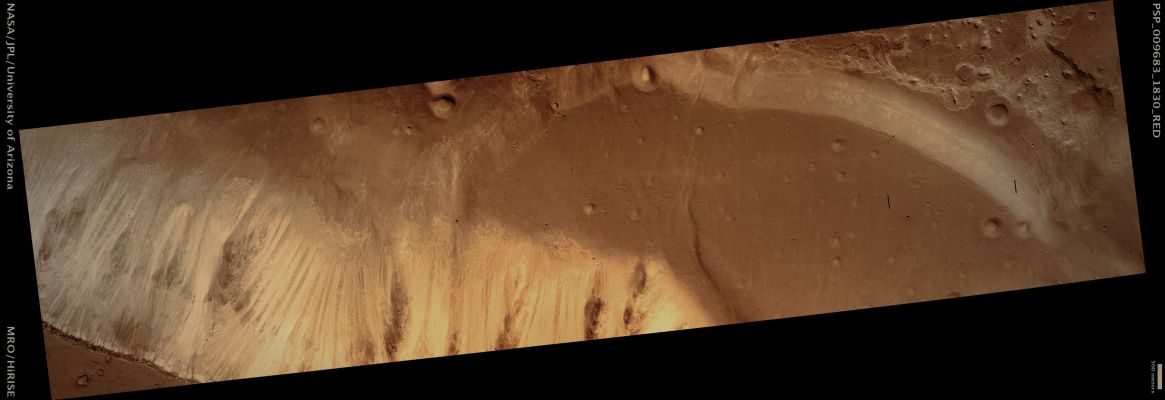
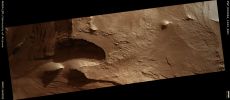
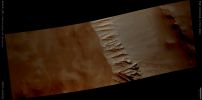
Possible "Intravalley Paleolake" in Shalbatana Vallis (possible True Colors; credits: Lunar Explorer Italia)
|
Mars Local Time: 15:30 (middle afternoon)
Coord. (centered): 3,0° North Lat. and 316,7° East Long.
Spacecraft altitude: 272,1 Km (such as about 170,1 miles)
Original image scale range: 54,4 cm/pixel (with 1 x 1 binning) so objects ~1,63 mt across are resolved
Map projected scale: 50 cm/pixel
Map projection: EQUIRECTANGULAR
Emission Angle: 5,5°
Phase Angle: 50,1°
Solar Incidence Angle: 55° (meaning that the Sun is about 35° above the Local Horizon)
Solar Longitude: 115,1° (Northern Summer)
Credits: NASA/JPL/University of Arizona
Additional process. and coloring: Lunar Explorer Italia
|
|











Evidence for late Hesperian lacustrine activity in Shalbatana Vallis, Mars
Evidence for late Hesperian lacustrine activity in Shalbatana Vallis, Mars
Gaetano Di Achille
International Research School of Planetary Sciences, Università “G. D'Annunzio,” Pescara, Italy
Gian Gabriele Ori
International Research School of Planetary Sciences, Università “G. D'Annunzio,” Pescara, Italy
Ibn Battuta Centre, Faculté des Sciences Semlalia, Université Cadi Ayyad, Marrakech, Morocco
Dennis Reiss
Institute of Planetary Research, German Aerospace Center (DLR), Berlin, Germany
An intravalley paleolake (more than 400 m deep) was detected along the course of Shalbatana Vallis from the evidence of shorelines and the occurrence of a few fan-delta deposits (including a Gilbert-type delta). The fronts of all the sedimentary deposits strikingly match the same topographic contours (2800 and 3000 m below the Martian datum), indicating the paleolake water levels under which they formed. Also, the corresponding shorelines are visible along the Shalbatana Vallis walls. The peculiar settings of the lake suggest that Shalbatana Vallis was impounded during its final hydrological activity and that ponding of water lasted enough time to allow the formation and evolution of the lacustrine system. Water source is uncertain, but a composite sapping mechanism is hypothesized in order to take into account the amount of water required to excavate, transport, and deposit the materials found in the deposits. Previous works and new crater counting computations indicate that the paleolake was active during the Hesperian epoch; therefore, at that time, surface conditions were different from those of modern Mars and supportive of flow and ponding of water. It is unclear whether the hydrological activity was sustained entirely by a favorable climatic regime and secondary regional factors like volcanism, impact cratering, and tectonism could have also triggered/accelerated the local groundwater activity, implying that the system could have evolved relatively independent from climatic conditions. The latter eventuality and the regional importance of this research advised against an extrapolation of its results to the overall debate about Martian climatic-geomorphological evolution.
Received 10 November 2006; accepted 4 May 2007; published 27 July 2007.
Citation: Di Achille, G., G. G. Ori, and D. Reiss (2007), Evidence for late Hesperian lacustrine activity in Shalbatana Vallis, Mars, J. Geophys. Res., 112, E07007, doi:10.1029/2006JE002858.
solo una precisazione (e scusatemi se faccio l'arrogante): premetto che non ho letto l'abstract di Di Achille & C. (perchè non so dove andarlo a prendere), ma sulla base di quanto detto e scritto sino ad ora, a me di "epocale" in questa "scoperta" mi sembra che ci sia solo il clamore che le viene riservato (ieri sera, intorno alle 22/23) era in prima pagina su televideo RAI). Probabilmente il motivo è che c'è di mezzo un Italiano, ed in questo momento di magra c'è bisogno di mettere in prima pagina un Italiano Intelligente (al quale faccio tanto di cappello), dato che le prime pagine sono occupate da scandaletti e scandalini, Premier che fanno i porcelloni e politici e magistrati che giocano a fare i contro-rivoluzionari (senza dimenticare il calcio, i suoi costi e le figure meschine che facciamo in giro per il Mondo...).
Dunque "Onore a Di Achille"! Ma la Verità - ripeto: in attesa di leggere l'abstract - è che questa "scoperta" è una non-scoperta. Le evidenze, infatti, sono indirette ed indiziarie: nè più, nè meno di quelle che usiamo noi o tanti altri Ricercatori come noi per operare LE MEDESIME CONGETTURE (perchè anche quelle di Di Achille sono congetture, cerchiamo di essere pragmatici, caxxo).
Però - come scrissi, più volte, tempo fa - se parli attraverso l'obbiettivo di una Università (meglio se USA), allora sei "credibile" (anche se dici ovvietà o sciocchezze), mentre se parli uti singulus (in quanto singolo individuo e privato ricercatore), allora sei "zero" (anche se dici in anticipo cose giuste e magari complesse - ricordate gli idrocarburi di Iperione?...).
Beh, scusatemi tanto (e sorry anche al Dr Di Achille), ma a me questo approccio non piace.
Non lo condivido, è settario ed è clamorosamente ingiusto verso tutti quelli che, come noi (ma non solo noi naturalmente) sputano sangue e veleno per creare scenari a fare ipotesi basate su quei pochissimi elementi oggettivi (foto, più che altro, e rarissime schede mineralogiche) dei quali dispongono.
Se posso dirlo, è la gente come noi che andrebbe, ogni tanto, riconosciuta e valorizzata.
Ah già, dimenticavo (ancora una volta): siamo in Italy, e qui, nella Terra dei Maestri della Legge e della Sacra Dialettica, la Regola Aurea riassunta nel detto "nemo propheta in Patria" non subisce eccezioni. Mai.
Ma che andassero tutti su Marte, valà....
un saluto - PC