Inizio Registrati Login

Elenco album Ultimi arrivi Ultimi commenti Più viste Più votate Preferiti Cerca

Inizio > MARS > Mars Reconnaissance Orbiter (MRO)
Ritorna alla pagina delle miniature FILE 1386/2237 Torna all'inizio Guarda foto precedente Guarda foto successiva Salta alla fine
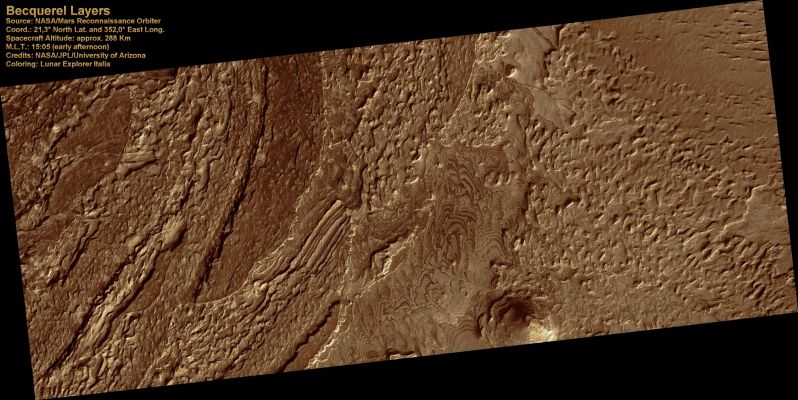
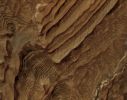
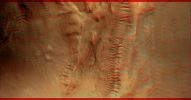
Layered Deposits in Becquerel Crater (possible natural colors; credits: Lunar Explorer Italia)
Image PSP_004078_2015 shows light-toned layered deposits along the floor of Becquerel Crater, an impact crater in Arabia Terra. The deposits consist of stacked, repeating layers which consistently appear to be only a few meters thick. 
The surface of the deposits also appears to be cracked into blocks a meter or so in length.
Layered deposits, such as these, form from sediments once deposited within the crater. Possible origins for the sediments include windblown debris, volcanic ash falling from the sky, or sediments that accumulated in a lake on the crater floor. The regular thickness of the layers suggests that they were most likely deposited in a water environment or by wind in a cyclic process.

Some of the layering has a dark appearance that produces an alternating bright-dark “zebra” banding. This may be the result of a thin surface layer of coarser and darker basalt sand collected on the more level surfaces, rather than indicating compositional differences in the eroded layered beds. Faults can also be seen displacing portions of the layered bed. An example of this can be seen just left of center in the bottom half of the subimage. The faulting indicates that the deposits have experienced disruption since their emplacement. 
 

Parole chiave: Mars from orbit - Craters - Becquerel Crater

Layered Deposits in Becquerel Crater (possible natural colors; credits: Lunar Explorer Italia)

Image PSP_004078_2015 shows light-toned layered deposits along the floor of Becquerel Crater, an impact crater in Arabia Terra. The deposits consist of stacked, repeating layers which consistently appear to be only a few meters thick.
The surface of the deposits also appears to be cracked into blocks a meter or so in length.
Layered deposits, such as these, form from sediments once deposited within the crater. Possible origins for the sediments include windblown debris, volcanic ash falling from the sky, or sediments that accumulated in a lake on the crater floor. The regular thickness of the layers suggests that they were most likely deposited in a water environment or by wind in a cyclic process.

Some of the layering has a dark appearance that produces an alternating bright-dark “zebra” banding. This may be the result of a thin surface layer of coarser and darker basalt sand collected on the more level surfaces, rather than indicating compositional differences in the eroded layered beds. Faults can also be seen displacing portions of the layered bed. An example of this can be seen just left of center in the bottom half of the subimage. The faulting indicates that the deposits have experienced disruption since their emplacement.

PSP_004072_1845_RED_abrowse-03.jpg PSP_004077_1325_RED_abrowse-PCF-LXTT.jpg PSP_004078_2015_RED_browse-00.jpg PSP_004078_2015_RED_browse-01.jpg PSP_004085_1420_PSP_004019_1420_RED_browse.jpg
Informazioni sul file
Nome del file:PSP_004078_2015_RED_browse-00.jpg
Nome album:MareKromium / Mars Reconnaissance Orbiter (MRO)
Valutazione (4 voti):55555(Mostra dettagli)
Parole chiave:Mars / from / orbit / - / Craters / - / Becquerel / Crater
Copyright:NASA/JPL/Univ. of Arizona e Lunar Explorer Italia per il processing addizionale e la colorizzazione
Dimensione del file:1433 KiB
Data di inserimento:Dic 08, 2008
Dimensioni:4089 x 2048 pixels
Visualizzato:57 volte
URL:https://www.lunexit.it/gallery/displayimage.php?pid=22772
Preferiti:Aggiungi ai preferiti


Powered by Coppermine Photo Gallery