Inizio Registrati Login

Elenco album Ultimi arrivi Ultimi commenti Più viste Più votate Preferiti Cerca

Inizio > MARS > Mars Reconnaissance Orbiter (MRO)
Ritorna alla pagina delle miniature FILE 1853/2237 Torna all'inizio Guarda foto precedente Guarda foto successiva Salta alla fine
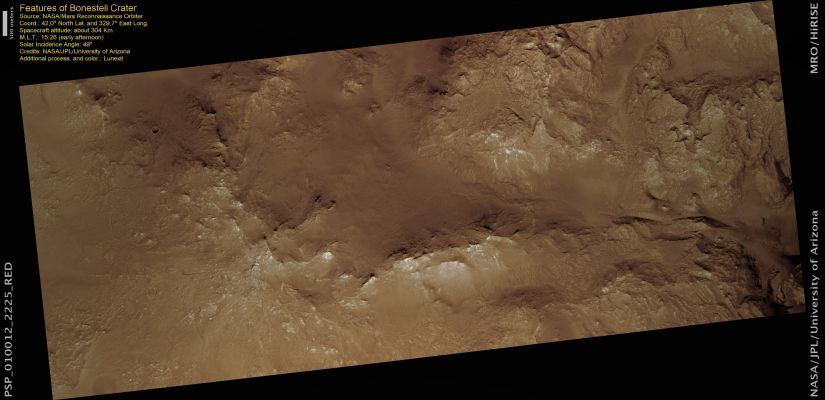
Deep Rocks Unveiled at Bonestell Crater (ctx frame; natural colors; credits: Lunexit)
Impact craters are sometimes nicknamed “Mother Nature's drill holes” because, thanks to them, deep rock formations are exposed at the surface. Bonestell Crater is a good example.
This image depicts part of the floor of this relatively young impact crater located in the Northern Lowlands. The Northern Lowlands occupy most of the northern half of Mars. They are younger than the Southern Highlands, as shown by the lower number of impact craters, and well below the Planet’s Average Elevation. Their origin is still a mystery.

Bonestell is about 42 Km (approx. 26 miles) in diameter and about 1250 meters (4100 feet) deep. The rocky hills on the floor of this crater constitute its “Central Peak”. 

Central peaks form due to elastic rebound of subsurface materials immediately after impact. The rocks in Bonestell's Central Peak may have been 4-to-8 Km below the surface before impact.
Parole chiave: Mars from orbit - Craters - Bonestell Crater

Deep Rocks Unveiled at Bonestell Crater (ctx frame; natural colors; credits: Lunexit)

Impact craters are sometimes nicknamed “Mother Nature's drill holes” because, thanks to them, deep rock formations are exposed at the surface. Bonestell Crater is a good example.
This image depicts part of the floor of this relatively young impact crater located in the Northern Lowlands. The Northern Lowlands occupy most of the northern half of Mars. They are younger than the Southern Highlands, as shown by the lower number of impact craters, and well below the Planet’s Average Elevation. Their origin is still a mystery.

Bonestell is about 42 Km (approx. 26 miles) in diameter and about 1250 meters (4100 feet) deep. The rocky hills on the floor of this crater constitute its “Central Peak”.

Central peaks form due to elastic rebound of subsurface materials immediately after impact. The rocks in Bonestell's Central Peak may have been 4-to-8 Km below the surface before impact.

PSP_010008_1555_RED.jpg PSP_010008_2630_RED.jpg PSP_010012_2225_RED_abrowse-00.jpg PSP_010012_2225_RED_abrowse-01.jpg PSP_010013_1725_RED.jpg
Informazioni sul file
Nome del file:PSP_010012_2225_RED_abrowse-00.jpg
Nome album:MareKromium / Mars Reconnaissance Orbiter (MRO)
Valutazione (4 voti):55555(Mostra dettagli)
Parole chiave:Mars / from / orbit / - / Craters / - / Bonestell / Crater
Copyright:NASA/JPL/Univ. of Arizona e Lunar Explorer Italia per il processing addizionale e la colorizzazione
Dimensione del file:963 KiB
Data di inserimento:Nov 06, 2008
Dimensioni:4228 x 2048 pixels
Visualizzato:55 volte
URL:https://www.lunexit.it/gallery/displayimage.php?pid=22444
Preferiti:Aggiungi ai preferiti


Powered by Coppermine Photo Gallery