Inizio Registrati Login

Elenco album Ultimi arrivi Ultimi commenti Più viste Più votate Preferiti Cerca

Inizio > SOLAR SYSTEM > Mercury
Ritorna alla pagina delle miniature FILE 54/248 Torna all'inizio Guarda foto precedente Guarda foto successiva Salta alla fine
The "True Colors" of Mercury?
...Ed alla fine, anche la NASA (almeno per quanto riguarda la Missione MESSENGER) si è "arresa" alla Logica Generale dei Colori adottata - tempo fa - da Lunexit.
Citiamo (come da nostro Sondaggio) "I colori di un Mondo dipendono (o, se volete, stanno) dagli (negli) occhi di chi lo guarda".

Una considerazione che potrà anche sembrarVi stupida e scontata ma che, va detto per Onestà Intellettuale, è stata oggettivata e fatta propria da Lunar Explorer Italia da tempo ed attraverso l'articolo "True Colors", che potete trovare nell'archivio del nostro blog TrePlanets.

A nostro avviso, questa considerazione NASA (che riprende Lunexit) deve farci ancora una volta sentire fieri del Lavoro che svolgiamo e dei risultati che otteniamo.

Anche se, a parte Voi Lettori e noi STAFF, non sembra essersene accorto nessun altro (specie in Italia)...

Caption NASA:

Date Acquired: October 6, 2008
Image Mission Elapsed Time (MET): 131775256, 131775260, 131775264, 131775268
Instrument: Wide Angle Camera (WAC) of the Mercury Dual Imaging System (MDIS)
Resolution: 5 Km/pixel (about 3 miles/pixel)
Scale: Mercury’s diameter is roughly 4880 Km (approx. 3030 miles)
Spacecraft Altitude: about 27.000 Km (approx. 17.000 miles)

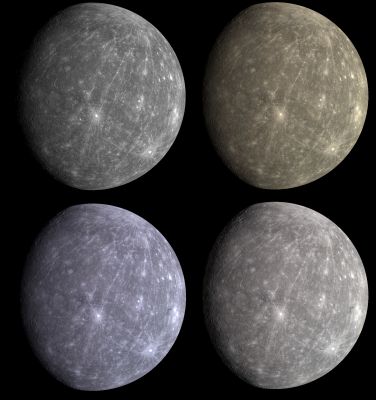
Of Interest: Given the WAC’s ability to take images through 11 narrow-band color filters, it is natural to wonder what does Mercury look like in “true” color such as would be seen by the human eye. However, creating such a natural color view is not as simple as it may seem. Shown here are four images of Mercury. The image in the top left is the previously released grayscale monochrome single WAC filter (430-nanometer) image; the remaining three images are three-color composites, produced by placing the same three WAC filter images with peak sensitivities at 480, 560, and 630 nanometers in the blue, green, and red channels, respectively. The differences between the color representations result from how the brightness and contrast of each individual WAC filter image was adjusted before it was combined into a color picture. In the top right view, all of the three filter images were stretched using the same brightness and contrast settings. In the bottom left picture, the brightness and contrast of each of the three filter images were determined independent of the others. In the bottom right, the brightness and contrast settings used in the upper right version were slightly adjusted to make each of the three filter images span a similar range of brightness and contrast values. 

So which color representation is “correct” for Mercury? The answer to that would indeed DEPEND ON THE EYES OF THE BEHOLDER. Every individual sees color differently; the human eye has a range of sensitivities that vary from person to person, resulting in different perceptions of “true” color. In addition, the three MDIS filter bands are narrow, and light at wavelengths between their peaks is not detected, unlike the human eye. In general, in light visible to the human eye, Mercury’s surface shows only very subtle color variations, as seen in the three images here. However, when images from all 11 WAC filters are statistically compared and contrasted, these subtle color variations can be greatly enhanced, resulting in extremely colorful representations of Mercury’s surface.
Parole chiave: Mercury

The "True Colors" of Mercury?

...Ed alla fine, anche la NASA (almeno per quanto riguarda la Missione MESSENGER) si è "arresa" alla Logica Generale dei Colori adottata - tempo fa - da Lunexit.
Citiamo (come da nostro Sondaggio) "I colori di un Mondo dipendono (o, se volete, stanno) dagli (negli) occhi di chi lo guarda".

Una considerazione che potrà anche sembrarVi stupida e scontata ma che, va detto per Onestà Intellettuale, è stata oggettivata e fatta propria da Lunar Explorer Italia da tempo ed attraverso l'articolo "True Colors", che potete trovare nell'archivio del nostro blog TrePlanets.

A nostro avviso, questa considerazione NASA (che riprende Lunexit) deve farci ancora una volta sentire fieri del Lavoro che svolgiamo e dei risultati che otteniamo.

Anche se, a parte Voi Lettori e noi STAFF, non sembra essersene accorto nessun altro (specie in Italia)...

Caption NASA:

Date Acquired: October 6, 2008
Image Mission Elapsed Time (MET): 131775256, 131775260, 131775264, 131775268
Instrument: Wide Angle Camera (WAC) of the Mercury Dual Imaging System (MDIS)
Resolution: 5 Km/pixel (about 3 miles/pixel)
Scale: Mercury’s diameter is roughly 4880 Km (approx. 3030 miles)
Spacecraft Altitude: about 27.000 Km (approx. 17.000 miles)

Of Interest: Given the WAC’s ability to take images through 11 narrow-band color filters, it is natural to wonder what does Mercury look like in “true” color such as would be seen by the human eye. However, creating such a natural color view is not as simple as it may seem. Shown here are four images of Mercury. The image in the top left is the previously released grayscale monochrome single WAC filter (430-nanometer) image; the remaining three images are three-color composites, produced by placing the same three WAC filter images with peak sensitivities at 480, 560, and 630 nanometers in the blue, green, and red channels, respectively. The differences between the color representations result from how the brightness and contrast of each individual WAC filter image was adjusted before it was combined into a color picture. In the top right view, all of the three filter images were stretched using the same brightness and contrast settings. In the bottom left picture, the brightness and contrast of each of the three filter images were determined independent of the others. In the bottom right, the brightness and contrast settings used in the upper right version were slightly adjusted to make each of the three filter images span a similar range of brightness and contrast values.

So which color representation is “correct” for Mercury? The answer to that would indeed DEPEND ON THE EYES OF THE BEHOLDER. Every individual sees color differently; the human eye has a range of sensitivities that vary from person to person, resulting in different perceptions of “true” color. In addition, the three MDIS filter bands are narrow, and light at wavelengths between their peaks is not detected, unlike the human eye. In general, in light visible to the human eye, Mercury’s surface shows only very subtle color variations, as seen in the three images here. However, when images from all 11 WAC filters are statistically compared and contrasted, these subtle color variations can be greatly enhanced, resulting in extremely colorful representations of Mercury’s surface.

ZQ-Mercury-PIA11025.jpg ZS-Mercury-PIA11077.jpg ZT-Mercury-WAC_1x1_color.png ZU-PIA12038.jpg ZU-PIA12051.jpg
Informazioni sul file
Nome del file:ZT-Mercury-WAC_1x1_color.png
Nome album:MareKromium / Mercury
Valutazione (4 voti):55555(Mostra dettagli)
Parole chiave:Mercury
Copyright:NASA/Johns Hopkins University Applied Physics Laboratory/Carnegie Institution of Washington e Lunar Explorer Italia per l'additional processing e la colorizzazione
Dimensione del file:4142 KiB
Data di inserimento:Ott 17, 2008
Dimensioni:1920 x 2040 pixels
Visualizzato:56 volte
URL:https://www.lunexit.it/gallery/displayimage.php?pid=22218
Preferiti:Aggiungi ai preferiti


Powered by Coppermine Photo Gallery