Inizio Registrati Login

Elenco album Ultimi arrivi Ultimi commenti Più viste Più votate Preferiti Cerca

Inizio > SOLAR SYSTEM > Mercury
Ritorna alla pagina delle miniature FILE 214/248 Torna all'inizio Guarda foto precedente Guarda foto successiva Salta alla fine
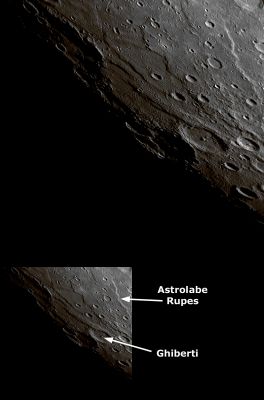
Astrolabe Rupes (natural colors; credits: Lunexit)
Date Acquired: October 6, 2008
Image Mission Elapsed Time (MET): 131774936
Instrument: Narrow Angle Camera (NAC) of the Mercury Dual Imaging System (MDIS)
Resolution: 660 meters/pixel (0,41 miles/pixel)
Scale: Ghiberti crater is approx. 123 Km in diameter (about 76 miles)
Spacecraft Altitude: about 26.000 Km (approx. 16.000 miles)

Of Interest: This NAC image, taken about 85 minutes after MESSENGER’s closest approach during the mission’s second Mercury flyby, shows a view of Astrolabe Rupes, named for the ship of the French explorer Jules Dumont d’Urville. Rupes is the Latin word for cliff. Mercury’s day/night transition (the Terminator) is located on the left side of the image, and the Sun is striking the cliff face of Astrolabe Rupes in the upper right of the image. Also visible in the image are additional unnamed rupes, whose cliff faces are casting dark shadows. One of these rupes intersects the crater Ghiberti, named for the Italian Renaissance sculptor. Rupes on Mercury are thought to have formed as the interior of Mercury cooled and the planet consequently contracted slightly. Determining the number and extent of rupes on Mercury can thus be used to understand the thermal history of the Planet.
Parole chiave: Mercury

Astrolabe Rupes (natural colors; credits: Lunexit)

Date Acquired: October 6, 2008
Image Mission Elapsed Time (MET): 131774936
Instrument: Narrow Angle Camera (NAC) of the Mercury Dual Imaging System (MDIS)
Resolution: 660 meters/pixel (0,41 miles/pixel)
Scale: Ghiberti crater is approx. 123 Km in diameter (about 76 miles)
Spacecraft Altitude: about 26.000 Km (approx. 16.000 miles)

Of Interest: This NAC image, taken about 85 minutes after MESSENGER’s closest approach during the mission’s second Mercury flyby, shows a view of Astrolabe Rupes, named for the ship of the French explorer Jules Dumont d’Urville. Rupes is the Latin word for cliff. Mercury’s day/night transition (the Terminator) is located on the left side of the image, and the Sun is striking the cliff face of Astrolabe Rupes in the upper right of the image. Also visible in the image are additional unnamed rupes, whose cliff faces are casting dark shadows. One of these rupes intersects the crater Ghiberti, named for the Italian Renaissance sculptor. Rupes on Mercury are thought to have formed as the interior of Mercury cooled and the planet consequently contracted slightly. Determining the number and extent of rupes on Mercury can thus be used to understand the thermal history of the Planet.

ZZ-Mercury-Plains-PIA14193-PCF-LXTT.jpg ZZ-Mercury-Pond-PIA15203-PCF-LXTT.jpg ZZ-Mercury-Rupes-CN0131773865_web.png ZZ-Mercury-Rupes-PIA11012.jpg ZZ-Mercury-Rupes-PIA13748-0.jpg
Informazioni sul file
Nome del file:ZZ-Mercury-Rupes-CN0131773865_web.png
Nome album:MareKromium / Mercury
Valutazione (3 voti):55555(Mostra dettagli)
Parole chiave:Mercury
Copyright:NASA/Johns Hopkins University Applied Physics Laboratory/Carnegie Institution of Washington e Lunar Explorer Italia per l'additional processing e la colorizzazione
Dimensione del file:973 KiB
Data di inserimento:Ott 17, 2008
Dimensioni:1018 x 1540 pixels
Visualizzato:55 volte
URL:https://www.lunexit.it/gallery/displayimage.php?pid=22213
Preferiti:Aggiungi ai preferiti


Powered by Coppermine Photo Gallery