|
|
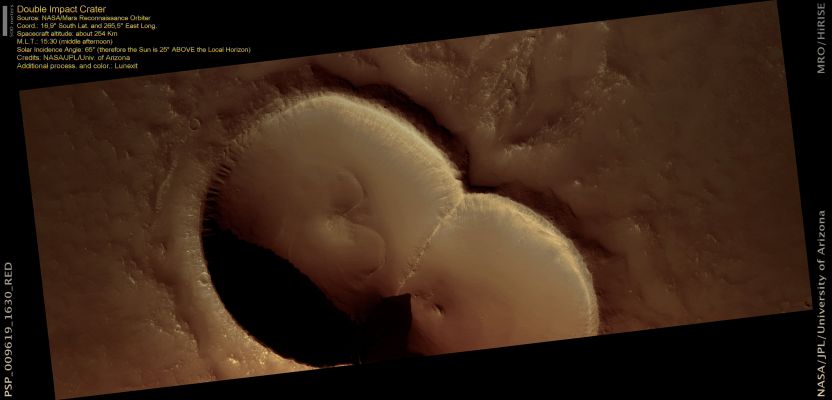
Double Impact Crater (natural colors; credits: Lunexit)
|
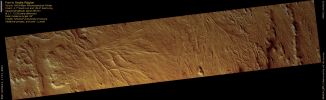
This image shows a double impact crater in Syria Planum, and probably formed when a binary asteroid pair (two asteroids closely orbiting each other, while also orbiting the Sun) struck the Surface. The asteroids must have been about the same size, on the order of a few hundred meters across, to produce these craters.
How is it possible to say that the double crater is due to a binary asteroid, instead of two independent impacts? Neither crater shows signs of burial by ejecta from the other. More importantly, the ejecta (material thrown out of the craters) shows signs of interacting; the ridges extending to the southeast of the crater probably formed when ejecta from the craters collided in midair, causing more debris to pile up at certain points.
This means that the impacts occurred within moments of each other.
Ejecta interaction features like this can also form in association with “secondary” craters (craters made by debris from other impacts, rather than by asteroids), since many secondary craters form at once. In this case, however, a binary asteroid is the likely cause. The very large size is one indicator (secondary craters are generally much smaller than the “primary” crater), and there is not an obvious nearby source crater. While secondary craters are common, binary impacts are expected to occur as well, since binary asteroid pairs are observed.
This crater pair is also of geologic interest since it exposes a cross-section of the local rocks. Thin, flat layers are visible in the upper walls. Since this region has seen extensive volcanic activity, these may be a mix of old lava flows and other volcanic debris. Exposures like this provide evidence for the extent and thickness of these deposits.
|
|











 (Mostra dettagli)

Questo, a mio avviso, è effettivamente un cratere da impatto (doppio e simultaneo, come spiega bene la caption NASA).
Perchè i crateri Lunari sono così diversi da quelli Marziani?
Beh, perchè la Luna è un mondo - da ere - geologicamente inattivo e meteorologicamente morto.
Marte, invece, è, si geologicamente quasi del tutto inattivo (io direi "quiescente", che suona meglio...), ma meteorologicamente è tutt'altro che defunto (c'è vento, c'è ghiaccio, c'è neve, forse ci sono anche sorgenti - con acque termali - calde e liquide - in profondità etc.).
Tutti gli agenti atmosferici conseguono un risultato essenziale, sempre: MODIFICANO l'ambiente su cui vanno ad incidere.
Questo doppio cratere, molto probabilmente, si è creato quando le acque superficiali di Marte non si erano ancora del tutto ritirate (evaporate? Inghiottite dal sottosuolo? Un pò ed un pò? ...ancora non lo sappiamo) e la loro azione smussante - anche se le acque che lo avvolgevano (probabilmente) erano ormai quasi stagnanti (e cioè soggette a correnti minime o nulle) - lo ha "trasformato" (io direi che ne ha arrotondato i bordi).
Poi le acque sono definitivamente sparite ed è subentrata - massiccia - l'azione del vento: che affila ed abbatte.
Ora pensa a questi due processi protratti per ere ed ere (leggi: milioni di anni) e probabilmente riuscirai a visualizzare la trasformazione di questo rilievo che, molto probabilmente, qualche milione di anni fa aveva bordi alti ed affilati (come lo sono i bordi di tantissimi crateri Lunari) ed era circondato da rocce scheggiate e, forse, da crepe.
L'acqua ha cancellato il 75-80% di quella che era la sua forma originale; il vento ha operato sul rimanente.
Ma quando guardi la Luna, da Tycho a Copernico, tu vedi i crateri così come erano milioni e milioni (centinaia di milioni) di anni fa: intatti. Poichè non c'è vento che affili, nè acqua che smussi.
Le uniche modifiche ipotizzabili alla superficie della Luna derivavano da eventi vulcanici, sismici e da nuovi impatti, che rimodificavano la superficie del nostro Satellite Naturale.
Oggi, di eventi vulcanici e sismici non vi è più traccia (forse qualcosa di residuale, ma DAVVERO residuale...) e l'unico elemento di trasformazione delle fattezze della Luna è dato dall'azione di bombardamento meteorico a cui essa è comunque soggetta e verso la quale essa è totalmente indifesa (causa la mancanza di un'atmosfera protettiva).
Ma con una precisazione: l'attività meteorica del passato (remoto) della Luna - e, in generale, della Porzione Interna del Sistema Solare -, era notevole. Quasi costante.
Oggi è rara e minore (se così non fosse, portare Uomini e mezzi sulla Luna ed intorno alla Luna sarebbe inipotizzabile, a causa del rischio eccessivo di ritrovarsi con "qualche pioggia di macigni sulla testa". Un rischio residuale anch'esso ma, a differenza di quello legato all'attività sismica e vulcanica, molto più "effettivo e reale" di quanto non si possa immaginare...
Spero di esserti stato di aiuto. Un abbraccio! Paolo