Inizio Registrati Login

Elenco album Ultimi arrivi Ultimi commenti Più viste Più votate Preferiti Cerca

Inizio > MARS > Mars Reconnaissance Orbiter (MRO)
Ritorna alla pagina delle miniature FILE 2062/2237 Torna all'inizio Guarda foto precedente Guarda foto successiva Salta alla fine
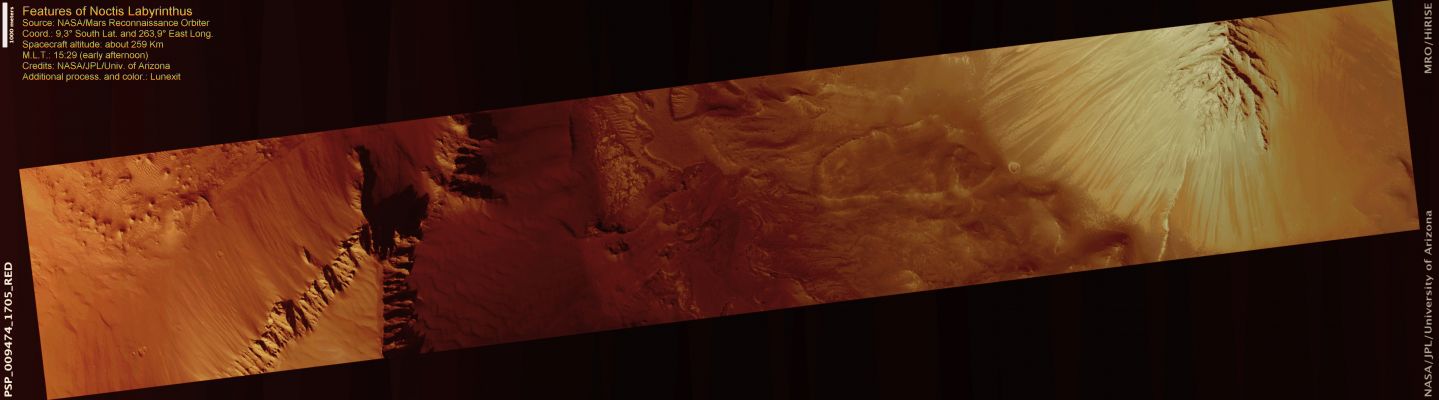
Water Bearing Minerals in Noctis Labyrinthus (natural colors; credits: Lunexit)
Noctis Labyrinthus consists of a series of Pits on the western end of the large Valles Marineris Canyon System. 

The HiRISE camera and the CRISM Spectrometer have revealed that the floors of some of these Pits exhibit layered rocks, or strata, that contain minerals with water. These Pits were formed several billion years ago, therefore the rocks and sediments on their floors record evidence of water during this period of Mars’ history.
The walls of the Pits are commonly covered with dust and other loose sediments that form dunes and dune-like forms, and in many cases the floors of the pits are also covered with these materials. This image shows an example of light-toned layers exposed beneath these sediments and dunes, and CRISM data show that these layers have hydrated minerals.

The dark-brown/orange tones in this natural color image correspond to areas with more Pyroxene, a mineral found in volcanic rocks and Martian Dust. Some Pits, such as this one, appear to have deposits associated with large landslides that are younger than the hydrated minerals and partially bury them.
Parole chiave: Mars from orbit - Noctis Labyrinthus

Water Bearing Minerals in Noctis Labyrinthus (natural colors; credits: Lunexit)

Noctis Labyrinthus consists of a series of Pits on the western end of the large Valles Marineris Canyon System.

The HiRISE camera and the CRISM Spectrometer have revealed that the floors of some of these Pits exhibit layered rocks, or strata, that contain minerals with water. These Pits were formed several billion years ago, therefore the rocks and sediments on their floors record evidence of water during this period of Mars’ history.
The walls of the Pits are commonly covered with dust and other loose sediments that form dunes and dune-like forms, and in many cases the floors of the pits are also covered with these materials. This image shows an example of light-toned layers exposed beneath these sediments and dunes, and CRISM data show that these layers have hydrated minerals.

The dark-brown/orange tones in this natural color image correspond to areas with more Pyroxene, a mineral found in volcanic rocks and Martian Dust. Some Pits, such as this one, appear to have deposits associated with large landslides that are younger than the hydrated minerals and partially bury them.

Psp_009461_2470_red.jpg Psp_009468_2385_red.jpg Psp_009474_1705_red.jpg Psp_009478_1770_red.jpg Psp_009480_2265_red.jpg
Informazioni sul file
Nome del file:Psp_009474_1705_red.jpg
Nome album:MareKromium / Mars Reconnaissance Orbiter (MRO)
Valutazione (7 voti):55555(Mostra dettagli)
Parole chiave:Mars / from / orbit / - / Noctis / Labyrinthus
Copyright:NASA/JPL/Univ. of Arizona e Lunar Explorer Italia per il processing addizionale e la colorizzazione
Dimensione del file:1056 KiB
Data di inserimento:Set 25, 2008
Dimensioni:7370 x 2048 pixels
Visualizzato:55 volte
URL:https://www.lunexit.it/gallery/displayimage.php?pid=21994
Preferiti:Aggiungi ai preferiti


Powered by Coppermine Photo Gallery