Inizio Registrati Login

Elenco album Ultimi arrivi Ultimi commenti Più viste Più votate Preferiti Cerca

Inizio > MARS > Mars Reconnaissance Orbiter (MRO)
Ritorna alla pagina delle miniature FILE 1747/2237 Torna all'inizio Guarda foto precedente Guarda foto successiva Salta alla fine
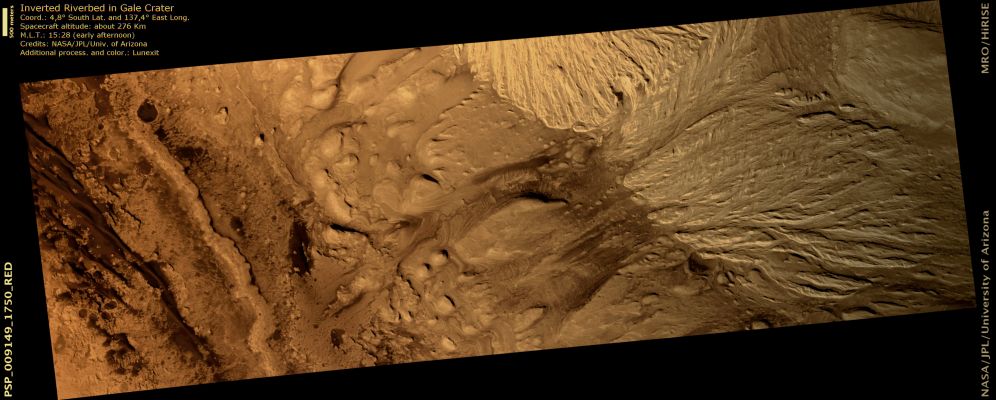
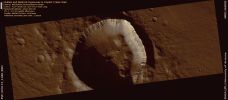
Inverted Riverbed in Gale Crater (False Colors; credits: Lunexit)
Gale Crater is a large, approximately 152 Km-diameter impact crater that lies near the Martian Equator. Contained within the crater is a massive central mound of layered material. With an average vertical thickness of almost 4 Km (about 2,4 miles), the Gale Crater Layered Deposits are twice as thick as the layers exposed along the Grand Canyon on Earth. Shown here is a portion of the mound with an inverted fluvial or river channel. 
Topographic inversion occurs when sediments are cemented together, forming a harder layer that is resistant to later erosion. This later erosion has preferentially removed material outside the channel, leaving the former riverbed exposed as a ridge — such as a topographic high. 
This inverted channel was originally detected by scientists using Mars Orbiter Camera (MOC) images onboard the Mars Global Surveyor Spacecraft.

Color variations visible in this image are mostly due to variable amounts of loose dark sediment that has accumulated unevenly across the scene.
Parole chiave: Mars from orbit - Craters - Gale Crater

Inverted Riverbed in Gale Crater (False Colors; credits: Lunexit)

Gale Crater is a large, approximately 152 Km-diameter impact crater that lies near the Martian Equator. Contained within the crater is a massive central mound of layered material. With an average vertical thickness of almost 4 Km (about 2,4 miles), the Gale Crater Layered Deposits are twice as thick as the layers exposed along the Grand Canyon on Earth. Shown here is a portion of the mound with an inverted fluvial or river channel.
Topographic inversion occurs when sediments are cemented together, forming a harder layer that is resistant to later erosion. This later erosion has preferentially removed material outside the channel, leaving the former riverbed exposed as a ridge — such as a topographic high.
This inverted channel was originally detected by scientists using Mars Orbiter Camera (MOC) images onboard the Mars Global Surveyor Spacecraft.

Color variations visible in this image are mostly due to variable amounts of loose dark sediment that has accumulated unevenly across the scene.

PSP_009138_2025_RED-00.jpg PSP_009138_2025_RED-01.jpg PSP_009149_1750_RED.jpg PSP_009151_1465_RED.jpg PSP_009155_1480_RED.jpg
Informazioni sul file
Nome del file:PSP_009149_1750_RED.jpg
Nome album:MareKromium / Mars Reconnaissance Orbiter (MRO)
Valutazione (5 voti):55555(Mostra dettagli)
Parole chiave:Mars / from / orbit / - / Craters / - / Gale / Crater
Copyright:NASA/JPL/Univ. of Arizona e Lunar Explorer Italia per il processing addizionale e la colorizzazione
Dimensione del file:1250 KiB
Data di inserimento:Ago 30, 2008
Dimensioni:5101 x 2048 pixels
Visualizzato:54 volte
URL:https://www.lunexit.it/gallery/displayimage.php?pid=21642
Preferiti:Aggiungi ai preferiti


Powered by Coppermine Photo Gallery