Inizio Registrati Login

Elenco album Ultimi arrivi Ultimi commenti Più viste Più votate Preferiti Cerca

Inizio > MARS > Mars Reconnaissance Orbiter (MRO)
Ritorna alla pagina delle miniature FILE 1771/2237 Torna all'inizio Guarda foto precedente Guarda foto successiva Salta alla fine
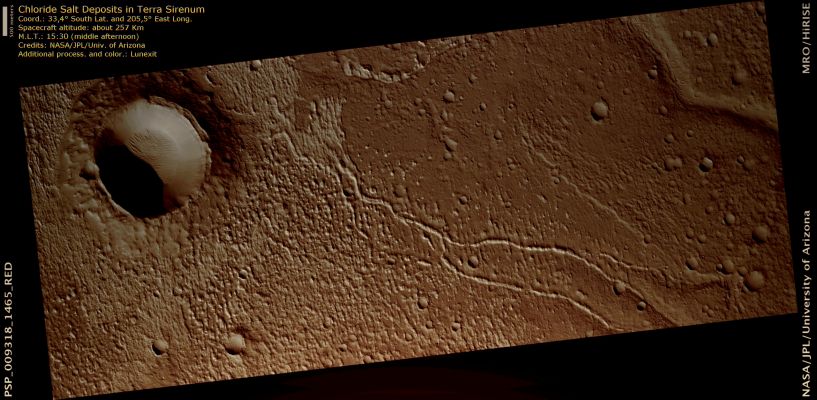
Chloride Salt Deposits within a Channel in Terra Sirenum (ctx frame - natural colors; credits: Lunexit)
This image shows a series of knobs, channels and inverted channels in the ancient Southern Highlands of Mars.
The inverted channels, which now appear as sinuous ridges, are filled with a fractured light-toned material that is also apparent in the knobs and nearby bedrock. Previous analyses of the infrared data from TES and THEMIS of similar materials in Terra Sirenum and elsewhere on Mars suggest that these light-toned materials are deposits of chloride salts such as Sodium Chloride (ordinary rock salt).

Salt deposits are key targets in the search for ancient life on Mars, because they represent places where bodies of liquid water may have ponded and evaporated. 
The salt forms an ideal setting in which to preserve signs of biological activity. The clear association of the salt with the sinuous channels visible here suggests that the material was precipitated from brines that once flowed through these channels. 
The fractured surface of the deposits is consistent with cracking by desiccation (rapid drying) of the thick salts as they were deposited.
Parole chiave: Mars from orbit - Terra Sirenum Region

Chloride Salt Deposits within a Channel in Terra Sirenum (ctx frame - natural colors; credits: Lunexit)

This image shows a series of knobs, channels and inverted channels in the ancient Southern Highlands of Mars.
The inverted channels, which now appear as sinuous ridges, are filled with a fractured light-toned material that is also apparent in the knobs and nearby bedrock. Previous analyses of the infrared data from TES and THEMIS of similar materials in Terra Sirenum and elsewhere on Mars suggest that these light-toned materials are deposits of chloride salts such as Sodium Chloride (ordinary rock salt).

Salt deposits are key targets in the search for ancient life on Mars, because they represent places where bodies of liquid water may have ponded and evaporated.
The salt forms an ideal setting in which to preserve signs of biological activity. The clear association of the salt with the sinuous channels visible here suggests that the material was precipitated from brines that once flowed through these channels.
The fractured surface of the deposits is consistent with cracking by desiccation (rapid drying) of the thick salts as they were deposited.

PSP_009311_1735_RED.jpg PSP_009313_1560_RED.jpg PSP_009318_1465_RED-00.jpg PSP_009318_1465_RED-01.jpg PSP_009320_1805_RED.jpg
Informazioni sul file
Nome del file:PSP_009318_1465_RED-00.jpg
Nome album:MareKromium / Mars Reconnaissance Orbiter (MRO)
Valutazione (4 voti):55555(Mostra dettagli)
Parole chiave:Mars / from / orbit / - / Terra / Sirenum / Region
Copyright:NASA/JPL/Univ. of Arizona e Lunar Explorer Italia per il processing addizionale e la colorizzazione
Dimensione del file:1266 KiB
Data di inserimento:Ago 30, 2008
Dimensioni:4188 x 2048 pixels
Visualizzato:76 volte
URL:https://www.lunexit.it/gallery/displayimage.php?pid=21634
Preferiti:Aggiungi ai preferiti


Powered by Coppermine Photo Gallery