Inizio Registrati Login

Elenco album Ultimi arrivi Ultimi commenti Più viste Più votate Preferiti Cerca

Inizio > SOLAR SYSTEM > Mercury
Ritorna alla pagina delle miniature FILE 48/248 Torna all'inizio Guarda foto precedente Guarda foto successiva Salta alla fine
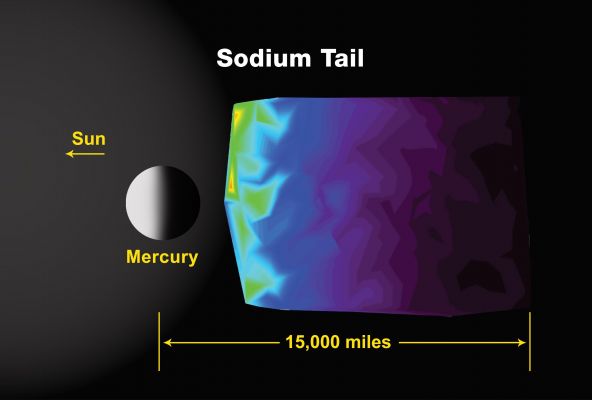
Mercury's "Sodium Tail"
Caption NASA:"This plot shows the intensity of emission of light associated with Sodium (Na) Atoms in the vicinity of Mercury. The observations were made with the Ultraviolet and Visible Spectrometer (UVVS) section of the Mercury Atmospheric and Surface Composition Spectrometer (MASCS). The intensity (up to 40 kiloRayleighs) indicates the relative abundance of material - in this case Sodium Atoms - along the observational line of sight back to the Spacecraft. 
While Sodium from Mercury has been observed with Earth-based telescopes, this is the highest-spatial-resolution image ever made. 
The geometry and observing circumstances have to be disentangled to infer the true spatial distribution, but the observations do confirm a North-South asymmetry that has previously been observed in ground-based Sodium images. 

The Sodium emission is at 589 nm (in the visible part of the spectrum and the same wavelength, or color, as in sodium lamps and street lights on Earth). Because Sodium Atoms have intense emission, they are easy to detect, and this makes sodium a good tracer for other volatile elements in Mercury's Exosphere".
Parole chiave: Graphs and Spectra

Mercury's "Sodium Tail"

Caption NASA:"This plot shows the intensity of emission of light associated with Sodium (Na) Atoms in the vicinity of Mercury. The observations were made with the Ultraviolet and Visible Spectrometer (UVVS) section of the Mercury Atmospheric and Surface Composition Spectrometer (MASCS). The intensity (up to 40 kiloRayleighs) indicates the relative abundance of material - in this case Sodium Atoms - along the observational line of sight back to the Spacecraft.
While Sodium from Mercury has been observed with Earth-based telescopes, this is the highest-spatial-resolution image ever made.
The geometry and observing circumstances have to be disentangled to infer the true spatial distribution, but the observations do confirm a North-South asymmetry that has previously been observed in ground-based Sodium images.

The Sodium emission is at 589 nm (in the visible part of the spectrum and the same wavelength, or color, as in sodium lamps and street lights on Earth). Because Sodium Atoms have intense emission, they are easy to detect, and this makes sodium a good tracer for other volatile elements in Mercury's Exosphere".

ZP-Mercury-PIA10382.jpg ZP-Mercury-PIA10394.jpg ZP-Mercury-PIA10396.jpg ZQ-Mercury-PIA10611.jpg ZQ-Mercury-PIA10942.jpg
Informazioni sul file
Nome del file:ZP-Mercury-PIA10396.jpg
Nome album:MareKromium / Mercury
Valutazione (4 voti):55555(Mostra dettagli)
Parole chiave:Graphs / and / Spectra
Copyright:NASA/University of Colorado/Johns Hopkins University Applied Physics Laboratory/Carnegie Institution of Washington
Dimensione del file:171 KiB
Data di inserimento:Ago 24, 2008
Dimensioni:3000 x 2025 pixels
Visualizzato:56 volte
URL:https://www.lunexit.it/gallery/displayimage.php?pid=21557
Preferiti:Aggiungi ai preferiti


Powered by Coppermine Photo Gallery