Inizio Registrati Login

Elenco album Ultimi arrivi Ultimi commenti Più viste Più votate Preferiti Cerca

Inizio > MARS > Mars Reconnaissance Orbiter (MRO)
Ritorna alla pagina delle miniature FILE 1729/2237 Torna all'inizio Guarda foto precedente Guarda foto successiva Salta alla fine
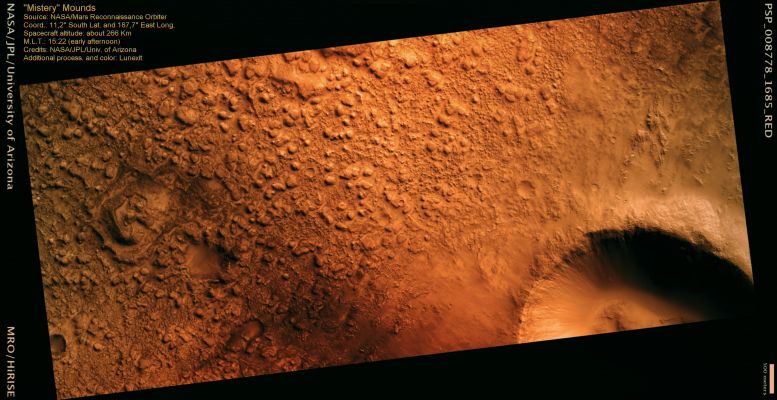
Mistery Mounds (MULTISPECTRUM; credits: Lunexit)
This image was targeted because a previous MGS-MOC image (R1100035) showed an distinctive field of Mounds on the floor of an ancient, large, filled-in Unnamed Crater.

The origin of the Mounds was unclear, so we hoped that a HiRISE image with higher resolution and color would solve the mystery. The HiRISE image shows much more detail on the Mounds and other rough textures, indicating that this is an eroded bedrock surface, perhaps exposed by removal of an overlying layer of fine-grained materials by the wind.
But how did the rocks form, and why did they erode onto Mounds? It could have been lava or impact ejecta or fluvial sediments, perhaps altered and indurated by groundwater. 
The Mounds could be due to how it was deposited — like hummocky Impact Ejecta — or how it was indurated. In other words, we haven't solved the mystery!...

Yet we may get new clues from future images of similar terrains in places where the origin is more interpretable, or from other datasets such as the mineral content determined by CRISM.
Parole chiave: Mars from orbit - Craters - Unnamed Crater with Mounds

Mistery Mounds (MULTISPECTRUM; credits: Lunexit)

This image was targeted because a previous MGS-MOC image (R1100035) showed an distinctive field of Mounds on the floor of an ancient, large, filled-in Unnamed Crater.

The origin of the Mounds was unclear, so we hoped that a HiRISE image with higher resolution and color would solve the mystery. The HiRISE image shows much more detail on the Mounds and other rough textures, indicating that this is an eroded bedrock surface, perhaps exposed by removal of an overlying layer of fine-grained materials by the wind.
But how did the rocks form, and why did they erode onto Mounds? It could have been lava or impact ejecta or fluvial sediments, perhaps altered and indurated by groundwater.
The Mounds could be due to how it was deposited — like hummocky Impact Ejecta — or how it was indurated. In other words, we haven't solved the mystery!...

Yet we may get new clues from future images of similar terrains in places where the origin is more interpretable, or from other datasets such as the mineral content determined by CRISM.

PSP_008710_1710_red-PCF-LXTT.jpg PSP_008774_1755_RED_abrowse-PCF-LXTT.jpg PSP_008778_1685_RED_abrowse.jpg PSP_008792_1410_RED_abrowse.jpg PSP_008825_2040_red.jpg
Informazioni sul file
Nome del file:PSP_008778_1685_RED_abrowse.jpg
Nome album:MareKromium / Mars Reconnaissance Orbiter (MRO)
Valutazione (7 voti):55555(Mostra dettagli)
Parole chiave:Mars / from / orbit / - / Craters / - / Unnamed / Crater / with / Mounds
Copyright:NASA/JPL/University of Arizona e Lunar Explorer Italia per l'elaborazione addizionale e la colorizzazione MULTISPECTRUM del frame
Dimensione del file:1138 KiB
Data di inserimento:Lug 19, 2008
Dimensioni:3982 x 2048 pixels
Visualizzato:55 volte
URL:https://www.lunexit.it/gallery/displayimage.php?pid=21149
Preferiti:Aggiungi ai preferiti


Powered by Coppermine Photo Gallery