|
|
Phoenix Lander "Hardware" (Day-Time Frame)
|
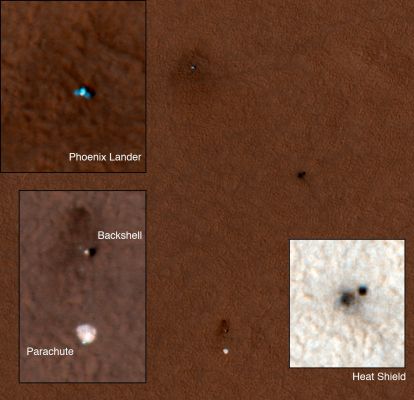
Caption NASA:"MRO’s HiRISE camera acquired this image of the Phoenix Landing Site 22 hours after landing. The image shows three unusual features which were not present in a pre-landing HiRISE image.
We expect to find three main pieces of hardware: the parachute attached to the backshell, the heat shield, and the lander itself.
The Parachute (bottom) is easy to identify because it is especially bright, and this image also clearly shows the Back-Shell. We can even see the stripes on the Parachute.
The dark marking (middle right) appears most consistent with disturbance of the ground from impact and bouncing of the Heat-Shield, which fell from a height of about 13 kilometers.
The last object (top) is the Lander, and we can clearly see the solar arrays on each side. The solar arrays were relatively dark in the image acquired 11 hours after landing, but are brighter than the Mars surface in this daytime image acquired with the HiRISE blue-green filter.
There are dark halos around all three locations, perhaps due to disturbing a thin dust coating.
North is about 7°to the right of straight up in this image and illumination is from the lower left".
|
|














Domandine..........
1) Se il Lander è a NORD e l'Heat Shield è ad EST il Lander è orientato verso SUD/SUD-OVEST?
2) la Back Shell, rispetto al Lander, è a SUD/EST?
3) Il sole dove sorge e tramonta su Marte? E' come sulla terra?
Saluti!
Allora: innanzitutto, la Caption NASA Originale al frame non fornisce dati sui Punti Cardinali, ma li ho dedotti io (magari sbagliando, certo) sulla base del fatto che l'unico rilievo riconoscibile nelle immagini panoramiche di Phoenix era ed è il bordo del Cratere Heimdall, che si posiziona a Sud/Sud-Ovest rispetto al Landing Site di Phoenix stessa.
Se (e ripeto "SE") questa assunzione di partenza è corretta, allora - combinando le info che ricaviamo dalle immagini panoramiche scattate dalla superficie di Vastitas con le info dell'immagine orbitale in oggetto - possiamo dire che: il Lander è più a Nord RISPETTO alla Back-Shell ed all'Heat-Shield e la sua "visione frontale" guarda direttamente verso Sud. Dato che il Sole, nell'Emisfero Boreale di Marte, si comporta così come accade sulla Terra, studiando le ombre proiettate dai rilievi prossimi al Lander a diverse ore del giorno, deduciamo che esso sorge dalla Sx del Lander, e quindi identifichiamo subito l'Est.
E, muovendoci "verso" Est/Sud-Est, troviamo la doppia macchia scura che dovrebbe essere l'Heat-Shield.
Andando poi verso Dx (ergo verso Ovest - nota: quando dico "verso Dx", intendo riferirmi ad una immagine panoramica ottenuta dalla superficie di Vastitas; la Dx dell'immagine superficiale di Vastitas corrisponde alla Sx dell'Osservatore di questo frame), inquadriamo, in netta direzione Sud, prima dell'orizzonte che ci lascia intuire il rim di Heimdall, la Back-Shell (il paracadute, dalla superficie, non è visibile).
Procedendo ancora di più verso Dx (ergo sempre verso Ovest), in direzione (approssimativa) Sud/Sud-Ovest, iniziamo a scorgere il bordo di Heimdall.
ATTENZIONE: l'immagine panoramica di superficie è leggermente "deformata" grandangolarmente, e quindi PUO' DARSI che Heimdall si posizioni NON a Sud/Sud-Ovest del Lander, bensì ad Ovest/Sud-Ovest del Lander.
Insomma...Non è proprio semplicissima la questione quando non si hanno i dati contestuali di riferimento (o se ne hanno solo pochi ed incompleti).
Saluti (circolari) a Te & Friends! PCF
Il nodo fondamentale da risolvere adesso (se non ho mal compreso) è il capire se sia possibile che un grandangolare possa "deformare" così tanto la prospettiva da "spostare a dx" e quindi di oltre 45° gli oggetti in lontananza. Io, infatti, nel frame orizzontale delle pagine precedenti, mi aspetterei la Backshell a sinistra mentre invece è praticamente al centro anzi oltre. Ci vorrebbe un fotografo a cui sottoporre il quesito. E forse so a chi chiedere. Tu che ne pensi? Ne vale la pena?
Salutoni!
domandina......: l'obiettivo del Lander realizza foto mosaici utilizzando il grandangolo?
Rispostina alla tua domandina: si.
O meglio: i fotomosaici li mettono assieme a Terra; tutti gli obbiettivi - rectius: le fotocamere - del Lander (come dei Rover), se opportunamente usati/e, possono contribuire a creare il materiale necessario per un fotomosaico.
Un abbraccio! PCF