Inizio Registrati Login

Elenco album Ultimi arrivi Ultimi commenti Più viste Più votate Preferiti Cerca

Inizio > MARS > Mars Reconnaissance Orbiter (MRO)
Ritorna alla pagina delle miniature FILE 1646/2237 Torna all'inizio Guarda foto precedente Guarda foto successiva Salta alla fine
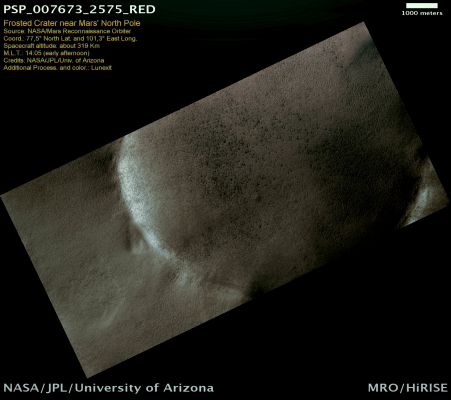
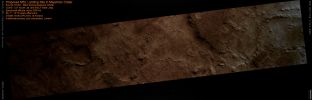
Frosted North Polar Crater (MULTISPECTRUM; credits: Lunexit)
This image was taken over the North Polar Region of Mars, just South of the Layered Ice Cap. 
The image shows a 10 Km diameter impact crater during Northern Spring, still covered by Carbon Dioxide ice/frost, and perhaps some water ice/frost.
There are color variations due to the presence of reddish dust mixed with the ice/frost in different proportions, and the dark and relatively blue spots form when CO2 is released in small jets from beneath the ice. 
There are no clear examples of small impact craters superimposed on the large crater, although there are many shallow depressions that might be degraded craters. 
This seems puzzling because small (approx. 10 meters in diameter) craters form much more frequently than 10 Km craters. 
In fact, they form about a billion times more frequently! The reason why there aren’t any sharp small craters is due to the fact that the ice destroys them, and does so rapidly, compared with the cratering rate.

Ice on Mars does not melt in the current climate, but it does expand and contract with temperature variations and it can flow.
Parole chiave: Mars from orbit - North Polar Region - Frosted Crater

Frosted North Polar Crater (MULTISPECTRUM; credits: Lunexit)

This image was taken over the North Polar Region of Mars, just South of the Layered Ice Cap.
The image shows a 10 Km diameter impact crater during Northern Spring, still covered by Carbon Dioxide ice/frost, and perhaps some water ice/frost.
There are color variations due to the presence of reddish dust mixed with the ice/frost in different proportions, and the dark and relatively blue spots form when CO2 is released in small jets from beneath the ice.
There are no clear examples of small impact craters superimposed on the large crater, although there are many shallow depressions that might be degraded craters.
This seems puzzling because small (approx. 10 meters in diameter) craters form much more frequently than 10 Km craters.
In fact, they form about a billion times more frequently! The reason why there aren’t any sharp small craters is due to the fact that the ice destroys them, and does so rapidly, compared with the cratering rate.

Ice on Mars does not melt in the current climate, but it does expand and contract with temperature variations and it can flow.

PSP_007612_2045_RED_abrowse~0.jpg PSP_007653_2010_RED_abrowse-00.jpg PSP_007673_2575_RED_abrowse.jpg PSP_007678_2050_RED_abrowse~0.jpg PSP_007704_1765_RED_abrowse~0.jpg
Informazioni sul file
Nome del file:PSP_007673_2575_RED_abrowse.jpg
Nome album:MareKromium / Mars Reconnaissance Orbiter (MRO)
Valutazione (3 voti):55555(Mostra dettagli)
Parole chiave:Mars / from / orbit / - / North / Polar / Region / - / Frosted / Crater
Copyright:NASA/JPL/University of Arizona e Lunar Explorer Italia per l'ingrandimento, l'elaborazione addizionale e la colorizzazione del frame
Dimensione del file:691 KiB
Data di inserimento:Mag 24, 2008
Dimensioni:2597 x 2300 pixels
Visualizzato:54 volte
URL:https://www.lunexit.it/gallery/displayimage.php?pid=20497
Preferiti:Aggiungi ai preferiti


Powered by Coppermine Photo Gallery