Inizio Registrati Login

Elenco album Ultimi arrivi Ultimi commenti Più viste Più votate Preferiti Cerca

Inizio > SOLAR SYSTEM > Jupiter: the "King" and His Moons
Ritorna alla pagina delle miniature FILE 295/325 Torna all'inizio Guarda foto precedente Guarda foto successiva Salta alla fine
The "Eyes" of Jupiter
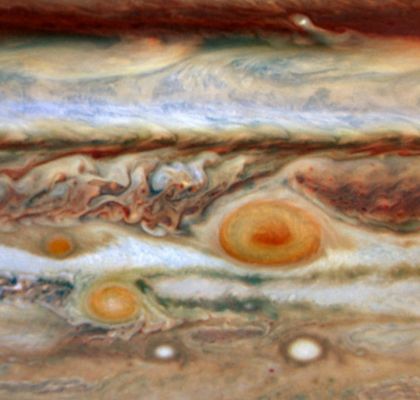
For about 300 years Jupiter's "Banded" Atmosphere has shown a remarkable feature to telescopic viewers, a large swirling storm system known as "The Great Red Spot". In 2006, another red storm system appeared, actually seen to form as smaller whitish oval-shaped storms merged and then developed the curious reddish hue. Now, Jupiter has a third red spot, again produced from a smaller whitish storm. All three are seen in this image made from data recorded on May 9 and 10 with the Hubble Space Telescope's Wide Field and Planetary Camera 2. The spots extend above the surrounding clouds and their red color may be due to deeper material dredged up by the storms and exposed to ultraviolet light, but the exact chemical process is still unknown. For scale, the Great Red Spot has almost twice the diameter of planet Earth, making both new spots less than one Earth-diameter across. The newest red spot is on the far left (West), along the same band of clouds as the Great Red Spot and is drifting toward it. If the motion continues, the new spot will encounter the much larger storm system in August. Jupiter's recent outbreak of red spots is likely related to large scale climate change as the gas Giant Planet is getting warmer near the Equator.
Parole chiave: Jupiter

The "Eyes" of Jupiter

For about 300 years Jupiter's "Banded" Atmosphere has shown a remarkable feature to telescopic viewers, a large swirling storm system known as "The Great Red Spot". In 2006, another red storm system appeared, actually seen to form as smaller whitish oval-shaped storms merged and then developed the curious reddish hue. Now, Jupiter has a third red spot, again produced from a smaller whitish storm. All three are seen in this image made from data recorded on May 9 and 10 with the Hubble Space Telescope's Wide Field and Planetary Camera 2. The spots extend above the surrounding clouds and their red color may be due to deeper material dredged up by the storms and exposed to ultraviolet light, but the exact chemical process is still unknown. For scale, the Great Red Spot has almost twice the diameter of planet Earth, making both new spots less than one Earth-diameter across. The newest red spot is on the far left (West), along the same band of clouds as the Great Red Spot and is drifting toward it. If the motion continues, the new spot will encounter the much larger storm system in August. Jupiter's recent outbreak of red spots is likely related to large scale climate change as the gas Giant Planet is getting warmer near the Equator.

Jupiter-water cloud-GAL-PIA01639_modest.jpg Jupiter.jpg JupiterSpots-HST.jpg JupiterSystem-050107_09.jpg Jupiter_Io-PIA10102.jpg
Informazioni sul file
Nome del file:JupiterSpots-HST.jpg
Nome album:MareKromium / Jupiter: the "King" and His Moons
Valutazione (4 voti):55555(Mostra dettagli)
Parole chiave:Jupiter
Copyright:NASA, ESA, M. Wong, I. de Pater (UC Berkeley), et al.
Dimensione del file:246 KiB
Data di inserimento:Mag 23, 2008
Dimensioni:1629 x 1550 pixels
Visualizzato:87 volte
URL:https://www.lunexit.it/gallery/displayimage.php?pid=20488
Preferiti:Aggiungi ai preferiti


Powered by Coppermine Photo Gallery