Inizio Registrati Login

Elenco album Ultimi arrivi Ultimi commenti Più viste Più votate Preferiti Cerca

Inizio > MARS > Mars Reconnaissance Orbiter (MRO)
Ritorna alla pagina delle miniature FILE 2170/2237 Torna all'inizio Guarda foto precedente Guarda foto successiva Salta alla fine
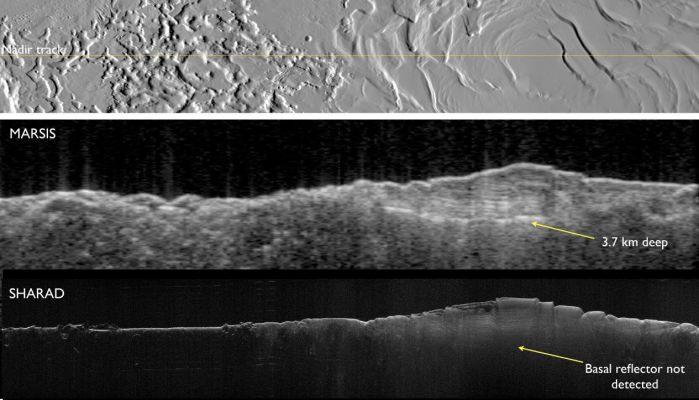
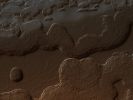
Under the Ice... (2)
Two complementary Radar Sounder Instruments work together to discover hidden Martian secrets. They are the Mars Advanced Radar for Subsurface and Ionospheric Sounding (MARSIS) on the European Space Agency's Mars Express orbiter and the Shallow Subsurface Radar (SHARAD) on NASA's Mars Reconnaissance Orbiter. 

MARSIS was designed to penetrate deep and it has delivered on its promise. This figure shows the base of Mars' South Polar Layered Deposits at the deepest recorded point of 3,7 Km (2,3 miles). 

In contrast, SHARAD was designed as a High-Resolution Radar for a maximum penetration of 1 Km (0,6 mile) has difficulty detecting the base of these layered deposits. 

MARSIS was funded by NASA and the Italian Space Agency and developed by the University of Rome, Italy, in partnership with NASA's Jet Propulsion Laboratory, Pasadena, Calif. Italy provided the instrument's digital processing system and integrated the parts. The University of Iowa, Iowa City, built the transmitter for the instrument, JPL built the receiver and Astro Aerospace, Carpinteria, Calif., built the antenna. JPL is a division of the California Institute of Technology in Pasadena. Additional information about Mars Express is at www.esa.int/marsexpress. 

SHARAD was provided by the Italian Space Agency (ASI). Its operations are led by the University of Rome and its data are analyzed by a joint U.S.-Italian science team. JPL, a division of the California Institute of Technology, Pasadena, manages the Mars Reconnaissance Orbiter for the NASA Science Mission Directorate, Washington.
Parole chiave: Radar View

Under the Ice... (2)

Two complementary Radar Sounder Instruments work together to discover hidden Martian secrets. They are the Mars Advanced Radar for Subsurface and Ionospheric Sounding (MARSIS) on the European Space Agency's Mars Express orbiter and the Shallow Subsurface Radar (SHARAD) on NASA's Mars Reconnaissance Orbiter.

MARSIS was designed to penetrate deep and it has delivered on its promise. This figure shows the base of Mars' South Polar Layered Deposits at the deepest recorded point of 3,7 Km (2,3 miles).

In contrast, SHARAD was designed as a High-Resolution Radar for a maximum penetration of 1 Km (0,6 mile) has difficulty detecting the base of these layered deposits.

MARSIS was funded by NASA and the Italian Space Agency and developed by the University of Rome, Italy, in partnership with NASA's Jet Propulsion Laboratory, Pasadena, Calif. Italy provided the instrument's digital processing system and integrated the parts. The University of Iowa, Iowa City, built the transmitter for the instrument, JPL built the receiver and Astro Aerospace, Carpinteria, Calif., built the antenna. JPL is a division of the California Institute of Technology in Pasadena. Additional information about Mars Express is at www.esa.int/marsexpress.

SHARAD was provided by the Italian Space Agency (ASI). Its operations are led by the University of Rome and its data are analyzed by a joint U.S.-Italian science team. JPL, a division of the California Institute of Technology, Pasadena, manages the Mars Reconnaissance Orbiter for the NASA Science Mission Directorate, Washington.

S-PIA08816.jpg SHARAD-1.gif SHARAD-2.jpg SPLD-PIA13269-0.jpg SPLD-PIA13269-PCF-LXTT2.jpg
Informazioni sul file
Nome del file:SHARAD-2.jpg
Nome album:MareKromium / Mars Reconnaissance Orbiter (MRO)
Valutazione (5 voti):55555(Mostra dettagli)
Parole chiave:Radar / View
Copyright:NASA/ESA/JPL-Caltech/University of Rome/Washington University in St. Louis
Dimensione del file:131 KiB
Data di inserimento:Apr 19, 2008
Dimensioni:1265 x 723 pixels
Visualizzato:77 volte
URL:https://www.lunexit.it/gallery/displayimage.php?pid=20193
Preferiti:Aggiungi ai preferiti

Commento 1 a 6 di 6
Pagina: 1

titanio44   [Apr 19, 2008 at 07:43 PM]
scusi dr MK ma lei lo fā apposta?.......mi capisce vero?...... ;O)
MareKromium   [Apr 19, 2008 at 08:05 PM]
A dire il vero, Carissimo Titanio44, io alla "casualitā" non credo molto. Piuttosto credo alla "causalitā"... Hai visto che č "sparito" TruePlanets ancora? Bah... Un abbraccio! - doc
Anakin   [Apr 21, 2008 at 08:17 AM]
Se fate capire anche me meglio, perchč io sono tremendamente malizioso di natura e non vorrei pensare, guardando queste immagini, male :-)
MareKromium   [Apr 21, 2008 at 09:07 AM]
Tranquillo Anakin: le immagini sono genuine! Titanio44 si riferiva ad una discussione teorica che avevamo avuto poco prima della pubblicazione - da parte della NASA stessa - di queste immagini. Diciamo che esse sono calate sul nostro discorso come "cacio sui maccheroni"! Un abbraccio a Te! PCF
walthari   [Dic 11, 2019 at 12:43 PM]
questa sezione geologica č veramente incredibile, notate i sistemi di faglia con andamento verticale e le discontinuitā della porzione superiore del rilievo polare (probabilmente stratificazioni di rocce sedimentarie).
MareKromium   [Dic 11, 2019 at 12:57 PM]
Per me é inspiegabile, E comunque faccio MOLTA fatica a "decodificarla". Bravo Walt per le note!

Commento 1 a 6 di 6
Pagina: 1


Powered by Coppermine Photo Gallery