Inizio Registrati Login

Elenco album Ultimi arrivi Ultimi commenti Più viste Più votate Preferiti Cerca

Inizio > MARS > Mars Reconnaissance Orbiter (MRO)
Ritorna alla pagina delle miniature FILE 1504/2237 Torna all'inizio Guarda foto precedente Guarda foto successiva Salta alla fine
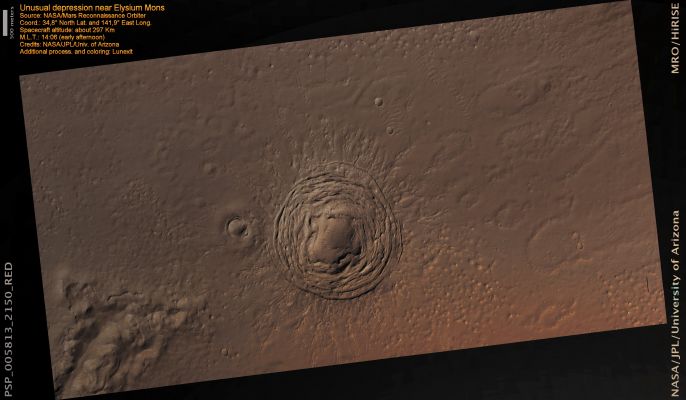
Unusual Depression near Elysium Mons (MULTISPECTRUM; elab. Lunexit)
This unusual depression and the associated concentric rings are situated within an area thought to have been deposited as a mud flow. Due to the lack of a distinctive, raised rim or other impact-related features, this crater is thought to have formed by the loss of material below the surface and subsequent collapse, rather than by an impact from space.
The exact mechanism for the loss of material is not fully understood, although the missing material was likely water in some form. This feature is near a large volcano, so perhaps there were explosive magma-water interactions that violently removed the water and some magma, followed by surface collapse. Or, less violently, there could have been simple melting of subsurface ice and then collapse of the surface into the resulting void. The rays emanating from the depression suggest some amount of violence before the surface collapse that sprayed material far from the depression.
Some aspects of this and other, nearby features are similar to the collapse pits  associated with Grímsvötn volcano in Iceland, which erupts beneath an ice-cap. However, there are no rays formed during the eruptions at Grímsvötn.

Parole chiave: Mars from orbit - Collapse Pit

Unusual Depression near Elysium Mons (MULTISPECTRUM; elab. Lunexit)

This unusual depression and the associated concentric rings are situated within an area thought to have been deposited as a mud flow. Due to the lack of a distinctive, raised rim or other impact-related features, this crater is thought to have formed by the loss of material below the surface and subsequent collapse, rather than by an impact from space.
The exact mechanism for the loss of material is not fully understood, although the missing material was likely water in some form. This feature is near a large volcano, so perhaps there were explosive magma-water interactions that violently removed the water and some magma, followed by surface collapse. Or, less violently, there could have been simple melting of subsurface ice and then collapse of the surface into the resulting void. The rays emanating from the depression suggest some amount of violence before the surface collapse that sprayed material far from the depression.
Some aspects of this and other, nearby features are similar to the collapse pits associated with Grímsvötn volcano in Iceland, which erupts beneath an ice-cap. However, there are no rays formed during the eruptions at Grímsvötn.

PSP_005770_1745_RED_abrowse-00.jpg PSP_005788_1035_RED_abrowse.jpg PSP_005813_2150_RED_abrowse.jpg PSP_005817_1515_RED_abrowse.jpg PSP_005924_2210_RED_abrowse.jpg
Informazioni sul file
Nome del file:PSP_005813_2150_RED_abrowse.jpg
Nome album:MareKromium / Mars Reconnaissance Orbiter (MRO)
Valutazione (6 voti):55555(Mostra dettagli)
Parole chiave:Mars / from / orbit / - / Collapse / Pit
Copyright:NASA/JPL/University of Arizona e Lunar Explorer Italia per l'ingrandimento, l'elaborazione addizionale e la colorizzazione del frame
Dimensione del file:1191 KiB
Data di inserimento:Nov 29, 2007
Dimensioni:4001 x 2331 pixels
Visualizzato:55 volte
URL:https://www.lunexit.it/gallery/displayimage.php?pid=18775
Preferiti:Aggiungi ai preferiti


Powered by Coppermine Photo Gallery