Inizio Registrati Login

Elenco album Ultimi arrivi Ultimi commenti Più viste Più votate Preferiti Cerca

Inizio > MARS > Mars Reconnaissance Orbiter (MRO)
Ritorna alla pagina delle miniature FILE 1449/2237 Torna all'inizio Guarda foto precedente Guarda foto successiva Salta alla fine
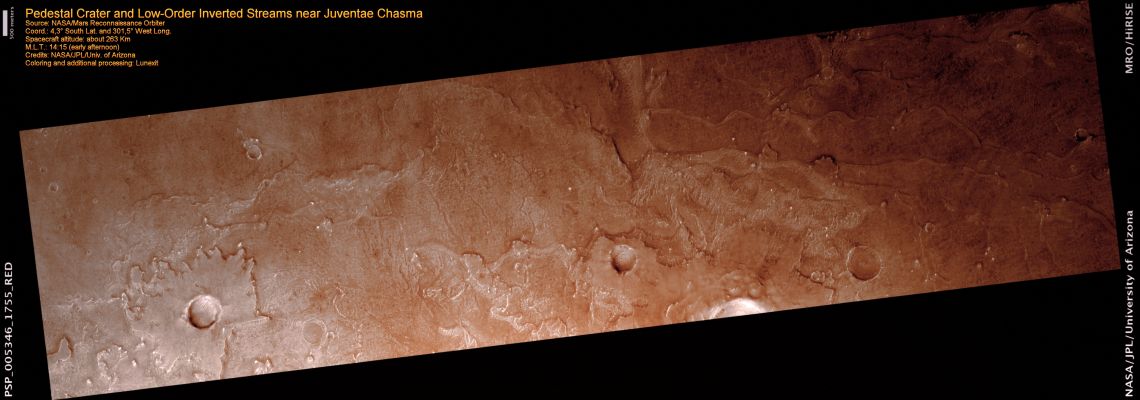
Low-Order Inverted Streams near Juventae Chasma  (context frame - elab. Lunexit)
This image shows plains North-West of Juventae Chasma, one of the Martian canyons that are part of the equatorial Valles Marineris System. The two most noticeable features in this scene are craters on mesas (plateaux) and raised, winding ridges. The raised ridges are "Inverted Channels". It is likely that liquid water, either pure or salt water, flowed through these channels. The channels are raised because streams transport sediment as they flow, deposit the heavier sediment on the stream floor, and, eventually fill in once their water supply dwindles. Over time, wind erosion modifies a landscape, and this has played an important role on these plains. It eroded the land around the channels leaving the remnant channels exposed and standing high. The channels did not erode as much since they were more resistant, possibly because the deposited sediment had cemented together. 
The craters on mesas are also evidence of active wind erosion: when craters form, they eject material out onto the surrounding landscape.
It appears that several of the craters’ ejecta visible here cemented, making the ejecta more resistant to erosion and leaving them standing high as craters on plateaux.
Parole chiave: Mars from orbit - Juventae Chasma

Low-Order Inverted Streams near Juventae Chasma (context frame - elab. Lunexit)

This image shows plains North-West of Juventae Chasma, one of the Martian canyons that are part of the equatorial Valles Marineris System. The two most noticeable features in this scene are craters on mesas (plateaux) and raised, winding ridges. The raised ridges are "Inverted Channels". It is likely that liquid water, either pure or salt water, flowed through these channels. The channels are raised because streams transport sediment as they flow, deposit the heavier sediment on the stream floor, and, eventually fill in once their water supply dwindles. Over time, wind erosion modifies a landscape, and this has played an important role on these plains. It eroded the land around the channels leaving the remnant channels exposed and standing high. The channels did not erode as much since they were more resistant, possibly because the deposited sediment had cemented together.
The craters on mesas are also evidence of active wind erosion: when craters form, they eject material out onto the surrounding landscape.
It appears that several of the craters’ ejecta visible here cemented, making the ejecta more resistant to erosion and leaving them standing high as craters on plateaux.

PSP_005343_2170_RED_abrowse-00~0.jpg PSP_005343_2170_RED_abrowse-01.jpg PSP_005346_1755_RED_abrowse-00.jpg PSP_005346_1755_RED_abrowse-01.jpg PSP_005349_0930_RED_abrowse-0.jpg
Informazioni sul file
Nome del file:PSP_005346_1755_RED_abrowse-00.jpg
Nome album:MareKromium / Mars Reconnaissance Orbiter (MRO)
Valutazione (4 voti):55555(Mostra dettagli)
Parole chiave:Mars / from / orbit / - / Juventae / Chasma
Copyright:NASA/JPL/University of Arizona e Lunar Explorer Italia per l'ingrandimento, l'elaborazione addizionale e la colorizzazione del frame
Dimensione del file:1328 KiB
Data di inserimento:Ott 25, 2007
Dimensioni:6001 x 2105 pixels
Visualizzato:56 volte
URL:https://www.lunexit.it/gallery/displayimage.php?pid=18475
Preferiti:Aggiungi ai preferiti


Powered by Coppermine Photo Gallery