|
|
On the Northern Slope of Arsia Mons: candidate Cavern Entrance (Annie)
|
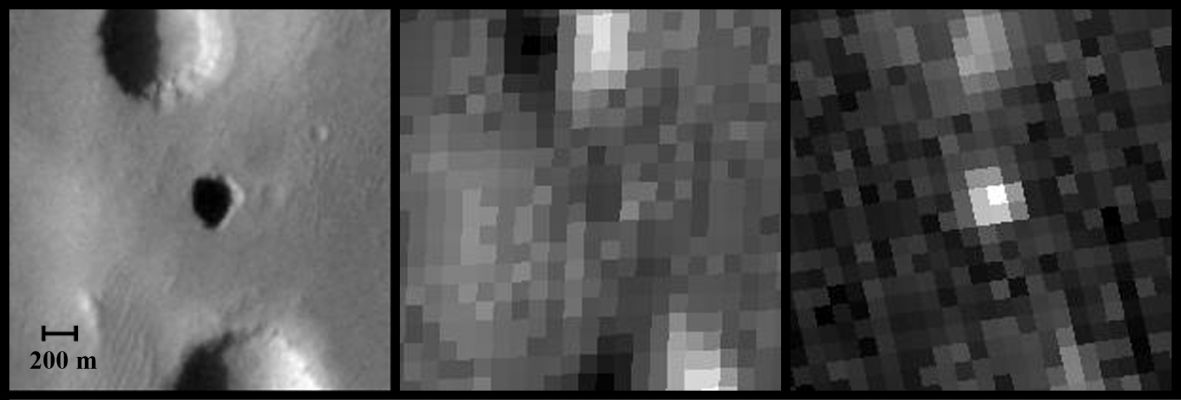
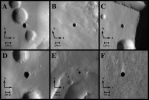
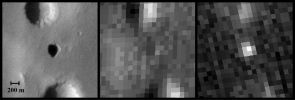
Caption NASA:"Each of the 3 images in this set covers the same patch of Martian Ground, centered on a possible cave skylight informally called "Annie" which has a diameter about double the length of a football field. The THEMIS camera on NASA's Mars Odyssey orbiter took all 3, gathering information that the hole is cooler than surrounding surface in the afternoon and warmer than the surrounding surface at night. This is thermal behavior that would be expected from an opening into an underground space.
The left image was taken in visible-wavelength light (fig. 1). The other 2 were taken in Thermal Infrared Wavelengths, indicating the relative temperatures of features in the image. The center image is from mid-afternoon. The hole is warmer than the shadows of nearby pits to the North and South, while cooler than sunlit surfaces. The thermal image at right was taken in the pre-dawn morning, about 4 M.L.T. .
At that hour, the hole is warmer than all nearby surfaces".
Nota Lunexit: ovviamente non era necessario nè uno scienziato nè un veggente per anticipare le mosse (di buon senso) della NASA, ma il fatto che i Tecnici di Pasadena abbiano effettivamente operato non solo delle riprese notturne di questa interessante Surface Feature, ma anche dei rilievi IR - come da noi suggerito ed anticipato, sebbene a proposito di un'altra (e forse più famosa) Candidate Cavern Entrance - ci ha dato, onestamente, una notevole soddisfazione!
|
|












La NASA, giustamente pragmatica, dice che questo fenomeno avviene perchè l'ambiente sottostante al "buco", nelle ore di Sole, accumula calore il quale viene poi rilasciato - lentamente - nelle ore in cui il Sole non c'è più (e cioè, in larga prevalenza, durante la notte).
Nelle ore di Sole, invece, mentre la superficie che circonda il "buco" si scalda e riflette (o, se preferisci, rilascia e disperde) gran parte dell'Energia Termica che riceve, l'ambiente sotterraneo - tramite il "buco" - si limita ad accumulare questa Energia, senza rifletterne (o, meglio, riflettendone e disperdendone un quantitativo esiguo, ai limiti dell'infinitesimale).
E' per questo motivo che, di pomeriggio - e, deduco, sin dal levar del Sole -, il "buco" appare (anzi: è) più freddo dell'ambiente che lo circonda.
Con questi dati alla mano, la conclusione NASA è ineccepibile.
Ma io, che sono pure pragmatico - ma un pò più immaginifico (e meno "fifone") degli Amici di Pasadena - dico che il fenomeno dell'emissione termica in oggetto, laddove studiata ed analizzata con maggiore cura ed attenzione, potrebbe anche avere un'altra causa.
Quale? Quella che sia il "buco" ad emettere calore proprio, senza limitarsi a rilasciare il calore (di sorgente esterna) accumulato. Tutto qui.
Certo: se così fosse, il "buco" (rectius: l'ambiente sotterraneo) dovrebbe essere COSTANTEMENTE più caldo dell'ambiente circostante, il che non è (dati NASA alla mano). Ma io - assumendomi le responsabilità derivanti da questa posizione - non riesco quasi mai a credere al 100% alla bontà e completezza assolute dei dati e delle info NASA.
Concludendo: se i dati NASA sono corretti, allora la spiegazione NASA è ineccepibile ed è anche l'unica valida; se invece detti dati NON fossero (interamente) corretti, allora...
Un abbraccio! PCF