Inizio Registrati Login

Elenco album Ultimi arrivi Ultimi commenti Più viste Più votate Preferiti Cerca

Inizio > MARS > Mars Reconnaissance Orbiter (MRO)
Ritorna alla pagina delle miniature FILE 1366/2237 Torna all'inizio Guarda foto precedente Guarda foto successiva Salta alla fine
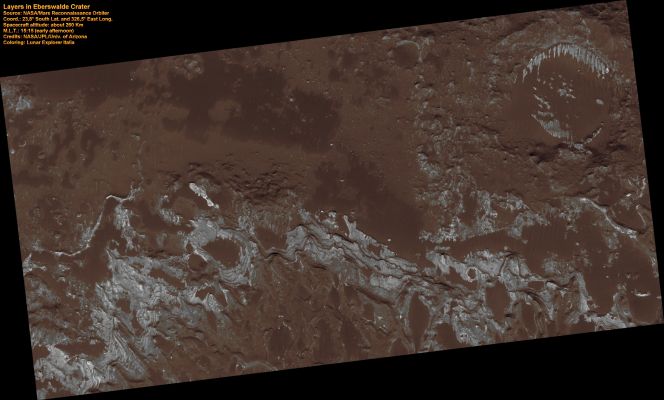
Layers in Eberswalde Crater
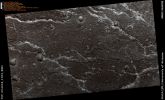
This image covers a portion of Eberswalde Crater, revealing a possible delta-lake transition. Water flowed into the crater through a series of tributary channels to the west of the crater and after the water entered, it formed a distributive network and partly filled the crater to form a lake (Eberswalde Crater is approx. 70 Km wide and 1,2 Km deep). 

The bright layers are part of the terminal scarp at the eastern edge of the delta. Some of the steeper slopes visible at the edge of the fan may be coarser-grained resistant channel ridges. The CRISM instrument on board the Mars Reconnaissance Orbiter has detected phyllosilicates (clays) in the bright layers. One of the ways clays form on Earth is when water erodes rock and makes fine particles which settle out of water; this often occurs in river deltas and lake beds. 
The delta in Eberswalde Crater and the detection of phyllosilicates provides evidence for possible persistent aqueous activity on Mars.
Parole chiave: Mars from orbit - Craters - Eberswalde Crater

Layers in Eberswalde Crater

This image covers a portion of Eberswalde Crater, revealing a possible delta-lake transition. Water flowed into the crater through a series of tributary channels to the west of the crater and after the water entered, it formed a distributive network and partly filled the crater to form a lake (Eberswalde Crater is approx. 70 Km wide and 1,2 Km deep).

The bright layers are part of the terminal scarp at the eastern edge of the delta. Some of the steeper slopes visible at the edge of the fan may be coarser-grained resistant channel ridges. The CRISM instrument on board the Mars Reconnaissance Orbiter has detected phyllosilicates (clays) in the bright layers. One of the ways clays form on Earth is when water erodes rock and makes fine particles which settle out of water; this often occurs in river deltas and lake beds.
The delta in Eberswalde Crater and the detection of phyllosilicates provides evidence for possible persistent aqueous activity on Mars.

PSP_004000_0945_RED_abrowse-01.jpg PSP_004000_0945_RED_browse~0.jpg PSP_004000_1560_RED_browse.jpg PSP_004006_1900_RED_abrowse-PCF-LXTT.jpg PSP_004018_1505_RED_abrowse.jpg
Informazioni sul file
Nome del file:PSP_004000_1560_RED_browse.jpg
Nome album:MareKromium / Mars Reconnaissance Orbiter (MRO)
Valutazione (8 voti):55555(Mostra dettagli)
Parole chiave:Mars / from / orbit / - / Craters / - / Eberswalde / Crater
Copyright:NASA/JPL/University of Arizona e Lunar Explorer Italia per l'ingrandimento, la pulizia digitale e la colorizzazione del frame
Dimensione del file:1303 KiB
Data di inserimento:Ago 02, 2007
Dimensioni:4980 x 3000 pixels
Visualizzato:58 volte
URL:https://www.lunexit.it/gallery/displayimage.php?pid=17653
Preferiti:Aggiungi ai preferiti


Powered by Coppermine Photo Gallery