Inizio Registrati Login

Elenco album Ultimi arrivi Ultimi commenti Più viste Più votate Preferiti Cerca

Inizio > MARS > Mars Reconnaissance Orbiter (MRO)
Ritorna alla pagina delle miniature FILE 1309/2237 Torna all'inizio Guarda foto precedente Guarda foto successiva Salta alla fine
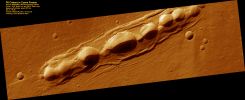
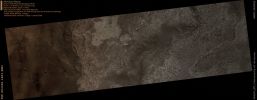
Pit Craters (or Collapse Pits) in Cyane Fossae
This image shows several pits along the floor of Cyane Fossae, a set of fissures between the giant volcanoes of Olympus Mons and Alba Patera (North-East of Olympus Mons). 
The fissures probably formed when the surface of the Planet was actively being stretched from the stresses of volcanic activity, causing the surface to split open along faults. There is no material piled up around the edges of the pits, as would be expected if these were impact craters or volcanic vents. Instead, parts of the Fossae floor likely collapsed into the void underlying Cyane Fossae, forming the pits. 
This type of process, in which the crust is split open, has occurred here on Earth, and it created the geologic "basin and range" province of the western United States. 
The walls of the pits are likely covered in dust and the few dark streaks along the walls are likely formed by avalanches of dust. Striations along the slope may be produced by the passage of DDs. 
Dust also appears on the floors of the collapse pits and covered most of the plains nearby. Despite the presence of this layer of dust, bouldery outcrops occur in places along the wall, suggesting that the underlying material is hard and rocky. 

Parole chiave: Mars from orbit - Collapse Pits

Pit Craters (or Collapse Pits) in Cyane Fossae

This image shows several pits along the floor of Cyane Fossae, a set of fissures between the giant volcanoes of Olympus Mons and Alba Patera (North-East of Olympus Mons).
The fissures probably formed when the surface of the Planet was actively being stretched from the stresses of volcanic activity, causing the surface to split open along faults. There is no material piled up around the edges of the pits, as would be expected if these were impact craters or volcanic vents. Instead, parts of the Fossae floor likely collapsed into the void underlying Cyane Fossae, forming the pits.
This type of process, in which the crust is split open, has occurred here on Earth, and it created the geologic "basin and range" province of the western United States.
The walls of the pits are likely covered in dust and the few dark streaks along the walls are likely formed by avalanches of dust. Striations along the slope may be produced by the passage of DDs.
Dust also appears on the floors of the collapse pits and covered most of the plains nearby. Despite the presence of this layer of dust, bouldery outcrops occur in places along the wall, suggesting that the underlying material is hard and rocky.

PSP_003326_1800_RED_browse.jpg PSP_003368_1755_RED_browse.jpg PSP_003370_2140_RED_browse.jpg PSP_003379_1835_RED_abrowse.jpg PSP_003392_1825_RED_abrowse.jpg
Informazioni sul file
Nome del file:PSP_003370_2140_RED_browse.jpg
Nome album:MareKromium / Mars Reconnaissance Orbiter (MRO)
Valutazione (2 voti):55555(Mostra dettagli)
Parole chiave:Mars / from / orbit / - / Collapse / Pits
Copyright:NASA/JPL/University of Arizona e Lunar Explorer Italia per la colorizzazione del frame
Dimensione del file:987 KiB
Data di inserimento:Lug 06, 2007
Dimensioni:5027 x 2048 pixels
Visualizzato:64 volte
URL:https://www.lunexit.it/gallery/displayimage.php?pid=17374
Preferiti:Aggiungi ai preferiti


Powered by Coppermine Photo Gallery