Inizio Registrati Login

Elenco album Ultimi arrivi Ultimi commenti Più viste Più votate Preferiti Cerca

Inizio > MARS > Mars Reconnaissance Orbiter (MRO)
Ritorna alla pagina delle miniature FILE 2228/2237 Torna all'inizio Guarda foto precedente Guarda foto successiva Salta alla fine
Seasonal frost in Terra Sirenum (according to NASA)
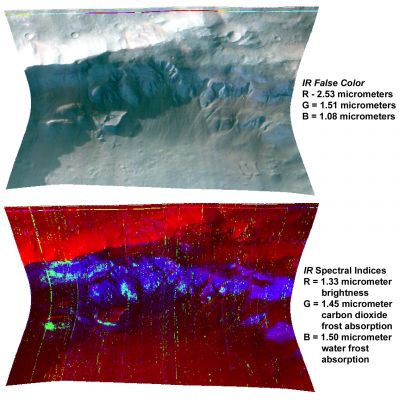
Caption NASA originale:"This image of the Terra Sirenum Region of Mars was taken by the Compact Reconnaissance Imaging Spectrometer for Mars (CRISM) at 09:18 UTC (4:18 a.m. EST) on Nov. 25, 2006, near 38,9° South Lat. and 195,9° East Long. CRISM's image was taken in 544 colors covering 0,36-3,92 micrometers and shows features as small as 18 mt (60 feet) across. 
At this time, Mars' Southern Hemisphere was experiencing mid-Winter. During Martian Southern Winter, the Southern Polar Cap is covered and surrounded by CO2 frost and water frost. This is unlike Earth, whose frozen Winter precipitation is made up of only one volatile -- water. The CO2 frost evaporates, or sublimates, at a lower temperature than water frost. So, during Spring, the CO2 ice evaporates first and leaves a residue of water frost, which later sublimates as well.

The image shown here covers part of a crater rim, which is illuminated from the upper left. North is at the top.

The topography creates a cold microenvironment on the South side of the rim that is partially protected from solar illumination. That cold surface contains an outlier of the southern seasonal frost about 15° of Lat. closer to the Equator than the average edge of the frost at this season. 
The top image was constructed from 3 infrared wavelengths that highlight the bluer color of frost than the background rock and soil. Note that the frost occurs both on sunlit and shaded surfaces on the south side of the rim. The shaded areas are still visible because they are illuminated indirectly by the Martian Sky. 
The bottom image was constructed by measuring the depths of spectral absorption bands due to water frost and CO2 frost and displaying the results in image form. Blue shows strength of an absorption due to water frost near 1,50 mmts and green shows strength of an absorption due to CO2 frost near 1,45 mmts. Red shows brightness of the surface at 1,33 micrometers -- outside of the frost absorption bands -- in order to show the relationship of frost to the illuminated crater rim.
In comparing the top and bottom images, note that water frost occurs in many locations on the south-facing side of the crater rim, both in sunlit and shaded areas. Because it faces away from the Sun, this side of the crater rim is colder than the north, Sun-facing side. 
This favors the formation of frost. In contrast, CO2 frost occurs only in the coldest, most shaded areas".
Parole chiave: Mars from orbit - Terra Sirenum

Seasonal frost in Terra Sirenum (according to NASA)

Caption NASA originale:"This image of the Terra Sirenum Region of Mars was taken by the Compact Reconnaissance Imaging Spectrometer for Mars (CRISM) at 09:18 UTC (4:18 a.m. EST) on Nov. 25, 2006, near 38,9° South Lat. and 195,9° East Long. CRISM's image was taken in 544 colors covering 0,36-3,92 micrometers and shows features as small as 18 mt (60 feet) across.
At this time, Mars' Southern Hemisphere was experiencing mid-Winter. During Martian Southern Winter, the Southern Polar Cap is covered and surrounded by CO2 frost and water frost. This is unlike Earth, whose frozen Winter precipitation is made up of only one volatile -- water. The CO2 frost evaporates, or sublimates, at a lower temperature than water frost. So, during Spring, the CO2 ice evaporates first and leaves a residue of water frost, which later sublimates as well.

The image shown here covers part of a crater rim, which is illuminated from the upper left. North is at the top.

The topography creates a cold microenvironment on the South side of the rim that is partially protected from solar illumination. That cold surface contains an outlier of the southern seasonal frost about 15° of Lat. closer to the Equator than the average edge of the frost at this season.
The top image was constructed from 3 infrared wavelengths that highlight the bluer color of frost than the background rock and soil. Note that the frost occurs both on sunlit and shaded surfaces on the south side of the rim. The shaded areas are still visible because they are illuminated indirectly by the Martian Sky.
The bottom image was constructed by measuring the depths of spectral absorption bands due to water frost and CO2 frost and displaying the results in image form. Blue shows strength of an absorption due to water frost near 1,50 mmts and green shows strength of an absorption due to CO2 frost near 1,45 mmts. Red shows brightness of the surface at 1,33 micrometers -- outside of the frost absorption bands -- in order to show the relationship of frost to the illuminated crater rim.
In comparing the top and bottom images, note that water frost occurs in many locations on the south-facing side of the crater rim, both in sunlit and shaded areas. Because it faces away from the Sun, this side of the crater rim is colder than the north, Sun-facing side.
This favors the formation of frost. In contrast, CO2 frost occurs only in the coldest, most shaded areas".

TRA_000878_1410_RGB.jpg Terra_Sirenum-PIA09101-01.jpg Terra_Sirenum-PIA09101.jpg Valles_Marineris-MRO-PCF-LXTT.jpg Vastitas_Borealis-DD-PIA12876.jpg
Informazioni sul file
Nome del file:Terra_Sirenum-PIA09101.jpg
Nome album:MareKromium / Mars Reconnaissance Orbiter (MRO)
Valutazione (3 voti):55555(Mostra dettagli)
Parole chiave:Mars / from / orbit / - / Terra / Sirenum
Copyright:NASA - Mars Reconnaissance Orbiter
Dimensione del file:358 KiB
Data di inserimento:Dic 24, 2006
Dimensioni:1728 x 1728 pixels
Visualizzato:58 volte
URL:https://www.lunexit.it/gallery/displayimage.php?pid=15389
Preferiti:Aggiungi ai preferiti


Powered by Coppermine Photo Gallery