Inizio Registrati Login

Elenco album Ultimi arrivi Ultimi commenti Più viste Più votate Preferiti Cerca

Inizio > MARS > Mars Reconnaissance Orbiter (MRO)
Ritorna alla pagina delle miniature FILE 2204/2237 Torna all'inizio Guarda foto precedente Guarda foto successiva Salta alla fine
Fault of Jus
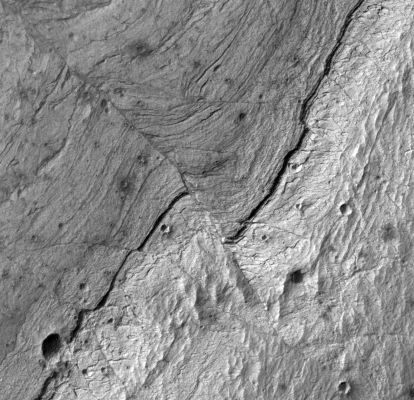
The sharpness and quality of HiRISE images allows geologists to work out the detailed geometry and sequence of events that have shaped the landscape. For example, this area shows exposures of light- and dark-toned layers of rock that have been faulted and folded. These rocks formed out of sedimentary deposits that originally accumulated in thick horizontal sequences, like a layer cake.

These layers have since been tilted on-end and eroded, exposing the sequence of layers that we now see at the surface. A prominent dark layer extends through the center of the scene from the upper right to the lower left of the image. This dark layer is discontinuous and offset along a fault.

The thin grey zone that extends from the upper left to the lower right of the image delineates the fault plane. This fault was originally a thrust, or compressional fault, that formed prior to the aforementioned tilting event. Tilting of this fault and the surrounding rock reveals a series of drag folds adjacent to the fault plane. These drag folds formed as the layered rock bent in response to friction along the fault plane as the thrust fault formed, prior to the tilting event. This fault offsets the dark layer by a maximum of 70-75 m. Smaller secondary folds and faults are also visible in this scene. The smallest resolved fault offset of an individual rock layer is 1-1.5 m. Also visible in this image are numerous small 4-10-m-diameter impact craters that are surrounded by ejecta of meter-scale boulders.

Parole chiave: Mars from orbit - Faults and cracks

Fault of Jus

The sharpness and quality of HiRISE images allows geologists to work out the detailed geometry and sequence of events that have shaped the landscape. For example, this area shows exposures of light- and dark-toned layers of rock that have been faulted and folded. These rocks formed out of sedimentary deposits that originally accumulated in thick horizontal sequences, like a layer cake.

These layers have since been tilted on-end and eroded, exposing the sequence of layers that we now see at the surface. A prominent dark layer extends through the center of the scene from the upper right to the lower left of the image. This dark layer is discontinuous and offset along a fault.

The thin grey zone that extends from the upper left to the lower right of the image delineates the fault plane. This fault was originally a thrust, or compressional fault, that formed prior to the aforementioned tilting event. Tilting of this fault and the surrounding rock reveals a series of drag folds adjacent to the fault plane. These drag folds formed as the layered rock bent in response to friction along the fault plane as the thrust fault formed, prior to the tilting event. This fault offsets the dark layer by a maximum of 70-75 m. Smaller secondary folds and faults are also visible in this scene. The smallest resolved fault offset of an individual rock layer is 1-1.5 m. Also visible in this image are numerous small 4-10-m-diameter impact craters that are surrounded by ejecta of meter-scale boulders.

T-TRA_000866_1420_RED.jpg T-TRA_000866_1420_RED.jpg TRA_000823_1720_RED_fault.jpg TRA_000823_1720_RED_fault.jpg TRA_000825_2665_IRB-00.jpg
Informazioni sul file
Nome del file:TRA_000823_1720_RED_fault.jpg
Nome album:Mars Reconnaissance Orbiter (MRO)
Valutazione (3 voti):55555(Mostra dettagli)
Parole chiave:Mars / from / orbit / - / Faults / and / cracks
Copyright:NASA - Mars Reconnaissance Orbiter
Dimensione del file:807 KiB
Data di inserimento:Ott 18, 2006
Dimensioni:1942 x 1872 pixels
Visualizzato:53 volte
URL:https://www.lunexit.it/gallery/displayimage.php?pid=13323
Preferiti:Aggiungi ai preferiti


Powered by Coppermine Photo Gallery