|
|
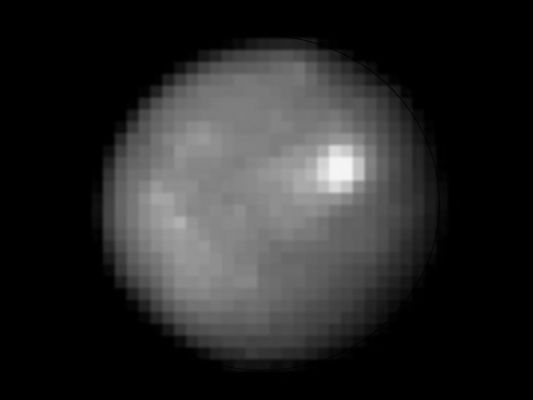
1-Ceres from Hubble Space Telescope
|
NASA's Hubble Space Telescope took these images of the asteroid 1 Ceres over a 2-hour and 20-minute span, the time it takes the Texas-sized object to complete one quarter of a rotation. One day on Ceres lasts 9 hours.
Hubble snapped 267 images of Ceres as it watched the asteroid make more than one rotation. By observing the asteroid during a full rotation, astronomers confirmed that Ceres has a nearly round body like Earth's. Ceres' shape suggests that its interior is layered like those of terrestrial planets such as Earth. Ceres may have a rocky inner core, an icy mantle, and a thim, dusty, outer crust.
The "Bright Spot" that we see is a mistery: it is (obviously) brighter than its surroundings, but it is still very dark (very low albedo) reflecting only a small portion of Sunlight.
|
|







Immagino che l'interesse per questo "sasso vagante" sia dovuto proprio a questo tipodi formazioni che lo rendono simile ad un paneta. Sbaglio?
Ma io fondo, se così fosse, perchè un qualsiasi corpo vagante con appena due rilievi dovrebbe essere interessante?
Trovo difficile pensare e credere che vi siano corpi rocciosi senza catene montuose
Questo potrebbe spazzare via quasi tutte le toerie sulla formazione del sistema solare se così fosse?
E se la vota fosse stata presente già 4.4 miliardi di anni fa, potrebeb enahc essere che in questi miliardi di anni, la vita, in tutte le sue forme potrebe essersi azzerata riniziando altre centianai di volte. O sbaglio?
Non solo per uno sviluppo tencologico che ci possa consentire ricerche sul luogo, partendo da mezzi che possano portarci in poco tempo (o tempo ragionevole) a destinazione, ma avere la strumentazione necessaria per capire cosa stiamo studiando e verificando e ultimo, ma non ultimo, anzi al primo posto, avere delle Coscienze evolute, libere da dogmi, poteri monetari, poteri religosi o di qualsisia altro tipo che possano ostacolare una sana e costruttiva ricerca.