Inizio Registrati Login

Elenco album Ultimi arrivi Ultimi commenti Più viste Più votate Preferiti Cerca

Inizio > SOLAR SYSTEM > Neptune and His Moons
Ritorna alla pagina delle miniature FILE 66/96 Torna all'inizio Guarda foto precedente Guarda foto successiva Salta alla fine
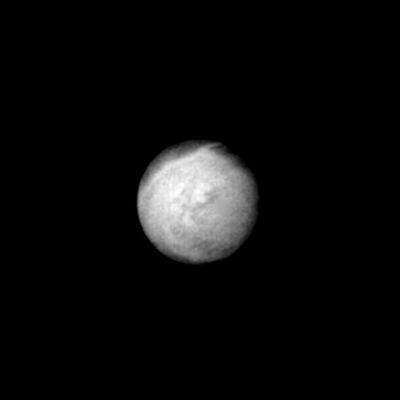
Strange "surface features" on Triton (clouds?!?)
Caption NASA originale"Already intriguing patterns of unknown origin appear on the surface of Neptune's largest satellite, Triton, in this image returned by Voyager 2. The image was taken Aug. 22, 1989, from a distance of about 4 MKM (approx. 2.5 MMs). Voyager images show that Triton's diameter is about 2.720 Km (approx. 1.690 miles) and that it is one of the brightest objects in the Solar System, reflecting about 70% of the sunlight that strikes it. This is the Hemisphere of Triton that always faces away from Neptune. The South Pole is near the bottom of the image. Triton's rotation axis is tilted so that the latitude at the center of the disk is 55° South. Dark regions at the top of the disk extend from roughly the equator to beyond 20° North. The margin between the bright and dark regions varies with longitude around the satellite. The gray, featureless area just to the right of the center of the disk is due to a reseau (reticule mark) in the camera".
Parole chiave: Neptune's Moons - Triton

Strange "surface features" on Triton (clouds?!?)

Caption NASA originale"Already intriguing patterns of unknown origin appear on the surface of Neptune's largest satellite, Triton, in this image returned by Voyager 2. The image was taken Aug. 22, 1989, from a distance of about 4 MKM (approx. 2.5 MMs). Voyager images show that Triton's diameter is about 2.720 Km (approx. 1.690 miles) and that it is one of the brightest objects in the Solar System, reflecting about 70% of the sunlight that strikes it. This is the Hemisphere of Triton that always faces away from Neptune. The South Pole is near the bottom of the image. Triton's rotation axis is tilted so that the latitude at the center of the disk is 55° South. Dark regions at the top of the disk extend from roughly the equator to beyond 20° North. The margin between the bright and dark regions varies with longitude around the satellite. The gray, featureless area just to the right of the center of the disk is due to a reseau (reticule mark) in the camera".

Triton-PIA01537_modest.jpg Triton-PIA01538_modest.jpg Triton-PIA01994.jpg Triton-PIA02212_modest.jpg Triton-PIA02213-moe-ELEI.jpg
Informazioni sul file
Nome del file:Triton-PIA01994.jpg
Nome album:Neptune and His Moons
Valutazione (2 voti):55555(Mostra dettagli)
Parole chiave:Neptune's / Moons / - / Triton
Copyright:NASA - Voyager 2 Project
Dimensione del file:11 KiB
Data di inserimento:Lug 05, 2006
Dimensioni:795 x 795 pixels
Visualizzato:56 volte
URL:https://www.lunexit.it/gallery/displayimage.php?pid=11643
Preferiti:Aggiungi ai preferiti


Powered by Coppermine Photo Gallery