Inizio Registrati Login

Elenco album Ultimi arrivi Ultimi commenti Più viste Più votate Preferiti Cerca

Inizio > SOLAR SYSTEM > Saturn: the "Ringed Beauty" and His Moons
Ritorna alla pagina delle miniature FILE 2064/2245 Torna all'inizio Guarda foto precedente Guarda foto successiva Salta alla fine
The "E-Ring" of Saturn: the "Enceladus Ring" (2)
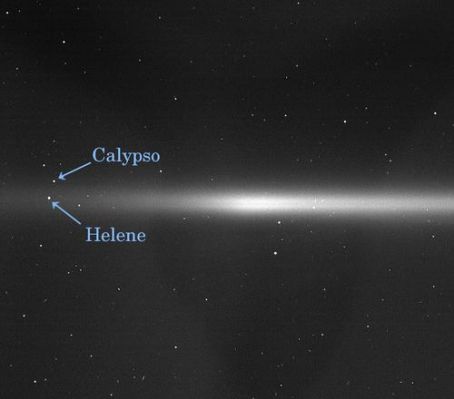
This appearance implies that the particles in this part of the Ring have nonzero inclinations (a similar affect is seen in Jupiter's Gossamer Ring). An object with a nonzero inclination does not orbit exactly at Saturn¿s Ring-Plane: its orbit takes it above and below it. Scientists are not entirely sure why the particles should have such inclinations, but they are fairly certain that the reason involves Enceladus. One possible explanation is that all the E-Ring particles come from the plume of icy material that is shooting due South out of the moon's Pole. 
This means all of the particles are created with a certain velocity out of the Ring-Plane, and then they orbit above and below that plane. 
Another possible explanation is that Enceladus produces particles with a range of speeds, but the moon gravitationally scatters any particles that lie very close to the Ring-Plane, giving them nonzero inclinations. Stray light within the camera system is responsible for the broad, faint "Y" shape across the image.

The image was taken in visible light with the Cassini spacecraft wide-angle camera on March 15, 2006, at a distance of approximately 2.4 million kilometers (1.5 million miles) from Saturn. The image scale on the sky at the distance of Saturn is 142 kilometers (88 miles) per pixel. 


Parole chiave: Saturn's Rings - the E-Ring

The "E-Ring" of Saturn: the "Enceladus Ring" (2)

This appearance implies that the particles in this part of the Ring have nonzero inclinations (a similar affect is seen in Jupiter's Gossamer Ring). An object with a nonzero inclination does not orbit exactly at Saturn¿s Ring-Plane: its orbit takes it above and below it. Scientists are not entirely sure why the particles should have such inclinations, but they are fairly certain that the reason involves Enceladus. One possible explanation is that all the E-Ring particles come from the plume of icy material that is shooting due South out of the moon's Pole.
This means all of the particles are created with a certain velocity out of the Ring-Plane, and then they orbit above and below that plane.
Another possible explanation is that Enceladus produces particles with a range of speeds, but the moon gravitationally scatters any particles that lie very close to the Ring-Plane, giving them nonzero inclinations. Stray light within the camera system is responsible for the broad, faint "Y" shape across the image.

The image was taken in visible light with the Cassini spacecraft wide-angle camera on March 15, 2006, at a distance of approximately 2.4 million kilometers (1.5 million miles) from Saturn. The image scale on the sky at the distance of Saturn is 142 kilometers (88 miles) per pixel.

The Rings-PIA08129.jpg The Rings-PIA08163-1.jpg The Rings-PIA08163-2.jpg The Rings-PIA08243.jpg The Rings-PIA08247.jpg
Informazioni sul file
Nome del file:The Rings-PIA08163-2.jpg
Nome album:Saturn: the "Ringed Beauty" and His Moons
Valutazione (4 voti):55555(Mostra dettagli)
Parole chiave:Saturn's / Rings / - / the / E-Ring
Copyright:NASA - Cassini Mission
Dimensione del file:15 KiB
Data di inserimento:Apr 26, 2006
Dimensioni:500 x 440 pixels
Visualizzato:55 volte
URL:https://www.lunexit.it/gallery/displayimage.php?pid=10771
Preferiti:Aggiungi ai preferiti


Powered by Coppermine Photo Gallery