Inizio Registrati Login

Elenco album Ultimi arrivi Ultimi commenti Più viste Più votate Preferiti Cerca

Inizio > MARS > Mars Reconnaissance Orbiter (MRO)
Ritorna alla pagina delle miniature FILE 2151/2237 Torna all'inizio Guarda foto precedente Guarda foto successiva Salta alla fine
Mars' Atmosphere
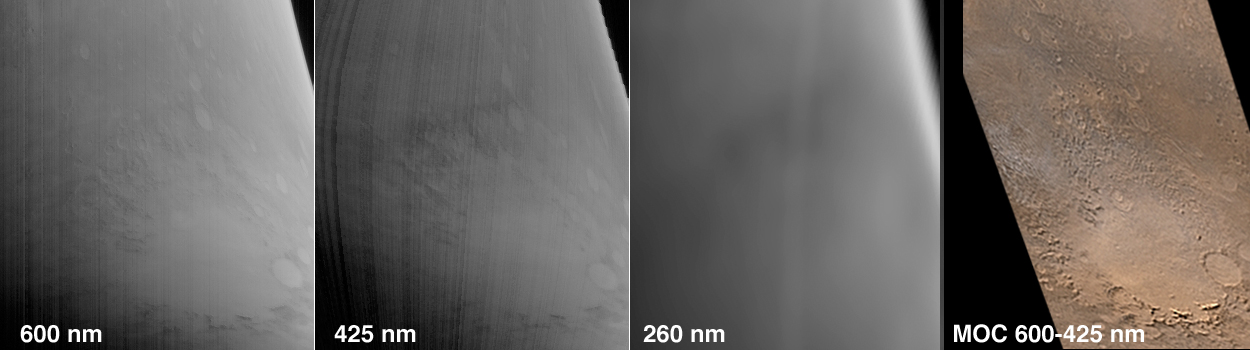
As part of the checkout of the Mars Reconnaissance Orbiter (MRO) payload after the 10 March 2006 orbit insertion, the Mars Color Imager (MARCI) acquired a seven band color wide angle view of Mars on 24 March 2006. Illustrated here are some of these test images. Note that the linear banding seen in these images are artifacts resulting from incomplete removal of the detector pixel to pixel variations. Such deviations from ground testing calibration are an important reason for taking checkout images.

In the first figure (MARCI2-2a), three views acquired by MRO MARCI are compared to a color composite of two views acquired about 4 hours later by the Mars Global Surveyor (MGS) Mars Orbiter Camera (MOC). MRO imaging occurred during the early morning on Mars, while the MGS observations were made at around 2 PM local solar time. The region of Mars imaged by MRO on this day was south of the Valles Marineris and includes the large Argyre Basin, its interior plains, Argyre Planitia, and the mountains that comprise the basin rim, Nereidum Montes to the northwest (middle of images) and Charitum Montes to the southeast (bottom of images).

The ultraviolet (UV) image (260 nm in MARCI2-2a) shows how the planet appears in an ozone absorption band. Relatively darker areas in this band normally will indicate the presence of ozone, and relatively lighter areas will indicate the absence of ozone. Water vapor on Mars is anticorrelated with ozone, meaning that lighter areas can be used to track water vapor. The term "relatively" is used here because Mars itself is very dark in the UV owing to absorption of UV light by iron-bearing minerals, and sunlight is deficient in UV relative to visible light, so in general Mars will always look dark in the UV. A second UV band on MARCI (not shown in the figure above) at a longer wavelength allows these differences to be quantified. The MOC wide angle image shows wispy, light water-ice clouds to the northwest of Argyre in the afternoon, but we cannot as yet correlate these clouds with the UV information (especially because the times of day are different). When in its final mapping orbit, MRO will view the same area as MGS separated by only 1 hour, and such correlations will be much more direct.


Parole chiave: Mars Atmosphere

Mars' Atmosphere

As part of the checkout of the Mars Reconnaissance Orbiter (MRO) payload after the 10 March 2006 orbit insertion, the Mars Color Imager (MARCI) acquired a seven band color wide angle view of Mars on 24 March 2006. Illustrated here are some of these test images. Note that the linear banding seen in these images are artifacts resulting from incomplete removal of the detector pixel to pixel variations. Such deviations from ground testing calibration are an important reason for taking checkout images.

In the first figure (MARCI2-2a), three views acquired by MRO MARCI are compared to a color composite of two views acquired about 4 hours later by the Mars Global Surveyor (MGS) Mars Orbiter Camera (MOC). MRO imaging occurred during the early morning on Mars, while the MGS observations were made at around 2 PM local solar time. The region of Mars imaged by MRO on this day was south of the Valles Marineris and includes the large Argyre Basin, its interior plains, Argyre Planitia, and the mountains that comprise the basin rim, Nereidum Montes to the northwest (middle of images) and Charitum Montes to the southeast (bottom of images).

The ultraviolet (UV) image (260 nm in MARCI2-2a) shows how the planet appears in an ozone absorption band. Relatively darker areas in this band normally will indicate the presence of ozone, and relatively lighter areas will indicate the absence of ozone. Water vapor on Mars is anticorrelated with ozone, meaning that lighter areas can be used to track water vapor. The term "relatively" is used here because Mars itself is very dark in the UV owing to absorption of UV light by iron-bearing minerals, and sunlight is deficient in UV relative to visible light, so in general Mars will always look dark in the UV. A second UV band on MARCI (not shown in the figure above) at a longer wavelength allows these differences to be quantified. The MOC wide angle image shows wispy, light water-ice clouds to the northwest of Argyre in the afternoon, but we cannot as yet correlate these clouds with the UV information (especially because the times of day are different). When in its final mapping orbit, MRO will view the same area as MGS separated by only 1 hour, and such correlations will be much more direct.

Q-U-BosporusPlanum-PCF-LXTT4.jpg Q-V-Argyre Basin-PIA08067.jpg Q-V-Atmosphere.jpg Q-pia08014-01-AEB1-full-reduced1.jpg Q-pia08014-02-AEB1-full-reduced1.jpg
Informazioni sul file
Nome del file:Q-V-Atmosphere.jpg
Nome album:Mars Reconnaissance Orbiter (MRO)
Valutazione (6 voti):55555(Mostra dettagli)
Parole chiave:Mars / Atmosphere
Copyright:NASA - Mars Reconnaissance Orbiter (MRO)
Dimensione del file:236 KiB
Data di inserimento:Apr 14, 2006
Dimensioni:1250 x 350 pixels
Visualizzato:62 volte
URL:https://www.lunexit.it/gallery/displayimage.php?pid=10598
Preferiti:Aggiungi ai preferiti


Powered by Coppermine Photo Gallery