|
|
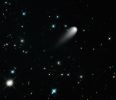
Comet ISON (Hubble Space Telescope's View)
|
Advanced amateur astronomers are already getting good images of Comet ISON, which currently shines at around +12th magnitude in the constellation Cancer. And although NASA’s Deep Impact/EPOXI mission is down for the count, plans are afoot for the Curiosity rover and the Mars Reconnaissance Orbiter to attempt imaging the comet when it makes its closest approach to the Red Planet on October 1st at 0.0724 Astronomical Units (A.U.) or 10,830,000 kilometres distant. If MSL is successful, it would be the first time that a comet has been observed from the surface of another world.
Currently, ISON sits about a magnitude below the projected light curve, (see below) but that isn’t all that unusual for a comet. Already, there’s been increasing talk of “ISON being a dud,” but as Universe Today’s Nancy Atkinson pointed out in a recent post, these assertions are still premature. The big question is what ISON will do leading up to perihelion, and if it will survive its passage 1.1 million kilometres above the surface of the Sun on November 28th to become a fine comet in the dawn skies in the weeks leading up to Christmas.
ISON is already starting to show a short, spikey tail in amateur images. Tsutomu Seki estimated it to be shining at about magnitude +11.1 on September 16th. Keep in mind, a caveat is in order when talking about the magnitudes of comets. Unlike stars, which are essentially a point source, the brightness of a comet is spread out over a large surface area. Thus, a comet may appear visually fainter than the quoted magnitude, much like a diffuse nebula. Although +6th magnitude is usually the limit for naked eye visibility, I’ll bet that most folks won’t pick up ISON with the unaided eye from typical suburban sites until it breaks +4th magnitude or so.
The forward scattering of light also plays a key role in the predicted brightness of a comet. The November issue of Astronomy Magazine has a great article on this phenomenon. It’s interesting to note that ISON stacks up as a “9” on their accumulated point scale, right at the lower threshold of comet “greatness,” versus a 15 for sungrazing Comet C/1965 S1 Ikeya-Seki. Another famous “9” was Comet C/1996 B2 Hyakutake, which passed 0.1018 A.U. or 15.8 million kilometres from Earth on March 25, 1996.
ISON will pass 0.429 A.U. or 64.2 million kilometres from Earth the day after Christmas. Bruce Willis can stay home for this one.
Here is a blow-by-blow breakdown of some key dates to watch for as ISON makes its plunge into the inner solar system:
-September 25th: ISON crosses the border from the astronomical constellation of Cancer into Leo.
-September 27th: ISON passes 2 degrees north of the planet Mars.
-October 1st: The 12% illuminated waning crescent Moon passes 10 degrees south of Mars & ISON.
-Early October: ISON may break +10th magnitude and become visible with binoculars or a small telescope.
-October 4th: New Moon occurs. The Moon then exits the dawn sky, making for two weeks of prime viewing.
-October 10th: ISON enters view of NASA’s STEREO/SECCHI HI-2A CAMERA:
-October 16th: ISON passes just 2 degrees NNE of the bright star Regulus, making a great “guidepost” to pin it down with binoculars.
-October 18th: The Full Moon occurs, after which the Moon enters the morning sky.
-October 26th: A great photo-op for astro-imagers occurs, as ISON passes within three degrees the Leo galaxy trio of M95, M96, & M105.
-October 30th: The 17% illuminated Moon passes 6 degrees south of ISON.
-Early November: Comet ISON may make its naked eye debut for observers based at dark sky sites.
-November 3rd: A hybrid (annular-total) solar eclipse occurs, spanning the Atlantic and Central Africa. It may just be possible for well placed observers to catch sight of ISON in the daytime during totality, depending on how quickly it brightens up. The Moon reaching New phase also means that the next two weeks will be prime view time for ISON at dawn.
-November 5th: ISON crosses the border from the astronomical constellation of Leo into Virgo.
-November 7th: ISON passes less than a degree from the +3.6 magnitude star Zavijava (Beta Virginis).
-November 8th: ISON passes through the equinoctial point in Virgo around 16:00 EDT/20:00 UT, passing into the southern celestial hemisphere and south of the ecliptic.
-November 14th: ISON passes less than a degree from the 10th magnitude galaxy NGC 4697.
-November 17th: The Moon reaches Full, passing into the morning sky.
-November 18th: ISON passes just 0.38 degrees north of the bright star Spica.
-November 22nd: ISON crosses into the astronomical constellation of Libra.
-November 23rd: ISON sits 4.7 degrees SSW of the planet Mercury and 4.9 SSW of Saturn, respectively.
-November 25th: ISON pays a visit to another famous comet, passing just 1.2 degrees south of short period comet 2P/Encke which may shine at +8th magnitude.
-November 27th: ISON enters the field of view of SOHO’s LASCO C3 coronagraph.
-November 28th: ISON reaches perihelion at ~18:00 PM EST/ 23:00 UT.
After that, all bets are off. The days leading up to perihelion will be tense ones, as ISON then rounds the Sun on a date with astronomical destiny. Will it join the ranks of the great comets of the past? Will it stay intact, or shatter in a spectacular fashion? Watch this space for ISON updates… we’ll be back in late November with our post-perihelion guide!
Be sure to also enjoy recently discovered Comet C/2013 R1 Lovejoy later the year.
(source: http://www.universetoday.com/104818/comet-ison-a-viewing-guide-from-now-to-perihelion/#ixzz2fpLTKJwD)
Read more: http://www.universetoday.com/104818/comet-ison-a-viewing-guide-from-now-to-perihelion/#ixzz2fpLG75us
|
|










Ma la notizia della Agenzia Spaziale Russa sugli aggiustamenti di orbita e oggetti sigariformi che le girano attorno?
Dai, dai pcf, dammi materiale per perle complottiste che c'ho ancora l'umore cupo ;)
1) influenze mareali (la Cometa sfiora un altro Corpo Celeste, molto più grande) e quindi devia dalla sua "corsa" originaria, eventualmente (NON necessariamente!) mutando orbita, oppure
2) un impatto (eventualità ultraremota, ma comunque possibile, conj un altro Corpo Celeste "ignoto", e non mappato.
C'è poi - se proprio vogliamo tirare i capelli alla Fisica, una terza possibilità: frammenazione del Corpo Celeste (la quale può avvenire per "n" motivi), contestuale perdita di momentum (o inerzia) e quindi aggiustamento di velocità e susseguente correzione di rotta (ricordate che la perdita di momentum, specie se sostanziale, rende un Corpo Celeste Errante MOLTO più sensibile alle influenze mareali esercitate dai Corpi Celesti Maggiori ai quali si avvicina.
Fuori da queste tre ipotesi, almeno alla luce della Fisica Moderna, non si può andare.
Corpi "Erranti" Anomali nelle sue prossimità? Si disse anche a proposito della MERAVIGLIOSA Hale-Bopp, che vidi a fuoco diretto attraverso potenti telescopi ed in fotografia. Cosa erano? Nessuno può saperlo, ma l'ipotesi più probabile è che si trattasse di frammenti della Cometa stessa i quali, catturati comunque dalla sua capacità attrattiva (Attrazione Gravitazionale), rimasero nei suoi pressi ed iniziarono a rivolvere attorno ad essa, così come fanno le Lune Minori attorno ad un Corpo Celeste Maggiore. Non si può obbiettare che la Cometa Hale-Bopp fosse troppo piccola e veloce per avere "compagni", perché esistono anche Asteroidi (relativamente) piccoli i quali hanno comunque "compagni" di corsa.
Le notizie che provengono dall'Agenzia Spaziale Russa, chissà perché, sono sempre "eclatanti", ma poi... si sciolgono come ghiaccio al Sole.
Domanda: si potrebbe trattare EFFETTIVAMENTE di Astronavi Aliene che la accompagnano? Certo che si! Vogliamo fare la stessa cosa anche noi, quando Halley ripasserà: e cioè "agganciarle" una Sonda ed inseguirla, sfruttando la sua velocità e capacità attrattiva, sino ai recessi del Sistema Solare.
Abbiamo prove che quello che si vede ora nei pressi di ISON siano effettivamente Astronavi e non semplici detriti? Zero.
Spero di aver risposto in maniera adeguata e quindi di essere riuscito ad evitare un "quote" su Perle Complottiste ... :-)
Un abbraccio a Tutti - paolo
Vedi Andrea, che si scatti una foto del cielo stellato da Terra, dall'HST o dalla Luna, la posizione relativa delle stelle rispetto all'Osservatore Terrestre NON cambia.
O meglio: Cambia! Ma in maniera impercettibile ed immisurabile!
La posizione (parallasse) delle stelle visibili rispetto all'Osservatore cambia, per assurdo (ma è VERO!), anche se, mentre osserviamo, per esempio, Cassiopea, facciamo un salto e la osserviamo al culmine del salto (spero di rendere l'idea).
La posizione dell'Osservatore, in verità (e non potrebbe essere altrimenti) INTERFERISCE sia con l'oggetto osservato (ergo con ed in funzione dellla sua posizione relativa rispetto ad esso) e sia, nel caso di oggetti multipli, con la posizione di ognuna delle sue componenti rispetto all'altra/alle altre.
Ma INTERFERIRE non implica la possibilità fisica di MISURARE l'interferenza (ivi: il cambio di prospettiva).
Il fatto che la posizione delle stelle rispetto ad un Punto Fisso (anche solo temporaneamente), cambi a seconda del luogo fisico dello scatto (Terra/Spazio Circumterrestre/Luna o anche Marte) e lo faccia in maniera percettibile/visivamente e tecnicamente misurabile, è una minchiata (e sorry per la scurrilità).
Ho visto tante immagini di Hale-Bopp (molte sono sulla Rete) in cui si vedono questi "punti" intorno ad essa che cambiano posizione da scatto a scatto, e la risposta non può che essere una: erano i "punti" a muoversi rispetto al target principale.
Fin qui, tutto ok: le stelle di "contorno" che cambiano non avevano né hanno rilevanza, perché Hale-Bopp si muoveva rapidissima nel cielo SOLO dal NOSTRO punto specifico di osservazione (e dunque il suo "sfondo", dal NOSTRO punto di vista, cambiava altrettanto rapidamente).
Ma ciò che rilevava e rileva, in realtà, non era né è lo "sfondo" di Hale-Bopp, bensì gli "oggetti prossimi" ad essa: e quelli, effettivamente, si muovevano!
Ma da qui a dire che si trattasse di Astronavi Aliene "al seguito" della Cometa...ecchecaxxo, ce ne passa!.
Il problema - scusatemi - è sempre lo stesso: l'INTERPRETAZIONE dei dati disponibili.
Questo vale per Hale-Bopp ed i suoi "accompagnatori" (veri o falsi che siano); vale per la Cometa ISON; vale per la "Sfinge di Cydonia" (se parliamo di eso-archeografia) et cetera.
Morale (parafrasando Max): il "complottista" interpreta i dati unilateralmente, in accordo ad un'unica "visione" (la sua) e pro domo propria. E ciò facendo, sbaglia.
Ma il "debunker", tuttavia, fa ESATTAMENTE la stessa cosa. E quindi sbaglia pure lui.
Il bello di questo Sito è che qui, "Complottisti" e "Debunkers" potrebbero parlarsi serenamente. Ed invece ciò non accade.
Peccato....
Ripeto non so se questa è la stessa notizia che avevo visto io (ora ricordo che le foto erano opera di un satellite cinese).
In realtà non hai considerato un caso in cui stelle si muovono: nelle fotografie di oggetti relativamente vicini all'osservatore ed in movimento, sebbene le posizioni reciproche degli astri restino invariati ;)
Qualcosa del genere / ° \
Poi ci sono le immagini riprese "dal satellite cinese geostazionario Tian Lian 1, che è utilizzato per il monitoraggio spaziale" che mostrano un corpo solido con 2 oggetti uguali o molto simili, sottili di forma allungata che gli orbitano intorno, in contro rotazione. Con tanto di ombra. http: // www .youtube .com /watch?v =EI3tTa 2iBlY#t=33
paolo/mk/pcf ? ce la faccio a quotarti su perle con questa? ;)
p.s: mi viene in mente la fine di quel filmone che è Iron Sky....
Per la cometa in se, i "tre pezzi" in realtà sono un "montaggio fotografico": 3 foto della stessa cometa montati ad hoc per qualche scopo, forse scientifico.
Poi c'è un'altra osservazione che dice che la cometa sia composta da 2 nuclei "solidi" ma uniti in qualche modo...
Ho detto. Di più nin zo'....picieeeeffeeee?
Una definizione "Super" (da intendersi come "prodotto di unioni"), appunto, rispetto a quella propria di una singola immagine. Abbraccione! paolo
Anche se qui parlano di image process, che tra l'altro mi sembra poco verosimile. Da una palla bianca, scurendo, esce una palla grigia, non tre nitide barrette bianche su sfondo nero....
Non è che tu puoi rispondermi mentre ancora sto scrivendo, che così non ci si capisce più niente :)
Cmq ok, cerco di mandarti i link più tardi dal pc che sul cell mi si annodano le dita
edit:
il link del video è quello
http: //www. youtube .com/ watch?v=EI3tTa2iBlY#t=33
il titolo su youtube è " WHAT's REALLY ORBITING ISON ??? " magari lo trovi così
orientativamente ritego che stiamo perdendo tempo su coproliti :)