|
|
Creation...
|
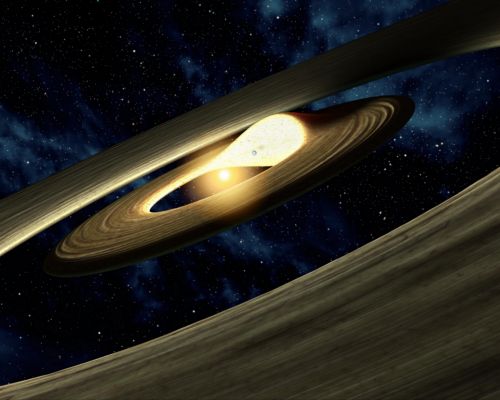
This artist's conception shows a lump of material in a swirling, planet- forming disk. Astronomers using NASA's Spitzer Space Telescope found evidence that a companion to a star -- either another star or a planet -- could be pushing planetary material together, as illustrated here.
Planets are born out of spinning disks of gas and dust. They can carve out lanes or gaps in the disks as they grow bigger and bigger. Scientists used Spitzer's infrared vision to study the disk around a star called LRLL 31, located about 1000 LY away in the IC 348 Region of the constellation Perseus. Spitzer's new infrared observations reveal that the disk has both an inner and outer gap.
What's more, the data show that infrared light from the disk is changing over as little time as one week -- a very unusual occurrence. In particular, light of different wavelengths seesawed back and forth, with short-wavelength light going up when long-wavelength light went down, and vice versa.
According to astronomers, this change could be caused by a companion to the star (illustrated as a planet in this picture). As the companion spins around, its gravity would cause the wall of the inner disk to squeeze into a lump. This lump would also spin around the star, shadowing part of the outer disk. When the bright side of the lump is on the far side of the star, and facing Earth, more infrared light at shorter wavelengths should be observed (hotter material closer to the star emits shorter wavelengths of infrared light). In addition, the shadow of the lump should cause longer-wavelength infrared light from the outer disk to decrease. The opposite would be true when the lump is in front of the star and its bright side is hidden (shorter-wavelength light would go down, and longer- wavelength light up). This is precisely what Spitzer observed.
The size of the lump and the planet have been exaggerated to better illustrate the dynamics of the system.
|
|











le onde gravitazionali, per quello che io credo di aver capito, confermano che lo spazio (l'universo) laddove sembra essere vuoto, è in realtà pieno, non nel senso più stretto del termine, ma non vuoto.
Aspetto che confermerebbe la tesi di Einstein che i pianeti e le galassie poggiano (o sembra) su qualcosa, piuttoste che essere sospesi.
Le onde gravitazionali, espandendo e contraendo lo spazio/tempo, confermano la tesi di Einstein, che per l'appunto asserisce come i pianeti (e tutti gli altri corpi) appoggiandosi sul vuoto (che in realtà è piano) sembrano rotolare piuttosto che "volare" nel vuoto.
Come fossero appoggiati ad una stuoia di gomma sprofondandoci un po dentro.
Ciò determina che forse, oltre questa stuoia di gomma, ci sia un altra stuoia di gomma, e forse un altra e un altra ancora.
Una stuoia di gomma che forse si può bucare guardando ad un altra zona dell'universo o di un altro universo.
Il buco nero, quindi, caon la sua enorme massa, sfonda questa stuoia mettendo in comunicazione stuoie diverse, diventando così un passaggio
Come sono andato?
In tal modo potrebbero viaggiare gli UFO ... Una bella bolla che li avvolge e ... opla ... in un punto qualsiasi, tramite preventive coordinate, dello Spazio a tempo pressoché "0"; solo così riesco a concepire i viaggi nello Spazio (quello che invece in molti si arrendono all'esistenza degli stessi: la invalicabile distanza!)
Ma Newton? Visionario (nel senso bello della parola). Tutto l'Universo sembra "poggiare" (o "sostenersi") su qualcosa. Gravitazione Universale.
"GRAVITONI"? Può essere. Ogni cosa è "parte" (o "complemento") di qualche altra cosa. Fisica Teorica. Nulla di più.
paolo
Perchè (facendo un esempio un pò forte) la mela non cade dall'albero in quanto attratta dalla gravità ma perchè le onde gravitazionali nello spazio hanno determinato il suo percorso