Inizio Registrati Login

Elenco album Ultimi arrivi Ultimi commenti Più viste Più votate Preferiti Cerca

Inizio > SOLAR SYSTEM > Asteroids and Comets
Ritorna alla pagina delle miniature FILE 10/282 Torna all'inizio Guarda foto precedente Guarda foto successiva Salta alla fine
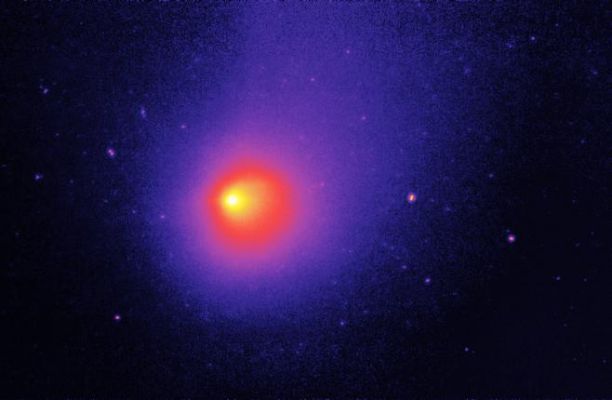
Comet Schwassmann-Wachmann I and two asteroids
Schwassmann-Wachmann 1 (its nucleus is about 30 Km in diameter and is too small to be resolved by the SST while the micron-sized dust grains in the coma and tail stream out away from the Sun) is thought to be a member of a relatively new class of objects called "Centaurs," of which 45 objects are known. These are small icy bodies with orbits between those of Jupiter and Neptune. Astronomers believe that Centaurs are recent escapees from the Kuiper Belt, a zone of small bodies orbiting in a cloud at the distant reaches of the Solar System. Two asteroids, 1996 GM36 (left) and 5238 Naozane (right) were serendipitously captured in the comet image. Because they are closer to us than the comet and have faster orbital velocities, they appear to move relative to the comet and background stars, thereby producing a slight elongated appearance. The SST data have allowed astronomers to use thermal measurements, which reduce the uncertainties of visible-light albedo (reflectivity) measurements, to determine their size.
Parole chiave: Comets and asteroids: images from Earth

Comet Schwassmann-Wachmann I and two asteroids

Schwassmann-Wachmann 1 (its nucleus is about 30 Km in diameter and is too small to be resolved by the SST while the micron-sized dust grains in the coma and tail stream out away from the Sun) is thought to be a member of a relatively new class of objects called "Centaurs," of which 45 objects are known. These are small icy bodies with orbits between those of Jupiter and Neptune. Astronomers believe that Centaurs are recent escapees from the Kuiper Belt, a zone of small bodies orbiting in a cloud at the distant reaches of the Solar System. Two asteroids, 1996 GM36 (left) and 5238 Naozane (right) were serendipitously captured in the comet image. Because they are closer to us than the comet and have faster orbital velocities, they appear to move relative to the comet and background stars, thereby producing a slight elongated appearance. The SST data have allowed astronomers to use thermal measurements, which reduce the uncertainties of visible-light albedo (reflectivity) measurements, to determine their size.

Comets-Hale-Bopp-00.jpg Asteroids-Sylvia_compo680.jpg Comets-Schwassmann_Wachmann_1-00.jpg Comets-Comet_Machholz.jpg 0-The Solar System.jpg
Informazioni sul file
Nome del file:Comets-Schwassmann_Wachmann_1-00.jpg
Nome album:Asteroids and Comets
Valutazione (14 voti):55555(Mostra dettagli)
Parole chiave:Comets / and / asteroids: / images / from / Earth
Copyright:NASA/JPL/Caltech/Ames Research Center/University of Arizona
Dimensione del file:26 KiB
Data di inserimento:Mar 07, 2005
Dimensioni:658 x 430 pixels
Visualizzato:57 volte
URL:https://www.lunexit.it/gallery/displayimage.php?pid=4666
Preferiti:Aggiungi ai preferiti


Powered by Coppermine Photo Gallery