




| Inizio > MOON > The Moon from JAXA - The "Kaguya" Lunar Probe |
 |
FILE 4/55 |  |
 |
 |
 |
|
|||
|
 |
||||||||
|
||||||||
|


| Informazioni sul file | |
| Nome del file: | Kaguya-024-hdtv_002_5c.jpg |
| Nome album: | MareKromium / The Moon from JAXA - The "Kaguya" Lunar Probe |
| Valutazione (4 voti): |  (Mostra dettagli) (Mostra dettagli) |
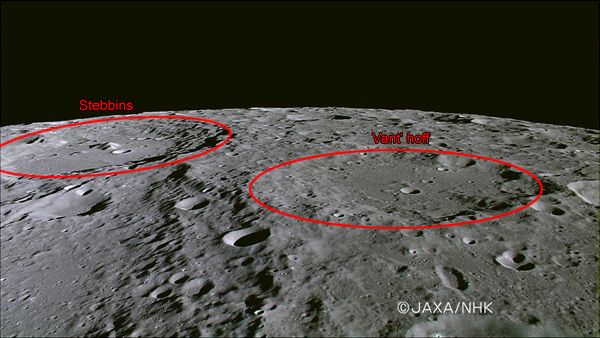
| Parole chiave: | The / Moon / from / orbit / - / Craters / - / Stebbins / and / Van't / Hoff |
| Copyright: | JAXA - Kaguya (SELENE) Project |
| Dimensione del file: | 152 KiB |
| Data di inserimento: | Feb 27, 2008 |
| Dimensioni: | 600 x 338 pixels |
| Visualizzato: | 58 volte |
| URL: | https://www.lunexit.it/gallery/displayimage.php?pid=19672 |
| Preferiti: | Aggiungi ai preferiti |


Credo che il prezzo a mq per il "terreno lunare" (scherzi, bufale e truffe a parte) non sia ancora stato fatto, però... Mettiamola così: la Regione è collinare, con crateri non impervi e modeste pianure; sei sul Lato Oscuro (e quindi non vedi la Terra, il che è un bene...); hai il costante spettacolo dell'Universo che si apre davanti a te; non ci sono vulcani attivi nè aree "militarmente" interessanti nei pressi; sei non lontanissimo da due future Basi USA ed Europa (caso mai ti trovassi in difficoltà...che ne so? Carenza d'aria o d'acqua...), sei circondato da abbondantissimi depositi di Elio-3, da miniere di Nickel e Manganese, probabilmente ci saranno una decina di giacimenti diamantiferi nei pressi e quindi...La "zona" è buona.
Ti faccio un prezzo stracciato (proprio perchè ti voglio bene): 250.000 Euro a metro/quadro. Che dici?...
Un abbraccio!!! doc
Notes: Helium-3 (He-3) is a light, non-radioactive isotope of Helium with two protons and one neutron, which is rare on Earth; it is sought after for use in nuclear fusion research. More abundant Helium-3 is thought to exist on the Moon (embedded in the upper layer of regolith by the Solar Wind over billions of years) and the Solar System's gas giants (left over from the original solar nebula), although still in low quantities (28 ppm of lunar regolith is Helium-4 and 0.01 ppm is Helium-3). It is proposed to be used as a second-generation fusion power source.
The Helion, the nucleus of a Helium-3 atom, consists of two protons but only one neutron, in contrast to two neutrons in ordinary Helium. Its existence was first proposed in 1934 by the Australian nuclear physicist Mark Oliphant while based at Cambridge University's Cavendish Laboratory, in an experiment in which fast deuterons were reacted with other Deuteron targets (the first demonstration of nuclear fusion). Helium-3, as an isotope, was postulated to be radioactive, until Helions from it were accidentally identified as a trace "contaminant" in a sample of natural Helium (which is mostly Helium-4) from a gas well, by Luis W. Alvarez and Robert Cornog in a cyclotron experiment at the Lawrence Berkeley National Laboratory, in 1939.
The Moon's surface contains Helium-3 at concentrations on the order of 0.01 ppm. A number of people, starting with Gerald Kulcinski in 1986, have proposed to explore the Moon, mine lunar regolith and using the Helium-3 for fusion. Because of the low concentrations of Helium-3, any mining equipment would need to process large amounts of regolith, and some proposals have suggested that Helium-3 extraction be piggybacked onto a larger mining and development operation.
Cosmochemist and geochemist Ouyang Ziyuan from the Chinese Academy of Sciences who is now in charge of the Chinese Lunar Exploration Program has already stated on many occasions that one of the main goals of the program would be the mining of Helium-3, from where "each year three space shuttle missions could bring enough fuel for all human beings across the World".
In January 2006 the Russian space company RKK Energiya announced that it considers lunar Helium-3 a potential economic resource to be mined by 2020, if funding can be found.
Mining gas giants for Helium-3 has also been proposed.[27] The British Interplanetary Society's hypothetical Project Daedalus interstellar probe design was fueled by Helium-3 mines on the planet Jupiter, for example. Jupiter's high gravity makes this a less energetically favorable operation than extracting Helium-3 from the other Gas Giants of the Solar System, however.
Morale: è chiaro adesso "perchè" ed "a chi" INTERESSA la Luna?!?... Un abbraccissimo! doc