Inizio Registrati Login

Elenco album Ultimi arrivi Ultimi commenti Più viste Più votate Preferiti Cerca

Inizio > THE LUNAR EXPLORER ARCHIVES > The Universe in Super Definition
Ritorna alla pagina delle miniature FILE 28/157 Torna all'inizio Guarda foto precedente Guarda foto successiva Salta alla fine
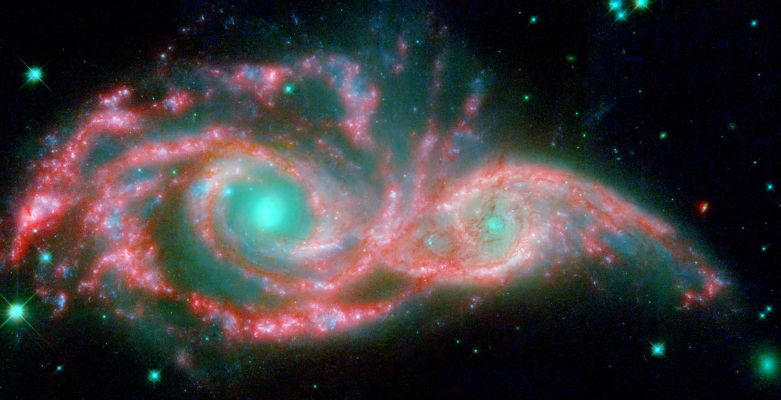
NGC 2207 and IC 2163: Colliding Galaxies
These shape-shifting galaxies have taken on the form of a giant mask. The icy blue eyes are actually the cores of two merging galaxies, called NGC 2207 and IC 2163, and the mask is their spiral arms. The false-colored image consists of infrared data from NASA's Spitzer Space Telescope (red) and visible data from NASA's Hubble Space Telescope (blue/green). 

NGC 2207 and IC 2163 met and began a sort of gravitational tango about 40 million years ago. The two galaxies are tugging at each other, stimulating new stars to form. Eventually, this cosmic ball will come to an end, when the galaxies meld into one. The dancing duo is located 140 million light-years away in the Canis Major constellation. 

The infrared data from Spitzer highlight the galaxies' dusty regions, while the visible data from Hubble indicates starlight. In the Hubble-only image (not pictured here), the dusty regions appear as dark lanes. 

The Hubble data correspond to light with wavelengths of .44 and .55 microns (blue and green, respectively). The Spitzer data represent light of 8 microns. 


Parole chiave: From Space Images - HST and SST

NGC 2207 and IC 2163: Colliding Galaxies

These shape-shifting galaxies have taken on the form of a giant mask. The icy blue eyes are actually the cores of two merging galaxies, called NGC 2207 and IC 2163, and the mask is their spiral arms. The false-colored image consists of infrared data from NASA's Spitzer Space Telescope (red) and visible data from NASA's Hubble Space Telescope (blue/green).

NGC 2207 and IC 2163 met and began a sort of gravitational tango about 40 million years ago. The two galaxies are tugging at each other, stimulating new stars to form. Eventually, this cosmic ball will come to an end, when the galaxies meld into one. The dancing duo is located 140 million light-years away in the Canis Major constellation.

The infrared data from Spitzer highlight the galaxies' dusty regions, while the visible data from Hubble indicates starlight. In the Hubble-only image (not pictured here), the dusty regions appear as dark lanes.

The Hubble data correspond to light with wavelengths of .44 and .55 microns (blue and green, respectively). The Spitzer data represent light of 8 microns.

N76-PIA08516-2.jpg Stephan_s Quintet-PIA02587.jpg NGC-2207-PIA08097.jpg M 84.jpg COROT7b-ESO.jpg
Informazioni sul file
Nome del file:NGC-2207-PIA08097.jpg
Nome album:The Universe in Super Definition
Valutazione (8 voti):55555(Mostra dettagli)
Parole chiave:From / Space / Images / - / HST / and / SST
Copyright:NASA/JPL-Caltech/STScI/Vassar
Dimensione del file:547 KiB
Data di inserimento:Apr 27, 2006
Dimensioni:2905 x 1486 pixels
Visualizzato:56 volte
URL:https://www.lunexit.it/gallery/displayimage.php?pid=14303
Preferiti:Aggiungi ai preferiti


Powered by Coppermine Photo Gallery