Inizio Registrati Login

Elenco album Ultimi arrivi Ultimi commenti Più viste Più votate Preferiti Cerca

Inizio > THE LUNAR EXPLORER ARCHIVES > The Universe in Super Definition
Ritorna alla pagina delle miniature FILE 5/157 Torna all'inizio Guarda foto precedente Guarda foto successiva Salta alla fine
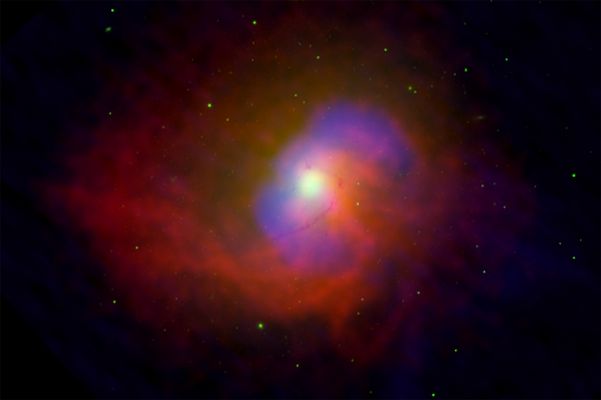
NGC 4696
In many cosmic environments, when material falls toward a Black Hole energy is produced as some of the matter is blasted back out in jets. In fact, such Black Hole "Engines" appear to be the most efficient in the Universe, at least on a galactic scale. This composite image illustrates one example of an elliptical galaxy with an efficient Black Hole Engine, NGC 4696. The large galaxy is the brightest member of the Centaurus galaxy cluster, some 150 MLY away. Exploring NGC 4696 in X-Rays (red) astronomers can measure the rate at which infalling matter fuels the supermassive Black Hole and compare it to the energy output in the jets to produce giant radio emitting bubbles. The bubbles, shown here in blue, are about 10.000 LY across. The results confirm that the process is much more efficient than producing energy through nuclear reactions - not to mention using fossil fuels. Astronomers also suggest that as the Black Hole pumps out energy and heats the surrounding gas, star formation is ultimately shut off, limiting the size of large galaxies like NGC 4696.
Parole chiave: From Space Images - Chandra X-Ray Space Telescope

NGC 4696

In many cosmic environments, when material falls toward a Black Hole energy is produced as some of the matter is blasted back out in jets. In fact, such Black Hole "Engines" appear to be the most efficient in the Universe, at least on a galactic scale. This composite image illustrates one example of an elliptical galaxy with an efficient Black Hole Engine, NGC 4696. The large galaxy is the brightest member of the Centaurus galaxy cluster, some 150 MLY away. Exploring NGC 4696 in X-Rays (red) astronomers can measure the rate at which infalling matter fuels the supermassive Black Hole and compare it to the energy output in the jets to produce giant radio emitting bubbles. The bubbles, shown here in blue, are about 10.000 LY across. The results confirm that the process is much more efficient than producing energy through nuclear reactions - not to mention using fossil fuels. Astronomers also suggest that as the Black Hole pumps out energy and heats the surrounding gas, star formation is ultimately shut off, limiting the size of large galaxies like NGC 4696.

Life-PIA03538.jpg Black Hole-PIA08696.jpg NGC-4696.jpg M 42~3.jpg M 82-PIA08093.jpg
Informazioni sul file
Nome del file:NGC-4696.jpg
Nome album:The Universe in Super Definition
Valutazione (12 voti):55555(Mostra dettagli)
Parole chiave:From / Space / Images / - / Chandra / X-Ray / Space / Telescope
Copyright:X-ray in red - NASA/ CXC/S.Allen (Kavli Inst., Stanford) et al.; Radio in blue - NRAO/G.Taylor (VLA); Infrared in green - NASA/ESA/W.Harris (McMaster Univ.)
Dimensione del file:151 KiB
Data di inserimento:Apr 27, 2006
Dimensioni:720 x 479 pixels
Visualizzato:89 volte
URL:https://www.lunexit.it/gallery/displayimage.php?pid=10780
Preferiti:Aggiungi ai preferiti


Powered by Coppermine Photo Gallery