Inizio Registrati Login

Elenco album Ultimi arrivi Ultimi commenti Più viste Più votate Preferiti Cerca

Inizio > MOON > SMART-1: the Moon from ESA
Ritorna alla pagina delle miniature FILE 317/2195 Torna all'inizio Guarda foto precedente Guarda foto successiva Salta alla fine
The "Peaks" of Eternal Sun-light (1)
"If we can confirm peaks of eternal light", says Bernard Foing, SMART-1 Project Scientist, "these could be a key locations for possible future lunar outposts". The existence of peaks of eternal light at the poles, that is areas that remain eternally illuminated regardless of seasonal variations, was first predicted in the second half of the nineteenth century by the astronomer Camille Flammarion.
Even if for most of the Moon the length of the day does not vary perceptibly during the course of seasons, this is not the case over the poles, where illumination can vary extensively during the course of the year. The less favourable illumination conditions occur around the Northern Winter Solstice, around 24 January. There are areas at the bottom of near-polar craters that do not see direct sunshine, where ice might potentially be trapped. Also there are areas at higher elevation on the rim of Polar craters that see the Sun more than half of the time. Eventually, there may be areas that are always illuminated!".
Parole chiave: Moon

The "Peaks" of Eternal Sun-light (1)

"If we can confirm peaks of eternal light", says Bernard Foing, SMART-1 Project Scientist, "these could be a key locations for possible future lunar outposts". The existence of peaks of eternal light at the poles, that is areas that remain eternally illuminated regardless of seasonal variations, was first predicted in the second half of the nineteenth century by the astronomer Camille Flammarion.
Even if for most of the Moon the length of the day does not vary perceptibly during the course of seasons, this is not the case over the poles, where illumination can vary extensively during the course of the year. The less favourable illumination conditions occur around the Northern Winter Solstice, around 24 January. There are areas at the bottom of near-polar craters that do not see direct sunshine, where ice might potentially be trapped. Also there are areas at higher elevation on the rim of Polar craters that see the Sun more than half of the time. Eventually, there may be areas that are always illuminated!".

APOLLO 12 AS 12-51-7485-4.jpg APOLLO 15 AS 15-85-11447.jpg 04-CopernicusCrater-LO5.jpg ZA-The Men Of Apollo 15-Apollo15-S70-17575.jpg ZZ-Apollo 15.jpg
Informazioni sul file
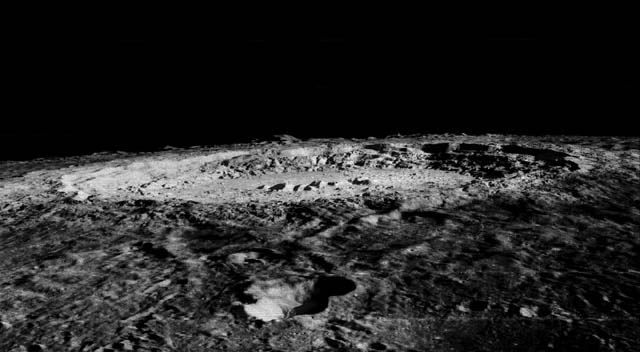
Nome del file:04-CopernicusCrater-LO5.jpg
Nome album:SMART-1: the Moon from ESA
Valutazione (3 voti):55555(Mostra dettagli)
Parole chiave:Moon
Copyright:NASA - Lunar Orbiter Project - Lunar Orbiter 5
Dimensione del file:34 KiB
Data di inserimento:Mag 04, 2005
Dimensioni:640 x 352 pixels
Visualizzato:236 volte
URL:https://www.lunexit.it/gallery/displayimage.php?pid=5478
Preferiti:Aggiungi ai preferiti


Powered by Coppermine Photo Gallery