Inizio Registrati Login

Elenco album Ultimi arrivi Ultimi commenti Più viste Più votate Preferiti Cerca

Inizio > MOON > The Lunar Surface in HR
Ritorna alla pagina delle miniature FILE 2181/2195 Torna all'inizio Guarda foto precedente Guarda foto successiva Salta alla fine
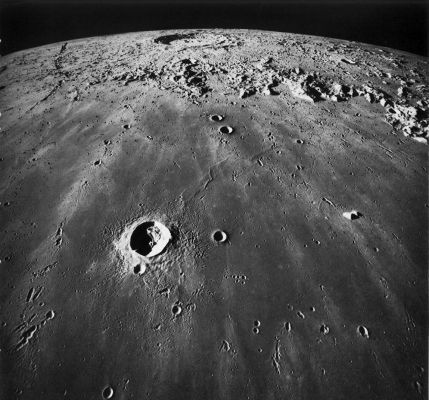
AS 17-2444 - Mare Imbrium & Copernicus Crater
This oblique view across southern Mare Imbrium looks toward Copernicus, the large crater near the horizon. The distance from the lower edge of the picture to the center of Copernicus is 400 km. The mountains at the edge of Mare Imbrium are the Montes Carpatus, and the large crater near the center of the picture is Pytheas, almost 19 km in diameter. Copernicus is one of the youngest of the Moon's large craters. It is visible from Earth, even without the aid of a telescope because of its bright ejecta blanket and its extensive bright rays. The many chains and clusters of small irregular craters and the many bright streaks or rays extending across Mare Imbrium are caused by the secondary impact of debris ejected from Copernicus. The viewing angle accentuates the radial pattern of the secondary impact features. The Sun angle is sufficiently low to show their relief, but high enough to show the contrast between the bright streaks and the normal dark mare surface. As in figure 124, herringbone ridges point toward the primary crater, and the flaring sides of the secondary craters point away from it. The arrow midway between Copernicus and the left edge of the photograph points to a less common pattern of secondary craters; these are concentric to Copernicus.
Parole chiave: The Moon from orbit - Mare Imbrium

AS 17-2444 - Mare Imbrium & Copernicus Crater

This oblique view across southern Mare Imbrium looks toward Copernicus, the large crater near the horizon. The distance from the lower edge of the picture to the center of Copernicus is 400 km. The mountains at the edge of Mare Imbrium are the Montes Carpatus, and the large crater near the center of the picture is Pytheas, almost 19 km in diameter. Copernicus is one of the youngest of the Moon's large craters. It is visible from Earth, even without the aid of a telescope because of its bright ejecta blanket and its extensive bright rays. The many chains and clusters of small irregular craters and the many bright streaks or rays extending across Mare Imbrium are caused by the secondary impact of debris ejected from Copernicus. The viewing angle accentuates the radial pattern of the secondary impact features. The Sun angle is sufficiently low to show their relief, but high enough to show the contrast between the bright streaks and the normal dark mare surface. As in figure 124, herringbone ridges point toward the primary crater, and the flaring sides of the secondary craters point away from it. The arrow midway between Copernicus and the left edge of the photograph points to a less common pattern of secondary craters; these are concentric to Copernicus.

APOLLO 17 AS 17-1672.jpg APOLLO 16 AS 16-122-19580.jpg APOLLO 17 AS 17-2444.jpg APOLLO 17 AS 17-2773.jpg APOLLO 16 AS 16-5006 (2).jpg
Informazioni sul file
Nome del file:APOLLO 17 AS 17-2444.jpg
Nome album:The Lunar Surface in HR
Valutazione (2 voti):55555(Mostra dettagli)
Parole chiave:The / Moon / from / orbit / - / Mare / Imbrium
Copyright:NASA - Apollo Programme - Apollo 16 (Gianluigi Barca e Lunar Explorer Italia)
Dimensione del file:220 KiB
Data di inserimento:Ago 27, 2006
Dimensioni:996 x 927 pixels
Visualizzato:53 volte
URL:https://www.lunexit.it/gallery/displayimage.php?pid=12508
Preferiti:Aggiungi ai preferiti


Powered by Coppermine Photo Gallery