Inizio Registrati Login

Elenco album Ultimi arrivi Ultimi commenti Più viste Più votate Preferiti Cerca

Inizio > MOON > The Lunar Surface in HR
Ritorna alla pagina delle miniature FILE 2133/2195 Torna all'inizio Guarda foto precedente Guarda foto successiva Salta alla fine
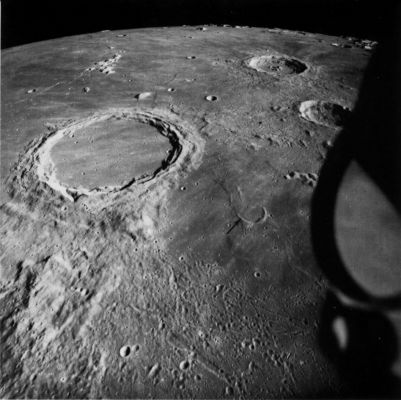
AS 15-1541 - Archimedes and Aristillus
The ejecta blanket and secondary impact craters of the mare-filled crater Archimedes (80 Km in diameter) are visible on the terrain toward the viewer (South) but not on the mare surface to the crater's left and right. Yet at one time ejecta like that to the south must have completely surrounded Archimedes because similar ejecta surrounds craters such as Aristillus (upper right). Thus, the mare lavas, in addition to filling the interior of Archimedes, obviously have covered the eastern and western parts of the ejecta. In turn, ejecta from Archimedes has covered materials of the Imbrium Basin like the rugged hills in the lower left of the picture. These stratigraphic relations prove that time elapsed between formation of the Imbrium basin and its filling by mare-time enough for impacts to create Archimedes, the deeply flooded crater to its right (arrow), and similar "Imbrian-age" craters elsewhere, as was pointed out by Eugene Shoemaker in 1962.

Archimedes has no visible central peak complex. Presumably the complex exists but has been completely inundated by the mare.
Parole chiave: The Moon from orbit - Craters - Archimedes

AS 15-1541 - Archimedes and Aristillus

The ejecta blanket and secondary impact craters of the mare-filled crater Archimedes (80 Km in diameter) are visible on the terrain toward the viewer (South) but not on the mare surface to the crater's left and right. Yet at one time ejecta like that to the south must have completely surrounded Archimedes because similar ejecta surrounds craters such as Aristillus (upper right). Thus, the mare lavas, in addition to filling the interior of Archimedes, obviously have covered the eastern and western parts of the ejecta. In turn, ejecta from Archimedes has covered materials of the Imbrium Basin like the rugged hills in the lower left of the picture. These stratigraphic relations prove that time elapsed between formation of the Imbrium basin and its filling by mare-time enough for impacts to create Archimedes, the deeply flooded crater to its right (arrow), and similar "Imbrian-age" craters elsewhere, as was pointed out by Eugene Shoemaker in 1962.

Archimedes has no visible central peak complex. Presumably the complex exists but has been completely inundated by the mare.

29-Farside-Luna3.jpg 32-Ranger7.jpg 36-Ranger7.jpg APOLLO 16-4136-B.jpg APOLLO 16 AS 16-4511.jpg
Informazioni sul file
Nome del file:APOLLO 15 AS 15-1541.jpg
Nome album:The Lunar Surface in HR
Valutazione (1 voti):55555(Mostra dettagli)
Parole chiave:The / Moon / from / orbit / - / Craters / - / Archimedes
Copyright:NASA - Apollo Programme - Apollo 15
Dimensione del file:144 KiB
Data di inserimento:Ago 15, 2006
Dimensioni:948 x 944 pixels
Visualizzato:54 volte
URL:https://www.lunexit.it/gallery/displayimage.php?pid=12291
Preferiti:Aggiungi ai preferiti


Powered by Coppermine Photo Gallery