|
|
Hellas Basin
|
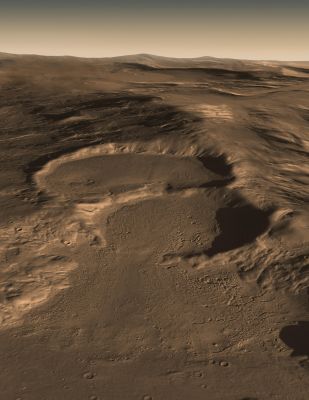
Caption NASA:"What created this unusual terrain on Mars?
The floors of several Mid-Latitude craters in Hellas Basin on Mars appear unusually grooved, flat, and shallow. New radar images from the Mars Reconnaissance Orbiter bolster an exciting hypothesis: huge glaciers of buried ice. Evidence indicates that such glaciers cover an area larger than a city and extend as much as a kilometer deep.
The ice would have been kept from evaporating into the thin Martian air by a covering of dirt. If true, this would indicate the largest volume of water ice outside of the Martian Poles, much larger than the frozen puddles recently discovered by the Phoenix Lander.
Such lake-sized ice blocks located so close to the Martian Equator might make a good drinking reservoir for future astronauts exploring Mars.
How the glaciers originally formed remains a mystery" (...).
Nota Lunexit: ATTENZIONE! Questa immagine - per bella e dettagliata che sembri o che sia - NON E' UNA FOTOGRAFIA! Essa è il risultato finale di un complesso mix di immagini reali le quali sono state riprese ed assemblate e quindi riprocessate digitalmente (vedasi, per maggiori informazioni, il "Solar System Visualization Project"). Un'opera fantastica e meritoria ed un risultato indubbiamente suggestivo ma...Questa immagine NON E' rappresentativa di una realtà specifica.
Essa è solo la ricostruzione digitale di una realtà specifica (il Bacino di Hellas), il che non è esattamente la stessa cosa...
|
|









Inoltre, gli scavi superficiali effettuati da Phoenix e da altri Rover, laddove le immagini presentavano una sostanza bianca, appena pochi cm sotto il terreno, mettevano in risalto l'acqua in forma ghiacciata