|
|
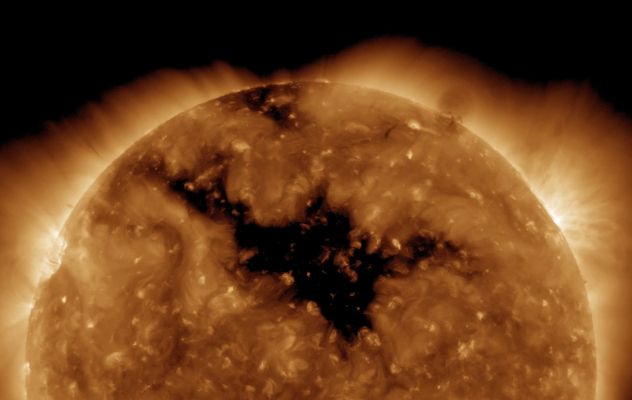
Deep Coronal Holes
|
Caption NASA:"This ominous, dark shape sprawling across the face of the Sun is a Coronal Hole -- a low density region extending above the Surface where the Solar Magnetic Field opens freely into interplanetary space.
Studied extensively from space since the 1960s in UltraViolet and X-Ray Light, Coronal Holes are known to be the source of the high-speed Solar Wind (such as atoms and electrons which flow outward along the open Magnetic Field lines). During periods of low activity, Coronal Holes typically cover regions just above the Sun's Poles.
But this extensive Coronal Hole dominated the Sun's Northern Hemisphere earlier this week, captured here in Extreme UV Light by cameras onboard the Solar Dynamics Observatory. The solar wind streaming from this Coronal Hole triggered auroral displays on Earth".
|
|










The supermassive black hole has a mass equivalent to 17 billion suns and is located, as we said, inside the galaxy NGC 1277 in the constellation of Perseus. It makes up about 14 percent of its host galaxy's mass, compared with the 0.1 percent a normal black hole would represent, scientists said.
"This is a really oddball galaxy," said study team member Karl Gebhardt of the University of Texas at Austin in a statement. "It's almost all black hole. This could be the first object in a new class of galaxy-black hole systems."
The giant black hole is about 11 times as wide as the orbit of Neptune around our Sun, researchers said. The mass is so far above normal that the scientists took a year to double-check and submit their research paper for publication, according to the study's lead author, Remco van den Bosch.
"The first time I calculated it, I thought I must have done something wrong. We tried it again with the same instrument, then a different instrument," van den Bosch, an astronomer at Germany's Max Planck Institute for Astronomy, told SPACE.com. "Then I thought, 'Maybe something else is happening".
Per Anakin: la tua domanda, al momento, non ha risposta. Però è bello pensare a quello che accadrebbe se ci addentrassimo all'interno di un Buco Nero... Abbraccio Circolare! paolo
P.S.: L'anomalia di questo specifico Buco Nero è che va (SEMBRA che vada) a coprire, in termini di estensione, l'intera Galassia alla quale accede (NGC, ossìa New General Catalog Object n. 1277). Non so, ma vista la notizia così, da Astrofisico, mi viene da pensare ad un errore di valutazione da parte degli Amici Texani. Però io, come ovvio, non ho le loro grandi conoscenze ed i loro (ritengo notevolissimi ed assai significativi) dati, e quindi può anche darsi che abbiano visto giusto. certo è che un Buco Nero grande quasi quanto la Galassia che lo "ospita", è un paradosso. Un incredibile ed affascinante paradosso.