Inizio Registrati Login

Elenco album Ultimi arrivi Ultimi commenti Più viste Più votate Preferiti Cerca

Inizio > MOON > Before the Moon and Walking on the Moon (partially edited)
Ritorna alla pagina delle miniature FILE 77/143 Torna all'inizio Guarda foto precedente Guarda foto successiva Salta alla fine
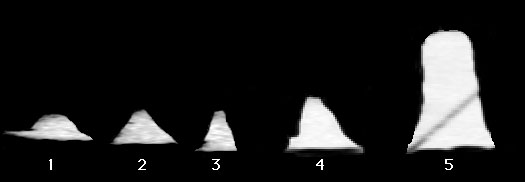
The "Blair Cuspids": possible shapes and visual appearance from Lunar datum (2)
These profile images are really negative images of the shadows of the 5 objects indicated by the numbers in the previous frame. The background has been blacked out by hand to emphasize the overall shape of each object. The shadows have been compressed in the direction of their length, according to the trigonometric relationship between an object's height (-->H), the length of its shadow (-->Ls), and the tangent of the Sun's elevation angle (-->A), above the surface on which the shadow falls. This relationship is: H = Ls tan(A).

Because the first four Cuspids appear to be situated on a fairly horizontal surface, the value of angle A was taken from the NASA support data to be the Sun's elevation above the horizon - 10,9° - and the images of the shadows were compressed by the value of that angle's tangent, such as 0,193°. 
A greater compression, corresponding to a Sun angle of 8° (tan(8) = 0,14) was used for the profile of Cuspid 5 because its shadow falls over the surface of the rectangular "trench", which is sloping downward away from the Sun, thus effectively decreasing the Sun's elevation above the surface. (…) 
The detailed contours of the objects are lost in these profiles due to the irregularities of the lunar surface and due to the blurring caused by the image compression algorithm. However, the general shapes of all the objects – except the first – can still be clearly seen to differ radically from the shapes of common lunar boulders and ridges. 
The profiles suggest that Cuspids 2 through 5 have heights greater than their widths, which would be a very unstable placement for a randomly placed boulder and even more unusual for a cluster of them. 
The hills and ridges of the Moon tend to be very low and rounded. The great lunar mountain Pico Mons in Mare Imbrium, for example, has a height only 16% of its width. 
Cuspids 2 though 4 are conical or pyramidal, while Cuspid 5 (still the tallest even with a lower Sun angle assumed) appears to be a cylinder. Based on the assumption that the sun's elevation is 8°  above the slope on which Cuspid 5's shadow is being cast, the object itself would have a height of approximately 15 meters. (…)

Parole chiave: The Blair Cuspids

The "Blair Cuspids": possible shapes and visual appearance from Lunar datum (2)

These profile images are really negative images of the shadows of the 5 objects indicated by the numbers in the previous frame. The background has been blacked out by hand to emphasize the overall shape of each object. The shadows have been compressed in the direction of their length, according to the trigonometric relationship between an object's height (-->H), the length of its shadow (-->Ls), and the tangent of the Sun's elevation angle (-->A), above the surface on which the shadow falls. This relationship is: H = Ls tan(A).

Because the first four Cuspids appear to be situated on a fairly horizontal surface, the value of angle A was taken from the NASA support data to be the Sun's elevation above the horizon - 10,9° - and the images of the shadows were compressed by the value of that angle's tangent, such as 0,193°.
A greater compression, corresponding to a Sun angle of 8° (tan(8) = 0,14) was used for the profile of Cuspid 5 because its shadow falls over the surface of the rectangular "trench", which is sloping downward away from the Sun, thus effectively decreasing the Sun's elevation above the surface. (…)
The detailed contours of the objects are lost in these profiles due to the irregularities of the lunar surface and due to the blurring caused by the image compression algorithm. However, the general shapes of all the objects – except the first – can still be clearly seen to differ radically from the shapes of common lunar boulders and ridges.
The profiles suggest that Cuspids 2 through 5 have heights greater than their widths, which would be a very unstable placement for a randomly placed boulder and even more unusual for a cluster of them.
The hills and ridges of the Moon tend to be very low and rounded. The great lunar mountain Pico Mons in Mare Imbrium, for example, has a height only 16% of its width.
Cuspids 2 though 4 are conical or pyramidal, while Cuspid 5 (still the tallest even with a lower Sun angle assumed) appears to be a cylinder. Based on the assumption that the sun's elevation is 8° above the slope on which Cuspid 5's shadow is being cast, the object itself would have a height of approximately 15 meters. (…)

APOLLO 8 AS 08-12-2144.jpg APOLLO 10 AS 10-30-4421.jpg ZZ-ZZ-The Blair Cuspids-L.jpg APOLLO 10 AS 10-31-4562 ALBEDO.jpg 05-Copernicus Crater.jpg
Informazioni sul file
Nome del file:ZZ-ZZ-The Blair Cuspids-L.jpg
Nome album:Before the Moon and Walking on the Moon (partially edited)
Valutazione (11 voti):55555(Mostra dettagli)
Parole chiave:The / Blair / Cuspids
Copyright:The Lunascan Project - Lan Fleming
Dimensione del file:7917 Bytes
Data di inserimento:Dic 08, 2005
Dimensioni:525 x 182 pixels
Visualizzato:112 volte
URL:https://www.lunexit.it/gallery/displayimage.php?pid=8640
Preferiti:Aggiungi ai preferiti


Powered by Coppermine Photo Gallery