Inizio Registrati Login

Elenco album Ultimi arrivi Ultimi commenti Più viste Più votate Preferiti Cerca

Inizio > THE LUNAR EXPLORER ARCHIVES > The Universe in Super Definition
Ritorna alla pagina delle miniature FILE 87/157 Torna all'inizio Guarda foto precedente Guarda foto successiva Salta alla fine
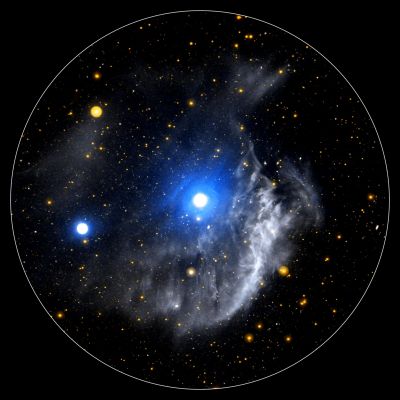
The Extended Region around the Planetary Nebula NGC 3242
The unfortunate name of Planetary Nebula for this class of Celestial Objects is a historical legacy credited to William Herschel during the 18th Century — a time when telescopes where small and objects like these, at least the central region, looked very similar to gas-giant planets such as Saturn and Jupiter. In fact, NGC 3242 has no relation to Jupiter or any other planet. 
Telescopes and their detectors have dramatically improved over the past few centuries. Our understanding of what Planetary Nebulae truly are has improved accordingly. 
When stars with a mass similar to our Sun approach the end of their lives by exhausting supplies of Hydrogen and Helium fuel in their cores, they swell up into cool red-giant stars. In a last gasp before death, they expel the layers of gas in their Outer Atmosphere. This exposes the core of the dying star, a dense hot ball of Carbon and Oxygen called a "White Dwarf". 

The White Dwarf is so hot that it shines very brightly in the UltraViolet Spectrum. The UltraViolet Light from the White Dwarf, in turn, ionizes the gaseous material expelled by the star causing it to glow. A Planetary Nebula is really the death of a low-mass star. 
Although low-mass stars like our Sun live for billions of years, Planetary Nebulae only last for about ten thousand years. As the central white dwarf quickly cools and the UltraViolet Light dwindles, the surrounding gas also cools and fades. 

In this image of NGC 3242 from the Galaxy Evolution Explorer, the Extended Region around the Planetary Nebula is shown in dramatic detail. The small circular white and blue area at the center of the image is the well-known portion of the famous Planetary Nebula. The precise origin and composition of the extended wispy white features is not known for certain. It is most likely material ejected during the star's red-giant phase before the White Dwarf was exposed. 
However, it may be possible that the extended material is simply interstellar gas that, by coincidence, is located close enough to the White Dwarf to be energized by it, and induced to glow with UltraViolet Light. 

NGC 3242 is located 1400 to 2500 Light-Years away in the constellation of Hydra. It was discovered by William Herschel in 1785.
Parole chiave: From Space Images - Galex Space Telescope

The Extended Region around the Planetary Nebula NGC 3242

The unfortunate name of Planetary Nebula for this class of Celestial Objects is a historical legacy credited to William Herschel during the 18th Century — a time when telescopes where small and objects like these, at least the central region, looked very similar to gas-giant planets such as Saturn and Jupiter. In fact, NGC 3242 has no relation to Jupiter or any other planet.
Telescopes and their detectors have dramatically improved over the past few centuries. Our understanding of what Planetary Nebulae truly are has improved accordingly.
When stars with a mass similar to our Sun approach the end of their lives by exhausting supplies of Hydrogen and Helium fuel in their cores, they swell up into cool red-giant stars. In a last gasp before death, they expel the layers of gas in their Outer Atmosphere. This exposes the core of the dying star, a dense hot ball of Carbon and Oxygen called a "White Dwarf".

The White Dwarf is so hot that it shines very brightly in the UltraViolet Spectrum. The UltraViolet Light from the White Dwarf, in turn, ionizes the gaseous material expelled by the star causing it to glow. A Planetary Nebula is really the death of a low-mass star.
Although low-mass stars like our Sun live for billions of years, Planetary Nebulae only last for about ten thousand years. As the central white dwarf quickly cools and the UltraViolet Light dwindles, the surrounding gas also cools and fades.

In this image of NGC 3242 from the Galaxy Evolution Explorer, the Extended Region around the Planetary Nebula is shown in dramatic detail. The small circular white and blue area at the center of the image is the well-known portion of the famous Planetary Nebula. The precise origin and composition of the extended wispy white features is not known for certain. It is most likely material ejected during the star's red-giant phase before the White Dwarf was exposed.
However, it may be possible that the extended material is simply interstellar gas that, by coincidence, is located close enough to the White Dwarf to be energized by it, and induced to glow with UltraViolet Light.

NGC 3242 is located 1400 to 2500 Light-Years away in the constellation of Hydra. It was discovered by William Herschel in 1785.

NGC-0253-HST.jpg PIA11805.JPG ARP_274-HST-2009-14-a-print.jpg From_HST-2009-19-a-print.jpg NGC-2841-PIA12001.jpg
Informazioni sul file
Nome del file:NGC-3242-PIA11968.jpg
Nome album:MareKromium / The Universe in Super Definition
Valutazione (3 voti):55555(Mostra dettagli)
Parole chiave:From / Space / Images / - / Galex / Space / Telescope
Copyright:NASA/JPL-Caltech
Dimensione del file:437 KiB
Data di inserimento:Apr 05, 2009
Dimensioni:2240 x 2240 pixels
Visualizzato:57 volte
URL:https://www.lunexit.it/gallery/displayimage.php?pid=24145
Preferiti:Aggiungi ai preferiti


Powered by Coppermine Photo Gallery