Inizio Registrati Login

Elenco album Ultimi arrivi Ultimi commenti Più viste Più votate Preferiti Cerca

Inizio > THE LUNAR EXPLORER ARCHIVES > The Universe in Super Definition
Ritorna alla pagina delle miniature FILE 124/157 Torna all'inizio Guarda foto precedente Guarda foto successiva Salta alla fine
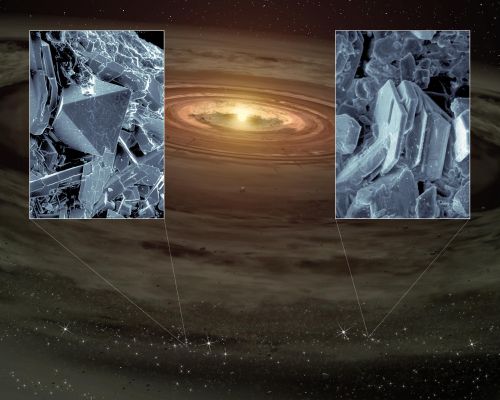
Quartz-like Crystals found in Planetary Disks
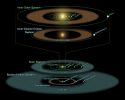
NASA's Spitzer Space Telescope has, for the first time, detected tiny quartz-like crystals sprinkled in young planetary systems. The crystals, which are types of silica minerals called Cristobalite and Tridymite, can be seen close-up in the black-and-white insets (Cristobalite is on the left, and Tridymite on the right). The main picture is an artist's concept of a young star and its swirling disk of planet-forming materials. 

Cristobalite and Tridymite are thought to be two of many planet ingredients. On Earth, they are normally found as tiny crystals in volcanic lava flows and meteorites from space. These minerals are both related to quartz. For example, if you were to heat the familiar quartz crystals often sold as mystical tokens, the quartz would transform into Cristobalite and Tridymite. 
Because Cristobalite and Tridymite require rapid heating and cooling to form, astronomers say they were most likely generated by shock waves traveling through the planetary disks. 

The insets are Scanning Electron Microscope pictures courtesy of George Rossman of the California Institute of Technology, Pasadena, Calif.
Parole chiave: Artistic Interpretations of the Universe

Quartz-like Crystals found in Planetary Disks

NASA's Spitzer Space Telescope has, for the first time, detected tiny quartz-like crystals sprinkled in young planetary systems. The crystals, which are types of silica minerals called Cristobalite and Tridymite, can be seen close-up in the black-and-white insets (Cristobalite is on the left, and Tridymite on the right). The main picture is an artist's concept of a young star and its swirling disk of planet-forming materials.

Cristobalite and Tridymite are thought to be two of many planet ingredients. On Earth, they are normally found as tiny crystals in volcanic lava flows and meteorites from space. These minerals are both related to quartz. For example, if you were to heat the familiar quartz crystals often sold as mystical tokens, the quartz would transform into Cristobalite and Tridymite.
Because Cristobalite and Tridymite require rapid heating and cooling to form, astronomers say they were most likely generated by shock waves traveling through the planetary disks.

The insets are Scanning Electron Microscope pictures courtesy of George Rossman of the California Institute of Technology, Pasadena, Calif.

Abell-901_and_902-PM.jpg PIA10955.jpg NGC-1569.jpg Cassiopeia_A-PIA11748.jpg MACS-J0717_5+3745-hs-2009-17-a-print.jpg
Informazioni sul file
Nome del file:PIA11417.jpg
Nome album:MareKromium / The Universe in Super Definition
Valutazione (4 voti):55555(Mostra dettagli)
Parole chiave:Artistic / Interpretations / of / the / Universe
Copyright:NASA/JPL-Caltech
Dimensione del file:592 KiB
Data di inserimento:Nov 23, 2008
Dimensioni:3000 x 2400 pixels
Visualizzato:56 volte
URL:https://www.lunexit.it/gallery/displayimage.php?pid=22637
Preferiti:Aggiungi ai preferiti


Powered by Coppermine Photo Gallery