Inizio Registrati Login

Elenco album Ultimi arrivi Ultimi commenti Più viste Più votate Preferiti Cerca

Inizio > THE LUNAR EXPLORER ARCHIVES > The Universe in Super Definition
Ritorna alla pagina delle miniature FILE 61/157 Torna all'inizio Guarda foto precedente Guarda foto successiva Salta alla fine
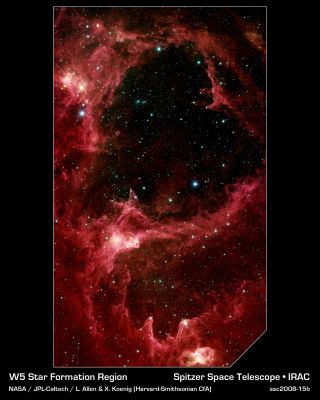
W 5 - Stellar "Nursery" (natural colors)
Generations of stars can be seen in this new infrared portrait from NASA's Spitzer Space Telescope. In this wispy star-forming region, called W5, the oldest stars can be seen as blue dots in the centers of the two hollow cavities (other blue dots are background and foreground stars not associated with the region). Younger stars line the rims of the cavities, and some can be seen as dots at the tips of the elephant-trunk-like pillars. The white knotty areas are where the youngest stars are forming. 
W5 spans an area of sky equivalent to four full moons and is about 6500 Light-Years away in the constellation Cassiopeia. The Spitzer picture was taken over a period of 24 hours. 
Like other massive star-forming regions, such as Orion and Carina, W5 contains large cavities that were carved out by radiation and winds from the region's most massive stars. According to the theory of triggered star-formation, the carving out of these cavities pushes gas together, causing it to ignite into successive generations of new stars. 
This image contains some of the best evidence yet for the triggered star-formation theory. Scientists analyzing the photo have been able to show that the ages of the stars become progressively and systematically younger with distance from the center of the cavities. 

This picture was taken with Spitzer's infrared array camera. It is a four-color composite, in which light with a wavelength of 3,6 microns is blue; 4,5-micron light is green; 5,8-micron light is orange; and 8-micron light is red.
Parole chiave: From Space Images - Spitzer Space Telescope (SST) Images

W 5 - Stellar "Nursery" (natural colors)

Generations of stars can be seen in this new infrared portrait from NASA's Spitzer Space Telescope. In this wispy star-forming region, called W5, the oldest stars can be seen as blue dots in the centers of the two hollow cavities (other blue dots are background and foreground stars not associated with the region). Younger stars line the rims of the cavities, and some can be seen as dots at the tips of the elephant-trunk-like pillars. The white knotty areas are where the youngest stars are forming.
W5 spans an area of sky equivalent to four full moons and is about 6500 Light-Years away in the constellation Cassiopeia. The Spitzer picture was taken over a period of 24 hours.
Like other massive star-forming regions, such as Orion and Carina, W5 contains large cavities that were carved out by radiation and winds from the region's most massive stars. According to the theory of triggered star-formation, the carving out of these cavities pushes gas together, causing it to ignite into successive generations of new stars.
This image contains some of the best evidence yet for the triggered star-formation theory. Scientists analyzing the photo have been able to show that the ages of the stars become progressively and systematically younger with distance from the center of the cavities.

This picture was taken with Spitzer's infrared array camera. It is a four-color composite, in which light with a wavelength of 3,6 microns is blue; 4,5-micron light is green; 5,8-micron light is orange; and 8-micron light is red.

Mira-PIA09958-1.jpg Abell-1689.jpg W5-PIA11047.jpg ARP-147.jpg HD-80606b.jpg
Informazioni sul file
Nome del file:W5-PIA11047.jpg
Nome album:MareKromium / The Universe in Super Definition
Valutazione (5 voti):55555(Mostra dettagli)
Parole chiave:From / Space / Images / - / Spitzer / Space / Telescope / (SST) / Images
Copyright:NASA/JPL-Caltech/Harvard-Smithsonian CfA
Dimensione del file:857 KiB
Data di inserimento:Set 17, 2008
Dimensioni:2400 x 3000 pixels
Visualizzato:57 volte
URL:https://www.lunexit.it/gallery/displayimage.php?pid=21912
Preferiti:Aggiungi ai preferiti


Powered by Coppermine Photo Gallery