Inizio Registrati Login

Elenco album Ultimi arrivi Ultimi commenti Più viste Più votate Preferiti Cerca

Inizio > THE LUNAR EXPLORER ARCHIVES > The Universe in Super Definition
Ritorna alla pagina delle miniature FILE 47/157 Torna all'inizio Guarda foto precedente Guarda foto successiva Salta alla fine
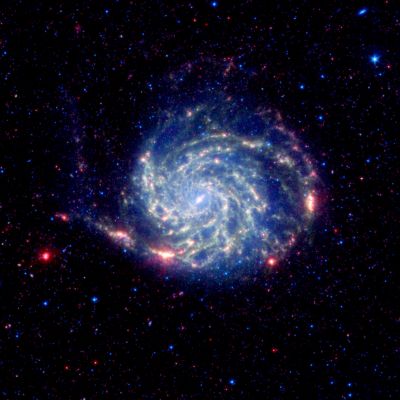
M 101 - The "Pinwheel Galaxy"
The Pinwheel Galaxy, otherwise known as Messier 101, sports bright reddish edges in this new infrared image from NASA's Spitzer Space Telescope. Research from Spitzer has revealed that this outer red zone lacks organic molecules present in the rest of the galaxy. The red and blue spots outside of the spiral galaxy are either foreground stars or more distant galaxies. 

The organics, called Polycyclic Aromatic Hydrocarbons (PAH), are dusty, carbon-containing molecules that help in the formation of stars. On Earth, they are found anywhere combustion reactions take place, such as barbeque pits and exhaust pipes. Scientists also believe this space dust has the potential to be converted into the stuff of life. 
Spitzer found that the PAH decrease in concentration toward the outer portion of the Pinwheel Galaxy, then quickly drop off and are no longer detected at its very outer rim. According to astronomers, there's a threshold at the rim where the organic material is being destroyed by harsh radiation from stars. Radiation is more damaging at the far reaches of a galaxy because the stars there have less heavy metals, and metals dampen the radiation. 
The findings help researchers understand how stars can form in these harsh environments, where PAH are lacking. Under normal circumstances, the PAH help cool down star-forming clouds, allowing them to collapse into stars. In regions like the rim of the Pinwheel — as well as the very early universe — stars form without the organic dust. Astronomers don't know precisely how this works, so the rim of the Pinwheel provides them with a laboratory for examining the process relatively close up. 

In this image, infrared light with a wavelength of 3,6 microns is colored blue; 8-micron light is green; and 24-micron light is red. 
All three of Spitzer's instruments were used in the study: the infrared array camera, the multiband imaging photometer and the infrared spectrograph.
Parole chiave: From Space Images - Spitzer Space Telescope (SST) Images

M 101 - The "Pinwheel Galaxy"

The Pinwheel Galaxy, otherwise known as Messier 101, sports bright reddish edges in this new infrared image from NASA's Spitzer Space Telescope. Research from Spitzer has revealed that this outer red zone lacks organic molecules present in the rest of the galaxy. The red and blue spots outside of the spiral galaxy are either foreground stars or more distant galaxies.

The organics, called Polycyclic Aromatic Hydrocarbons (PAH), are dusty, carbon-containing molecules that help in the formation of stars. On Earth, they are found anywhere combustion reactions take place, such as barbeque pits and exhaust pipes. Scientists also believe this space dust has the potential to be converted into the stuff of life.
Spitzer found that the PAH decrease in concentration toward the outer portion of the Pinwheel Galaxy, then quickly drop off and are no longer detected at its very outer rim. According to astronomers, there's a threshold at the rim where the organic material is being destroyed by harsh radiation from stars. Radiation is more damaging at the far reaches of a galaxy because the stars there have less heavy metals, and metals dampen the radiation.
The findings help researchers understand how stars can form in these harsh environments, where PAH are lacking. Under normal circumstances, the PAH help cool down star-forming clouds, allowing them to collapse into stars. In regions like the rim of the Pinwheel — as well as the very early universe — stars form without the organic dust. Astronomers don't know precisely how this works, so the rim of the Pinwheel provides them with a laboratory for examining the process relatively close up.

In this image, infrared light with a wavelength of 3,6 microns is colored blue; 8-micron light is green; and 24-micron light is red.
All three of Spitzer's instruments were used in the study: the infrared array camera, the multiband imaging photometer and the infrared spectrograph.

BLG-109.jpg SN-1006-PIA10926.jpg M-101-PIA10968.jpg W5-SST.jpg NGC-0404-PIA11393-1.jpg
Informazioni sul file
Nome del file:M-101-PIA10968.jpg
Nome album:MareKromium / The Universe in Super Definition
Valutazione (4 voti):55555(Mostra dettagli)
Parole chiave:From / Space / Images / - / Spitzer / Space / Telescope / (SST) / Images
Copyright:NASA/JPL-Caltech/STScI
Dimensione del file:715 KiB
Data di inserimento:Set 17, 2008
Dimensioni:2766 x 2766 pixels
Visualizzato:58 volte
URL:https://www.lunexit.it/gallery/displayimage.php?pid=21911
Preferiti:Aggiungi ai preferiti


Powered by Coppermine Photo Gallery